


It is increasingly clear that the US is content with Israel taking the initiative to degrade Hamas and Hezbollah, as it focuses on the coming presidential election.
Israel’s killing of Yahya Sinwar, the Hamas leader and mastermind behind the October 7, 2023 attacks, is a major development. It is particularly significant, as it comes less than a month after it killed Hezbollah secretary general Hassan Nasrallah and senior military leaders in his group.
These killings represent major coups not just for Israel but also for the US. As Washington supplies Israel with advanced military equipment for its war, it tacitly – and sometimes openly – endorses the latter’s actions in Gaza and Lebanon, supporting its stated goal of eliminating Hamas and Hezbollah. Conversely, with the US presidential election in less than a month’s time, the administration of President Joe Biden is determined to avoid getting dragged into a war with Iran under any circumstances.
It is confident that Israel has recognised the futility of dragging it into a conflict by attacking Iranian nuclear or energy facilities, which could provoke a large-scale retaliation from Tehran. The use of the Thaad missile defence system, manned by American soldiers in Israel, is aimed at deterring Iran and reassuring Israel of the US commitment to its security, albeit at a high cost.
There is broad consensus among US-based foreign policy thinkers I spoke to in recent days that neither Israel nor Iran is seeking a direct conventional war. Israel will probably strike key military sites inside Iran, and Tehran might retaliate with significant but limited strikes.
In turn, Israel will probably focus its subsequent retaliatory actions on Hezbollah, Iran’s strongest regional proxy. As a result, Lebanon will bear the brunt of the Iranian-Israeli confrontation as long as Hezbollah continues to regroup and position itself and Lebanon in the service of Iran, while Tehran avoids a direct war with Israel.
Between now and January 20, when the next US president enters office, the Biden administration is expected to disengage from the Middle East, regardless of developments in Gaza or Lebanon. It is also possible that whoever succeeds Mr Biden – Vice President Kamala Harris or former president Donald Trump – the US is unlikely to overly engage in the region’s affairs, leaving Israel to act as it wishes, possibly creating a new reality by severely degrading Hezbollah. This could eventually allow America to reassert its role in the region.
The belief among some optimistic thinkers, that Hezbollah might agree to transform itself into exclusively a political party within the Lebanese context, is pure fantasy. Hezbollah has not been weakened yet to the point where it would accept major concessions. Therefore, Lebanon is expected to continue to pay the price.
The US-based experts I spoke to believe that Hezbollah still retains the ability to launch rockets and has, according to varying estimates, a significant arsenal. Thus, Hezbollah is unlikely to facilitate the full implementation of UN Security Resolution 1701, which calls for its withdrawal from the area between the Israeli border and the Litani River, and for it to surrender its weapons to the Lebanese state.
This will strengthen Israel’s resolve to clear the buffer zone of Hezbollah elements to neutralise the threat of rocket and drone launches from the region, which are preventing Israelis from returning to northern Israel. How long this will take remains uncertain – especially with Iran unlikely to pressure Hezbollah to withdraw from the buffer zone.
Tehran recently announced its withdrawal from indirect negotiations with the US aimed at reaching a comprehensive deal. Such an agreement would normalise bilateral relations, lift sanctions on Iran and require it to curb its proxies. These negotiations are now postponed until after the US presidential election.
The conclusion is that Iran is not negotiating in good faith regarding its regional behaviour and its strategy of maintaining proxies as part of its regional expansion.
-
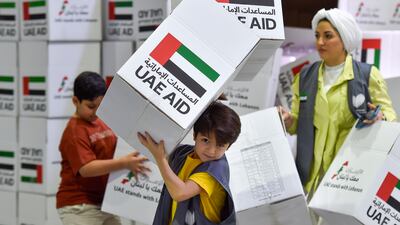
Aid for Lebanon being packed by volunteers at Expo Centre Sharjah. All photos: Ahmed Ramzan / The National -
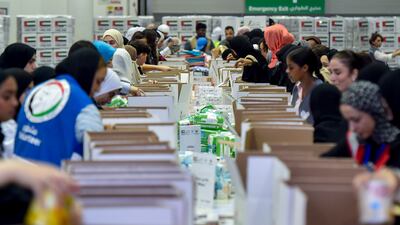
Organisers said 3,000 volunteers came out to support the event -
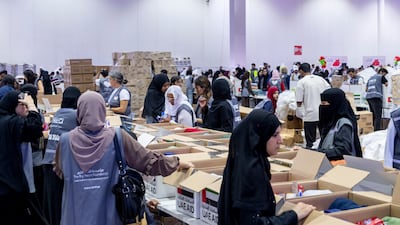
Goods such as tinned food, blankets, rice, tea, dates and sugar were packed into boxes -
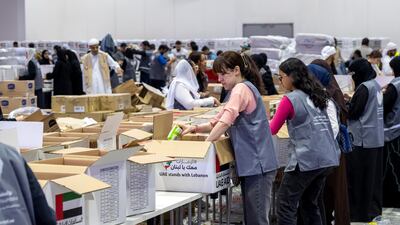
The initiative is called 'UAE Stands With Lebanon' -
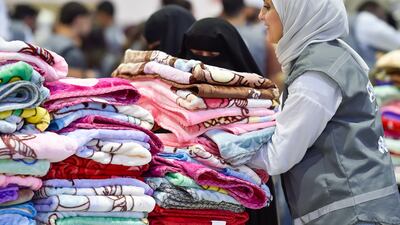
Volunteers pack up blankets for the needy -
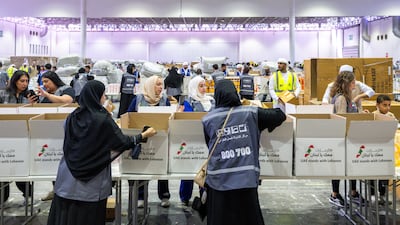
The Sharjah drive and another one at Dubai Expo City, on Sunday, comprise a second round of aid collection to support Lebanon -
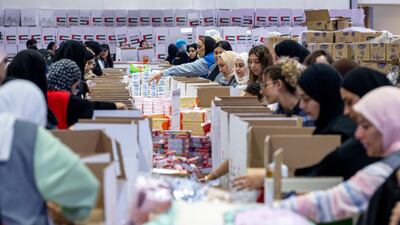
Volunteers busy packing boxes of essential aid for displaced people in Lebanon -
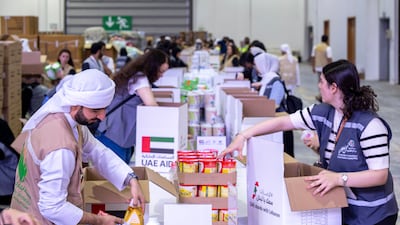
Volunteers came from different nationalities and all walks of life -
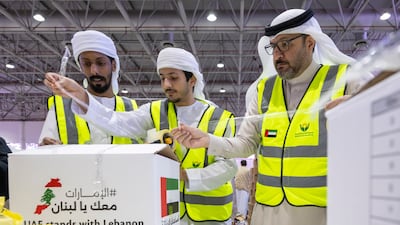
The goods were packed into boxes and will be dispatched for Lebanon swiftly -
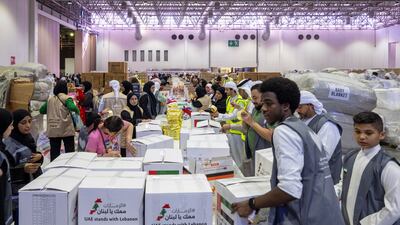
Expo Centre Sharjah was thronged with volunteers looking to do their bit -
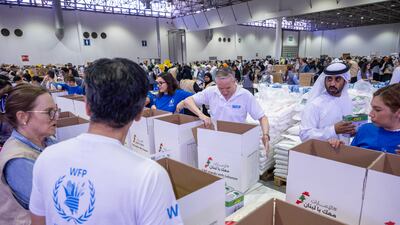
Stephen Anderson, director of World Food Programme UAE and representative to the GCC, centre, packing boxes. Mr Anderson said the UAE had stepped up in a big way. -
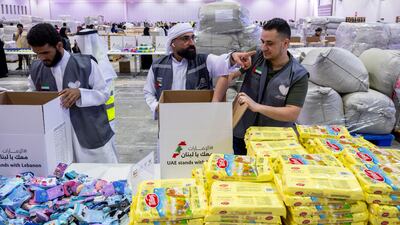
Volunteers packing vital supplies -
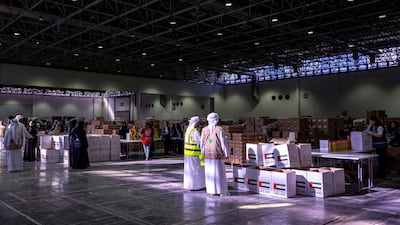
The event ended at 1pm with 250 tonnes of aid packed


Thus, the only option – in the American view – would be to impose a new reality concerning these proxies. The entity capable of enforcing this reality is Israel, with solid backing from the US. This situation will lead to continuous escalation between Iran and Israel, whether because of direct tit-for-tat attacks, even if limited, or Israel’s determination to weaken Hezbollah’s capabilities.
After Sinwar’s assassination, it is possible that the Biden administration will make only minimal efforts to end the war in Gaza. It did recently demand that Israel heed its concerns about the humanitarian cost of its operation, but the question is whether it will go beyond that.
Israel should use this moment to do two things: ensure genuine security for the people of Gaza and improve their living conditions.
Indeed, any positive political vision for Gaza begins with security. Israel should announce that it does not intend to remain in Gaza and is ready to secure areas one by one, allowing people to return to their homes. It should then invite financial support from the international community and advance a “day after” strategy.
Similarly, in southern Lebanon, the return of displaced people is a key element of any lasting solution. In both cases, reconstruction and rehabilitation are essential components of any solution based on a long-term vision for the day after.
All this would require bold political decisions, which are yet to be seen from the Israeli leadership.
These ideas are unlikely to be implemented immediately. However, an honest attempt to push them forward without imposing strict deadlines could help regional players to escape the current strategic impasse.

