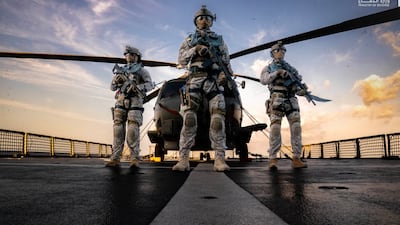
A series of military deployments, pacts and defence agreements involving Saudi Arabia highlights the kingdom’s focus on deepening co-operation with regional partners while reshaping its own security priorities and, in turn, those of key allies.
As the Houthi missile and drone threat grows, Saudi Arabia, with energy sites and airports spread across vast territory, has become increasingly exposed to the spillover from the wider US-Iran conflict, which could once again escalate into full-scale war.
Developments include Egypt’s confirmation of a military presence in the kingdom, an agreement with Syria on military training and sharing expertise, reports of Sudanese forces now in Yemen, and a defence pact with Turkey and Pakistan.
But they also extend to partners outside the region, with France sending troops, radars and air-defence systems to protect strategic oil facilities, Greece operating at least one Patriot missile battery in Yanbu in the west and the US providing air-defence support.
The UK recently announced it would provide RAF Typhoon fighter jets to Saudi Arabia for defensive counter-air missions, following Houthi attacks on civilian targets, including Aramco facilities and a deadly strike on King Khalid International Airport on October 10. Italy sent radars, anti-missile batteries and other assets to help the kingdom defend itself.
A Saudi source with links to government circles told The National that Riyadh’s requests for military assistance from allies are focused primarily on military equipment and capabilities rather than the deployment of foreign troops. The source said Saudi Arabia has a wide range of strategic sites and infrastructure to protect, and needs support from its partners to strengthen its defensive capabilities.
Asked whether Riyadh might eventually require foreign troops on the ground, the source said they did not believe additional forces would be needed inside the kingdom.
Egypt's presence
Saudi Arabia has been locked in worsening hostilities with the Houthis since July, when the war in Yemen was reignited by the wider conflict in the Middle East. It has since sought defensive and offensive support from a range of allies to protect its skies and strategic infrastructure.
Egypt's Foreign Minister Badr Abdelatty confirmed this week that Egyptian forces were in Saudi Arabia at Riyadh’s request and that Cairo was strengthening its presence. “We already have a military presence there at the request of our brothers and sisters in Saudi Arabia to help, and we are strengthening that,” he told France 24.
Mr Abdelatty said the mission was “mainly for defensive objectives to defend sensitive sites, including holy sites and others”, referring to Islam’s two holiest cities, Makkah and Madinah.
Security sources in Cairo told The National that Egyptian personnel had been sent alongside armoured vehicles, anti-aircraft batteries, surface-to-surface missiles and Amoun air-defence systems designed to intercept low-flying missiles and drones.
The precise number of personnel and their whereabouts have not been disclosed. The sources said the mission was intended to defend Saudi Arabia rather than take part in offensive operations against the Houthis, although the troops could defend themselves if attacked.
Egypt’s involvement is notable given its military weight and long-standing security relationship with Riyadh. Last month, the parliament authorised President Abdel Fattah El Sisi to take necessary measures to help defend Saudi Arabia if the kingdom requested assistance. Mr El Sisi had said days earlier that Cairo was prepared to help protect its Gulf ally.
The move marks a shift in Egypt’s approach to the Iran war. Cairo had previously focused on diplomatic efforts to end the fighting, repeatedly describing Gulf security as an extension of its own.
Retired Egyptian army general and military analyst Samir Ragheb said Egypt’s search for a negotiated end to the conflict was no longer enough. “The deployment in Saudi Arabia signals a shift for Egypt from a cautious observer to an effective partner, as the two countries recalibrate their strategic partnership,” he said.
He added that Egypt’s economic interests were closely tied to regional security, with threats from the Houthis also endangering shipping routes leading to the Suez Canal, a major source of revenue for Cairo.
The deployment is not Egypt’s first in the Gulf. In May, UAE President Sheikh Mohamed and Mr El Sisi visited an Egyptian fighter jet unit deployed in the Emirates. The UAE and Saudi Arabia have been important financial backers of Cairo, providing investment and other support during successive economic crises.
Syria’s role
Syria is deepening military co-operation with Riyadh following a defence agreement signed by Saudi Crown Prince Mohammed bin Salman and President Ahmad Al Shara during the Syrian leader’s visit to the kingdom last week. A Syrian diplomatic source told state news agency Sana that the agreement covered training, the exchange of expertise and military consultation, serving the interests of both countries.
Mr Al Shara’s government has presented the deal as part of its effort to rebuild the Syrian army. Foreign Minister Asaad Al Shibani said Damascus needed Saudi expertise in areas such as the defence industry and military academies. He rejected reports that Syrian forces had been stationed in Yemen, saying there was no plan for such a move in the near future and adding that any cross-border military operation would be discussed openly and “not be done in secret”.
However, sources familiar with discussions between the two countries have described preparations for a possible deployment of regular Syrian troops to Saudi Arabia, without clarifying where those troops might be sent.
A source in contact with senior Syrian military officials told The National that the Defence Ministry had asked commanders of the army’s five legions to nominate soldiers for an assignment abroad, with Saudi Arabia identified as the destination. Hundreds of infantrymen had been nominated, the source said. The information could not be verified through other sources.
Retired Jordanian major general and military commentator Abdallah Hasanat said Syria could provide thousands of troops, although Saudi Arabia would need to equip them. “The Syrian troops will be equipped by Saudi Arabia, including with weapons and equipment,” he said, adding that the Syrian army needed extensive restructuring. They could help defend Saudi Arabia or participate in any ground operation inside Yemen, he added.
Two security sources, one Arab and one western, also told The National that reports of Syrian soldiers in Yemen might refer to irregular foreign fighters rather than members of the regular army.
The distinction is important for Mr Al Shara, whose government faces pressure from Washington to contain foreign fighters who joined armed groups during Syria’s civil war. Sending regular troops abroad would also carry risks for a country still grappling with instability, economic hardship and security challenges along its borders.
Sudan's deployment
More fighters from Sudan, part of the Sudanese Armed Forces (SAF) led by Gen Abdel Fattah Al Burhan, could also be deployed to support Saudi Arabia, although those troops are currently engaged in a civil war that began in April 2023.
A Yemeni source familiar with the matter said Gen Al Burhan could send soldiers to the Saudi border with Yemen if needed, although Saudi Arabia has made it clear on several occasions that it is capable of defending its territory against any attempted attacks by the Houthis.
The feasibility of such a move remains uncertain given the SAF’s manpower constraints and the demands of its war against the Rapid Support Forces.

A retired Sudanese general who has maintained close links to the army claimed about 600 members of the SAF-allied Shield of Sudan militia were in the final stages of preparations for a potential deployment. The National could not verify the information from other sources.
Sudan has a history of involvement in the Saudi-led coalition's military intervention in Yemen, which began in 2015. Sudanese deployment grew to several thousand troops, including a substantial contingent from the RSF, which played a prominent role in the campaign before Sudan's civil war erupted between the army and the paramilitary group.
Saudi Arabia also signed the Makkah Joint Defence Agreement with Turkey and Pakistan in August. The pact stipulates an armed attack against any one of the three countries would be regarded as an attack against all. It has yet to be put into practice, with the parties still working out the framework for its implementation.
The kingdom “would not hesitate to respond decisively” to any threat or attack targeting its security, Prince Mohammed said last month. Saudi Arabia “possesses highly capable personnel and military capabilities that can fully counter and deter threats,” he added.

