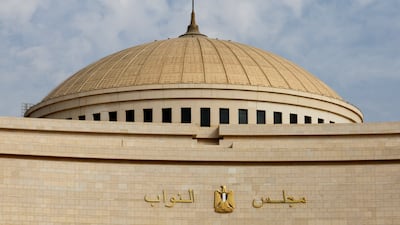

Egypt's parliament has authorised President Abdel Fattah El Sisi to send troops to Saudi Arabia, an MP close to the government said on Monday, clearing the last constitutional hurdle to a possible deployment against the Houthis.
“Parliament approved authorising President El Sisi to send forces to Saudi Arabia if required, and after co-ordination between the two countries,” Mostafa Bakry wrote on X after a closed session in Cairo, the third over the past nine days to discuss the matter.
Parliament, he said, had given the President “freedom of decision according to his assessment”. It has not published the result of the vote, which was held by roll call behind closed doors. However, under Article 152 of the constitution, sending the army on a combat mission abroad requires the backing of two-thirds of the 596-member house, or 398 MPs.
The approval does not mean troops will deploy immediately. Mr El Sisi, as supreme commander of the armed forces, now has the legal authority to act, but has said Egypt will do so only if Saudi Arabia asks. No formal Saudi request has been announced.
Monday's vote came after more than a week of debate. Mr El Sisi asked parliament for the mandate on October 17, at a graduation ceremony at the Egyptian Military Academy, saying it was inconceivable that Saudi Arabia's security would be harmed.
The National Defence Council, which he chairs, met the following day and pledged “all necessary and possible forms of support” to the kingdom, without specifying their form, size or duration.
MPs were expected to approve the request quickly. The four main pro-government parties hold 403 of the 568 elected seats.
Instead, the House met in two closed sessions on October 18 and 19, then adjourned for a week. Assem El Gazzar, deputy speaker and head of the pro-government National Front Party, said nearly 500 MPs had asked to speak, more than he had seen on any other issue.
Most parties backed the request. The Wafd, Egypt's oldest liberal party, said Saudi security was “an inseparable part” of Egypt's national security. The Justice Party told its MPs to vote in favour, and the Salafist Nour Party called for defensive co-ordination with Riyadh.
The Egyptian Social Democratic Party, which has about a dozen seats, told its MPs to abstain, citing the economic cost and the risk of regional escalation. Maha Abdel Nasser, one of its MPs, rejected what she called an open-ended and vague mandate and urged a diplomatic solution.
Mohamed Abdel Aleem Dawoud, head of the Wafd's parliamentary bloc, and the independent MP Diaa El Din Dawoud also reserved their positions.
The crisis became personal for many Egyptians on October 10, when a Houthi strike on Riyadh's airport killed 12 people. Among them was Azza Ramzy, a 28-year-old flight attendant from Beheira province.
The Houthis have warned Egypt against intervening. Yahya Al Raei, speaker of the Houthi-run parliament in Sanaa, wrote to his Egyptian counterpart Hisham Badawi that involvement would pose “a grave danger” to Egypt's national security.
Egypt has strong reasons to side with Riyadh. Saudi Arabia is one of its biggest financial backers, and Houthi attacks on Red Sea shipping have already cut revenue from the Suez Canal, one of Egypt's main sources of foreign currency.
It is not yet clear what form Egyptian support would take. Officials have described any mission as defensive, and have not said whether it would involve ground troops, air defence or naval forces.

