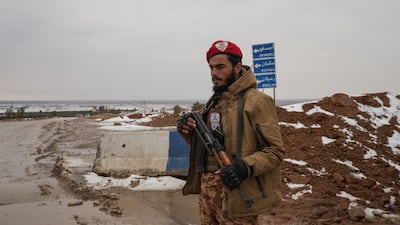

Syria's government has removed three army commanders from their posts, in a shake-up to reduce the power of factions that were rivals during the civil war.
The three prominent commanders from the former rebel Syrian National Army have been reassigned to administrative positions outside their former areas of command. The move is part of efforts by Syria’s authorities to consolidate the armed forces under a centralised chain of command.
After Bashar Al Assad was ousted in December 2024, the new authorities incorporated dozens of armed factions into the Defence Ministry in an effort to rapidly establish control across the country. These included the SNA.
Who are the three men?
The most prominent figure is Mohammed Al Jassem, known as Abu Amsha. Born in Hama, he joined the revolution early on, forming what was known as the Fireline Brigade. He later aligned with several other groups and ran into disputes with Al Nusra Front, the forerunner of now-President Ahmad Al Shara's faction.
Abu Amsha’s brigade, part of the Syrian National Army, fought in Hama, Aleppo and Idlib before establishing a power base in Afrin. He took part in Turkey’s military operations in northern Syria and became known for his close ties to Ankara.
In August 2023, the US sanctioned him over serious human rights abuses attributed to his brigade, including property seizures and kidnappings. His faction was incorporated into the new Syrian army as the 62nd Division after Assad’s fall.
"He did not have a lot of genuine support; he was very well-known for all the money he had accumulated around the end of the war, by extortion and taxes. He then bought support around Hama by funding projects," Gregory Waters, an expert from the Syria Project at the Atlantic Council, told The National.
Ahmed Al Hayes, known as Abu Hatem Shaqra, comes from Deir Ezzor. During the war, he established himself in northern Aleppo. He later led a faction called Ahrar Al Sharqiya and participated in the battle for Afrin alongside Abu Amsha. The US imposed sanctions on Shaqra in 2021, accusing him of involvement in serious abuses including executions, torture and kidnappings in a prison held by the group.
His faction was incorporated into the new Syrian army after Al Assad’s fall, and Abu Hatem became commander of the 86th Division. His division was in charge of the desert around northern Aleppo, explained Mr Waters.
The third man, Sayf Boulad Abu Bakr, is from Bizaah in northern Aleppo. After defecting from the Assad regime at the start of the uprising, he fought with the secular opposition before joining ISIS and later leaving the group to become commander of the Turkish-backed Hazzem Division. "He was vetted by the US for a long time," said Mr Waters.
His forces participated in the capture of Al Bab and the battle for Afrin. The US sanctioned him and the Hazzem Division in 2023 over alleged human rights abuses, including kidnappings and torture. After Assad’s fall, he was appointed commander of the 76th Division. His forces were later implicated in a flurry of coastal violence in March 2025. The EU sanctioned Sayf Bulad and his division, accusing them of involvement in attacks on civilians.

Why the move?
Syria’s new authorities have so far taken a decentralised approach to rebuilding the armed forces, in contrast to the highly top-down system under the Assad regime. The leadership has relied on local military structures that emerged during the war, whose links to the state remain largely formal. The model has helped the new authorities consolidate control quickly, all over Syria, but has posed issues for the central command in unifying the army.
The Syrian authorities therefore set out a plan to unify the forces and create "more layers of command and bureaucracy," explained Mr Waters. "It was in the works at the end of 2025; now, it is put in place".
The Syrian Army is being reorganised into five corps, reducing the role of individual faction commanders and placing units under a more standardised chain of command.
The Defence Ministry's Five Corps Project "is intended to begin dissolving the early decision to structure and empower based on historic faction leadership and geographic bias," said Charles Lister, director of the Syria Programme at the Middle East Institute. The move was brought to light by the removal of three Syrian National Army leaders, with more expected.
"Each Corps now has a commander and a chief of staff, and two deputy commanders who are in administrative roles, this is the positions they were put in," Mr Waters told The National.
"They have been stripped of their soldiers, but they still have access to the chain of command in the Ministry of Defence.
"The harm they can do is now mitigated."

