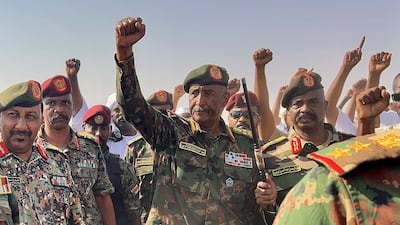
Political figures and analysts have accused the head of the Sudanese Armed Forces, Gen Abdel Fattah Al Burhan, of political manoeuvring and remaining under the influence of the Islamist movement.
They have also warned the prolonged civil war is depriving Sudan's children of education and exposing them to forced recruitment.
In an interview with Sky News Arabia, Mohamed Abdel Hakam, a leader of the Sumoud alliance, Sudan’s largest civilian coalition, said Gen Al Burhan had full control over the army and the levers of power, but faced constraints on decision-making because of the influence of allied groups, including those within his own office.
Mr Abdel Hakam alleged Gen Al Burhan had made significant concessions during his meeting with Massad Boulos, US senior adviser for Arab and African affairs, in Egypt on October 5.
Those talks took place on the sidelines of the African Union’s co-ordination meeting, less than two weeks after Washington withheld a visa for Gen Al Burhan ahead of the UN General Assembly in New York.
The move was reportedly linked to the army-led administration’s resistance to a US proposal for a 90-day humanitarian ceasefire, followed by political negotiations aimed at ending the war and restoring a transition to civilian rule. Sudan has said it did not reject the proposal but instead submitted comments on it.
Political analyst and military expert Hashim Abu Ranat also accused Gen Al Burhan of political scheming, saying the army chief had accepted certain conditions but was reluctant to disclose them to his allies.
Mr Abu Ranat said Gen Al Burhan had returned to his allies to inform them that he was prepared to make concessions, while continuing to pursue his objectives in Darfur, including driving out the Janjaweed militia.
He claimed the Islamic Movement has a decisive role in shaping political and military decisions, alongside affiliated army officers. “Al Burhan is a tool in the hands of the Islamic Movement,” Mr Abu Ranat said.
Meanwhile, Sudanese activist Nagisa Hagar has warned the conflict is depriving an entire generation of Sudanese children of education.
She said many children who should have been attending kindergarten or primary school have lost these critical years, leaving them outside of the education system.
Ms Hagar also warned that children faced the risk of recruitment by the warring parties, particularly the Sudanese army and groups affiliated with it.
She said videos published by these groups showed children being recruited, warning of the serious threat posed by forced recruitment and the imposition of responsibilities on children that should instead be borne by adults and state institutions.
The war broke out in April 2023 after a power struggle between the army and the Rapid Support Forces paramilitary over the transition to civilian rule and the planned integration of the rival bodies. Repeated diplomatic initiatives have failed to secure a lasting ceasefire.
The conflict has created one of the world’s largest humanitarian crises. More than 14 million people have been displaced and nearly 20 million face hunger, according to the UN World Food Programme.