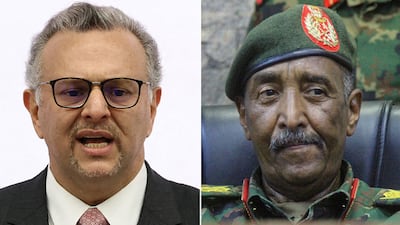
US President Donald Trump’s senior adviser for Arab and African affairs, Massad Boulos, has met Sudanese army chief and de facto leader Gen Abdel Fattah Al Burhan in Egypt as Washington steps up efforts to end the country’s three-year war.
Mr Boulos said on Monday that he had attended a lunch hosted by Egyptian President Abdel Fattah El Sisi in New Alamein at the weekend alongside Gen Al Burhan.
The rare publicly announced encounter took place on the sidelines of the African Union’s eighth midyear co-ordination meeting. Mr Boulos did not describe the encounter as a formal bilateral meeting, but used the occasion to reaffirm US support for Sudan’s unity, sovereignty and territorial integrity.

“The United States stands ready to support all efforts leading to a comprehensive dialogue among the Sudanese political forces, leading to a preliminary road map of the future of the Sudan,” Mr Boulos said in a post on X.
“We encourage the Sudanese to be inclusive and to engage actively with regional and international stakeholders to co-ordinate views.”
The encounter came less than two weeks after Washington withheld a visa for Gen Al Burhan before the UN General Assembly in New York. The move was reportedly linked to Sudan’s army-led administration resisting a US proposal for a 90-day humanitarian ceasefire, followed by political negotiations to end the war and revive a transition towards civilian rule.
Sudan has claimed it did not reject the US ceasefire proposal, but instead submitted comments on it.
US State Department spokesman Tommy Pigott said last month that neither the Sudanese Armed Forces nor the paramilitary Rapid Support Forces, nor their leaders, represented legitimate constitutional government for Sudan.
The US has nevertheless continued to press for a negotiated settlement. Mr Boulos said the US was working with Egypt and other regional and international partners to end the fighting and ease the humanitarian crisis, in line with Mr Trump’s calls for a political solution.
Mr Boulos added that the US aimed ultimately to help Sudan restore security, begin reconstruction and move towards a civilian-led government through an “inclusive, Sudanese-owned and Sudanese-led” national dialogue.

The war broke out in April 2023 after a power struggle between the army and the RSF over the transition to civilian rule and the planned integration of the rival forces. Repeated diplomatic initiatives have failed to secure a lasting ceasefire.
The conflict has created one of the world’s largest humanitarian crises. More than 14 million people have been displaced and nearly 20 million face hunger, according to the UN World Food Programme.
A strike on two World Food Programme lorries in Sudan’s South Kordofan state at the weekend killed one of their drivers, the WFP said. The agency did not attribute responsibility for the attack and called for an impartial investigation.
Fighting is intensifying in Kordofan, a strategically important region where Sudan's army and the RSF are battling for territory.
Mr Boulos condemned the attack on the WFP lorries in a post on X following his encounter with Gen Al Burhan, saying it was part of a “clear and dangerous pattern” of assaults on humanitarian operations.
Both the SAF and the RSF have been accused by the UN of war crimes and human rights violations. The UN Human Rights Council on Monday condemned indiscriminate attacks on civilians and aerial bombardments and drone strikes that have caused civilian deaths and damaged critical infrastructure.
Drone warfare has escalated sharply. UN figures show that about 1,100 civilians were killed in drone strikes between January and June this year, accounting for most of the roughly 1,400 civilian deaths documented by the UN during that period.

