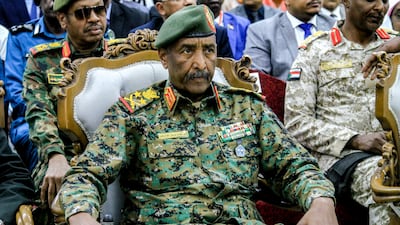
The US decision to withhold a visa from Sudanese Armed Forces chief Gen Abdel Fattah Al Burhan for the UN General Assembly has renewed questions over his disputed legitimacy as the country’s leader, an expert in Sudanese affairs said.
Gen Al Burhan was due to address the General Assembly on Sudan’s behalf, but Washington withheld his visa as part of a US-backed push for a ceasefire in the war between the SAF and the Rapid Support Forces paramilitary group.
The State Department said neither the SAF, the RSF, nor either of their leaders “represent legitimate, constitutional governance for Sudan”. The RSF is led by Gen Mohamed Dagalo.

The Sudanese government rejected the US statement, however, saying any peace initiative must respect Sudan’s sovereignty, unity, territorial integrity and “legitimate national institutions”, while calling for an end to what it described as negative foreign interference.
Khaled Omar, the Sudanese expert, told Sky News Arabia that Gen Al Burhan’s position as army chief did not automatically give him the constitutional authority to represent Sudan at the UN.
“Al Burhan is the Sudanese army chief, and the constitutional duties of an army chief do not include going to the United Nations platform to address the world,” the expert said. “His natural place is the headquarters of the armed forces.”
The expert disputed Gen Al Burhan’s status as head of the Transitional Sovereignty Council, saying he seized power in a 2021 military coup that was rejected by Sudanese people and prompted the African Union to suspend Sudan’s membership over the unconstitutional change of government.
“The question of Al Burhan's legitimacy as President of Sudan is highly contested,” Mr Omar said, but the issue extends beyond the war-ravaged nation to the international community, he added.
Al Burhan's 'contradictory messages'
The expert said the dispute over Gen Al Burhan’s legitimacy was not new, referring to protests by Sudanese demonstrators in New York during the army chief's visit to the UN in 2022.
“The army is one of the institutions of the state and the military establishment, but that does not give its commander a certificate to represent the legitimacy of the government and the state,” Mr Omar said. “These are two different things and should not be confused.”
Mr Omar added the US message over Gen Al Burhan’s visa was intended to pressure the army chief to engage with Washington’s ceasefire efforts.
Since receiving the first US truce proposal following the Quad road map issued last September, Mr Al Burhan had sent “contradictory messages”, the expert said.
“He initially said he would accept the ceasefire, then said he had comments,” Mr Omar said. Those concerns were incorporated into subsequent proposals and four drafts of a ceasefire were prepared.
The US administration subsequently concluded Gen Al Burhan was “buying time” and was not sincere in his interactions with the initiative.
“Therefore, it wanted to send him this message directly: 'what you seek from continuing the war will not be achieved,'” Mr Omar said. "'The better option for you is to choose what the majority of Sudanese have chosen: to move towards peace and end the war.'”
The war, now well into its fourth year, has created one of the world's worst humanitarian crises, displacing about 14 million people. It broke out when differences between Gen Al Burhan and Gen Dagalo boiled over into open hostilities that began in the capital, Khartoum, but soon spread across the country.
As well as the vast Darfur region, the RSF controls parts of the Kordofan and Blue Nile regions, while the SAF is in control of the capital as well as northern, central and eastern Sudan. Each side has its own government, with the army-aligned administration sitting in Port Sudan on the Red Sea and the RSF's in Nyala in Darfur.

