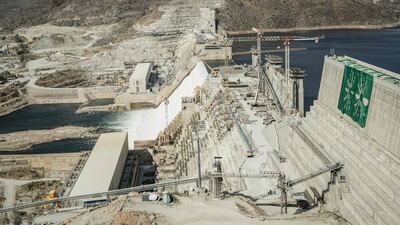
Egypt remains committed to a diplomatic and political solution to its dispute with Ethiopia over a controversial Nile dam, Prime Minister Mostafa Madbouly has said.
In an interview with CNN Business Arabic, Mr Madbouly said the Nile is a matter of “national security and existential importance” for Egypt. The country depends on the river for about 95 per cent of its water resources.
Egypt and Ethiopia last week announced they were expelling diplomats in a new escalation in their already tense relations. The leaders of Egypt, Eritrea and Sudan – three nations accused by Ethiopia of aiding an anti-government rebellion there – plus Somalia, were meeting on Sunday to shore up their loose alliance.

Mr Madbouly rejected what he described as Ethiopian efforts to portray Egypt as an obstacle to the development of African countries. He said Cairo supports development in all nations as long as it does not harm other states, particularly in the case of rivers.
“These rivers are governed by international law, which establishes that all riparian states are partners in the river and its water resources,” Mr Madbouly said.
Egypt has maintained this position since the beginning of the dispute and will continue to pursue a diplomatic and political solution, he said, adding that President Abdel Fattah El Sisi had reaffirmed that approach days earlier.
At the same time, Mr Madbouly said Egypt had “clear, non-negotiable principles and parameters”, including clear regulations and Egypt's prior consent, as well as Sudan's, regarding the Grand Ethiopian Renaissance Dam.
He said the dam's operation and management should be based on a shared vision to prevent harm to downstream countries, particularly during periods of prolonged drought.
“The major challenge arises during multi-year droughts: how the dam is refilled could significantly impact Egypt's water resources,” Mr Madbouly said.
Last week, Mr El Sisi said Egypt was creating “space for diplomacy and peaceful solutions” on the Ethiopian dams. “But that will not be at the expense of Egypt's existence and its people,” he added.
Egypt's infrastructure drive
Mr Madbouly also defended the government's large-scale infrastructure investment programme, saying it had been necessary to create the foundations for economic growth following the political turmoil that began in 2011.
Egypt at the time lacked adequate electricity and energy capacity to meet citizens' needs or support economic growth, while its water, sanitation, road, port and airport networks were also insufficient, he said.
“These are the very foundations required for any nation to launch its economy,” Mr Madbouly said.
The state had to take the lead in building the infrastructure because political instability and uncertainty had made it difficult to attract sufficient private-sector investment into large, long-term projects, he said.
The Prime Minister said that Egypt's economy grew by 5.1 per cent in the 2025/26 fiscal year, up from 4.4 per cent in the previous year, an Egyptian official said. He added that the government was aiming for growth of 5.4 per cent in the current fiscal year, which began in July.
The growth was driven by the domestic economy's productive capacity rather than external factors or exceptional, one-off sources of funding, the official said, rejecting concerns that the expansion might not be sustainable.
“Thank God, the Egyptian economy has grown at very good rates, all based on what we call sustainable sectors,” the official said.

