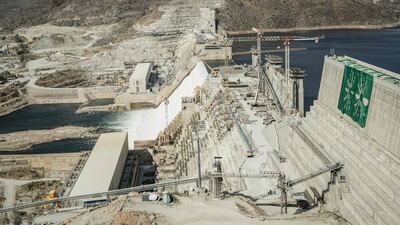

Egypt needs to double its share of Nile water, not just protect it, Foreign Minister Badr Abdelatty said, as tension with Ethiopia rose on two fronts.
Mr Abdelatty was speaking at a meeting late on Tuesday, chaired by President Abdel Fattah El Sisi and attended by military commanders. “Egypt lies in the zone of water poverty,” he said.
Mr El Sisi said Egypt was creating “space for diplomacy and peaceful solutions” on the Ethiopian dams. “But that will not be at the expense of Egypt's existence and its people,” he added.
He also said the Grand Ethiopian Renaissance Dam was built only because of the unrest Egypt went through from 2011 to 2013, and the “absence of the state” at the time.
Egypt relies on the Nile for more than 98 per cent of its freshwater. Its annual share is 55.5 billion cubic metres. Egyptian Water Minister Hani Sewilam said this month that the country needs about 123 billion cubic metres.
Mr Abdelatty said Egypt would not accept any new dams or a repeat of “what happened with the current Ethiopian dam”. In August, Ethiopia's Water and Energy Minister Habtamu Itefa confirmed plans to build three more dams on the Blue Nile.
Mr Abdelatty also said Egypt was following “all developments concerning the situation inside Ethiopia”. But he added that Cairo stayed out of other countries' affairs and had “no hostility” towards Ethiopia.
His comments came after Ethiopia's army chief accused Egypt of backing rebels in the country's north.
Field Marshal Birhanu Jula said forces fighting his troops would not succeed unless they were “backed, supported and supplied by Sudan, Egypt and other external powers”. He gave no evidence.
A day later, Egyptian Foreign Ministry spokesman Nader Zaki said Cairo respected other states' sovereignty and did not interfere in their affairs. Any claims casting doubt on that commitment were “null and void”, he said, without naming Ethiopia. Sudan's army called the comments “baseless”. Eritrea, which also faced accusations from Addis Ababa, said Ethiopia was shifting the blame.
'Existential issue'
In response, Eritrea said Ethiopia's pursuit of access to the Red Sea had alarmed its neighbours, while its hosting of militia training in support of Sudan's Rapid Support Forces (RSF) had further strained regional ties.
The accusations follow a sharp escalation in fighting in northern Ethiopia.
On September 21, seven armed groups formed an alliance to remove Prime Minister Abiy Ahmed. They included the Tigray People's Liberation Front and Amhara's Fano militias, which fought on opposite sides in the 2020-2022 war.
TPLF fighters have since seized airports in Tigray and pushed into the Afar and Amhara regions. The fighting has all but ended the 2022 Pretoria peace deal.
This month, RSF fighters filmed prisoners they said were Tigrayans captured alongside army troops in Blue Nile State. Their identities and the circumstances of their capture could not be independently verified.
But the presence of Tigrayan fighters on the Sudanese army’s side is not only an RSF allegation. International Crisis Group says thousands are based in army-held territory and many have fought alongside its forces against the RSF. The group says the arrangement has angered Ethiopia, which fears the fighters could cross back to join the campaign against Mr Abiy’s government.
Cairo has also taken its renewed case on the dam abroad in a continued effort to internationalise the matter. Prime Minister Mostafa Madbouly told the UN General Assembly last week that the Nile was “an existential issue that allows for no compromise”.
But Cairo has received mixed signals from the major powers. Washington’s growing military ties with Ethiopia have unsettled some in Egypt, where US President Donald Trump’s comments on the Nile dam had raised hopes of American support in the decade-old dispute.
American personnel began training Ethiopian forces in August, and the two countries agreed to deepen defence co-operation.
Weeks later, Chinese President Xi Jinping visited Cairo and backed Egypt’s right to protect its water security.

