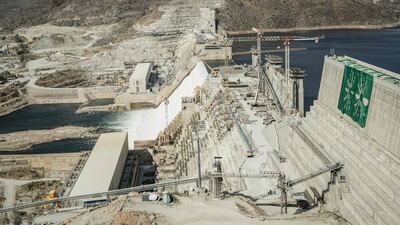

Egypt has set out its most detailed recent public case in the Nile dispute, warning that its high dependence on the river leaves little room for unilateral action upstream.
Egypt's case centres on Ethiopia's Grand Ethiopian Renaissance Dam and a broader argument that Ethiopian development does not depend on controlling the Nile's flow.
At a press briefing in Cairo on Sunday, Water Resources and Irrigation Minister Hani Sewilam said Egypt's water security rests on an exceptionally narrow base. More than 98 per cent of its renewable water comes from beyond its borders, while its annual renewable supply of about 56.8 billion cubic metres falls far short of estimated needs of 123 billion cubic metres. “Egypt is an extremely arid country that relies almost entirely on the Nile,” Mr Sewilam said.

Per capita availability has fallen to about 472 cubic metres a year, below the 500-cubic-metre threshold commonly used to define so-called absolute water scarcity.
Mr Sewilam used those figures to reinforce Cairo's argument that the Nile cannot be left to unilateral decisions upstream.
The presentation also amounted to a rebuttal of the long-standing upstream argument that Egypt receives an outsize share of the river. Its annual allocation of 55.5 billion cubic metres, Mr Sewilam said, represented only about 2.7 per cent of the roughly 2,000 billion cubic metres of rainfall that falls each year across the wider Nile Basin.
Only an estimated 84 billion cubic metres, or 4 to 5 per cent of that rainfall, reaches Aswan. Egypt relies on the river for almost all of its renewable supply, while much of the basin's rainfall is consumed or retained before reaching the main channel. “The passage of time does not mean that Egypt accepts the reality imposed on it,” said Mr Sewilam.
Ethiopia, by contrast, had far greater rainfall and water resources, he said. It received more than 1,000 billion cubic metres of rainfall in 2023, about 467 billion cubic metres of it within the Ethiopian part of the Nile Basin. Its renewable water resources were estimated at around 122 billion cubic metres a year, with groundwater recharge between 51 billion and 81 billion cubic metres.
The minister sought to shift the argument away from historical allocations and towards a broader question: whether Ethiopia's economic development requires control over the Blue Nile.
'Virtual water'
Ethiopia has more than 18 million hectares of agricultural land, compared with about 4.03 million in Egypt. Its rain-fed agriculture uses about 148 billion cubic metres of “green water” a year, while direct “blue water” use was about 9.68 billion cubic metres and the livestock water footprint 85.5 billion cubic metres. “Support for development in Nile Basin states is not a political slogan,” said Mr Sewilam.
The presentation comes as Egyptian officials have sharpened their response to Ethiopian references to controlling Nile water and plans to build three more dams on the Blue Nile.
Foreign Minister Badr Abdelatty recently criticised what Cairo regards as attempts to claim ownership of a transboundary river.
Mr Sewilam warned that how GERD was operated mattered as much as the water it retained. Unilateral and uncoordinated operation of the dam, he said, could cause sharp changes in downstream releases: sudden increases he described as an “artificial flood”, or reduced flows amounting to an “artificial drought”. Either could disrupt management of downstream dams and water infrastructure in Egypt and Sudan.
Egypt has repeatedly called for a binding agreement on the filling and operation of GERD, whose construction Cairo says was undertaken without adequate consultation.
Ethiopia says the dam is a sovereign project intended to generate electricity and has rejected arrangements it views as constraining its use of its natural resources. Cairo has responded by portraying the dispute as part of a much broader strategy to manage a worsening water deficit at home.
Egypt reused about 23.2 billion cubic metres of water a year, Mr Sewilam said, while agricultural drainage treatment projects had added nearly 4.8 billion cubic metres of annual capacity.
The government is also expanding desalination, groundwater use and food imports, effectively importing “virtual water”, and deploying telemetry, satellite imagery, artificial intelligence, mathematical models and drones to monitor supplies.
'Existential interests'
The strategy, dubbed Water 2.0, centres on treating and reusing water, upgrading infrastructure, expanding automated monitoring and improving predictions of Nile inflows. Those forecasts are then linked to the important operation of the High Dam and its reserves.
“Egypt will not turn a blind eye to its existential interests in the Nile,” said Mr Sewilam.
The minister also sought to counter the idea that Egypt opposed dams or development elsewhere in the basin. He cited more than $120 million in co-operation projects across the Nile Basin and other African states, including wells, solar-powered groundwater stations, flood-protection works, water-quality laboratories and training.
He also cited a new $100 million financing mechanism for Nile Basin countries.
The message was that Egypt supports dams and development when projects involve notification, information-sharing, impact studies and consensus, as Cairo argues has occurred in the southern Nile Basin.
Cairo has also worked hard to internationalise its case, taking the dispute repeatedly to the UN Security Council.
The clearest recent diplomatic development came during Chinese President Xi Jinping's state visit to Cairo this month, when a joint statement recorded Beijing's recognition of Egypt's “legitimate right to safeguard its water and food security” and called on all Nile Basin states to comply with international law, “including the obligation not to cause harm”.
Cairo is refining the case it intends to take into the next stage of the dispute: that Egypt's extreme water scarcity makes an upstream order without binding rules unacceptable.
Egypt retains “all procedures and measures permitted under international law to protect its water security and the rights and interests of its people”, Mr Sewilam said.
His sharpest warning was reserved for recent Ethiopian references to “controlling” Nile water. Such language, he said, had stripped away the reassuring rhetoric that had long surrounded the dam.
For years, Addis Ababa presented GERD primarily as a source of electricity and development. Cairo now says the rhetoric surrounding it points to something broader: an Ethiopian claim to decide how and when the waters of a shared river reach Egypt and Sudan.

