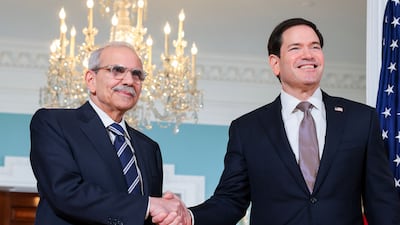
US Secretary of State Marco Rubio hosted Lebanese Prime Minister Nawaf Salam in Washington on Monday as the US tries to advance a peace deal between Beirut and Israel.
Negotiations on the US-brokered Israel-Lebanon framework that was initially agreed to in June have slowed amid continuing Israeli bombing of southern Lebanon, despite a supposed ceasefire. Meanwhile, Lebanon has failed to disarm Hezbollah, which was a key part of the deal.
After the meeting, Mr Salam said he looked forward to a “renewed partnership” with the US, one that "aligns with the project of rebuilding the state and strengthening its legitimate institutions".
He said he also urged the US to activate the trilateral framework through "reciprocity and gradualism" and called for a clear timeline.
Implementing the deal should proceed along with Israeli withdrawal and the extension of Lebanese state authority, he added.
In its own readout, the State Department said Mr Rubio reaffirmed the US commitment to supporting Lebanon as it implements the framework deal, which officials described as the "only path to a durable peace" between Lebanon and Israel.
Mr Rubio also reaffirmed US support for a sovereign Lebanese state outside of the "pernicious influence of Hezbollah and Iran".

A central dispute over implementing the Israel-Lebanon framework is the order in which things should happen. Lebanon first wants to see an Israeli withdrawal, while Israel wants Hezbollah disarmed first, leading to a stalemate in talks.
Hanin Ghaddar, the Friedmann senior fellow in The Washington Institute's Linda and Tony Rubin Programme on Arab Politics, said the agreement is clear on what should happen next.
Israel has withdrawn from one "pilot zone" and Lebanon has posted its army there – so Lebanon must next disarm and dismantle Hezbollah before seeking more Israeli withdrawal.
“Lebanon deployed the army but has not done the disarmament. So the sequence is now with Lebanon,” Ms Ghaddar said. “The sequence now means that Lebanon has to do something before asking for further Israeli withdrawal.”
In Mr Salam's statement, he does not mention Hezbollah's disarmament or dismantlement. Rather, he discusses the “confinement of arms to the hands of the state” and “exclusivity of arms".
Ms Ghaddar said Iran-backed Hezbollah is now just “a shadow of what used to be”, at only about 10–20 per cent of its former strength.
She said there were deeper political issues, such as the extent to which Hezbollah remains embedded in Lebanese state institutions.
“These decisions are not yet sovereign,” said Ms Ghaddar.
She added that Washington has adopted something of a “passive role” and needs to establish a verification mechanism and use tools including sanctions to help remove Hezbollah's influence from Lebanese institutions.
IMF meeting
Lebanon's Finance Minister Yassine Jaber was also in Washington to meet International Monetary Fund managing director Kristalina Georgieva at the fund's headquarters. He said Beirut is seeking a new staff-level agreement with the multilateral lender.
Lebanon signed a staff-level agreement with the IMF in April 2022 after the country was plunged into economic crisis due to years of mismanagement and corruption, but Beirut has been slow to implement the changes.
The IMF in September said recent approval of amendments to the current government's bank resolution law marked a “significant step forward” in its banking sector reform strategy.
According to 2022 government estimates, Lebanon said losses from the financial crisis were about $70 billion, a sum that is likely to have increased since then.
Mr Jaber and Mr Salam also met US Treasury Secretary Scott Bessent.
"The Secretary urged the Lebanese government to take proactive steps to disrupt Iranian and Hizballah financial networks," Treasury said in a readout.
"Secretary Bessent also noted the importance of Lebanon advancing key financial sector reforms to restore confidence in Lebanon’s banking system."
The Lebanese delegation was also expected to hold discussions with senior officials at the World Bank.

