

The owner and insurers of the giant container ship that blocked the Suez Canal have made a preliminary deal in its dispute with the waterway’s authority.
An "agreement in principle" has been struck between the two parties, UK P&I Club, one of the Ever Given's insurers, said on Wednesday.
The 400-metre vessel has been moored at Great Bitter Lake, half way through the canal, since March 29. It had blocked the canal for six days and caused a major disruption in global trade.
The main point of contention is the compensation sum the Suez Canal Authority is claiming for the vessel’s salvage.
This would cover the rescue operation, the costs of stalled canal traffic and lost transit fees.
The SCA at first demanded $916 million in compensation, later lowered to $550 million.
"We agreed to settle this issue in a peaceful way without going through the courts and agreed on a final settlement. The deal is being drafted and will be reviewed," Suez Canal Authority (SCA) Chairman Osama Rabie told a local Egyptian television programme later in the evening on Wednesday.
Khaled Abu Bakr, who leads the authority's legal team, told The National the SCA had received a more "reasonable offer" from the ship's owner, Japanese shipping company Shoei Kisen Kaisha.
Mr Rabie said the sum on the deal would not be made public until everything is finalised, but called the settlement "satisfactory" from the authority's view.
"I want to reassure you that this settlement upheld all of our rights, the cost of the rescue operation and the damages that befell the waterway. We also maintained our relationship with our partners... and the political and economic relations with Japan, thank God," Mr Rabie said.
Since the ship’s refloating, the authority has been locked in a legal dispute with the ship’s owners.
-
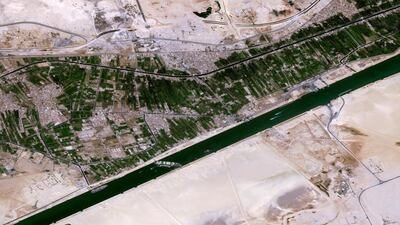
Satellite image shows the Suez Canal, a global trade way, blocked by the Ever Given vessel. Airbus Space -
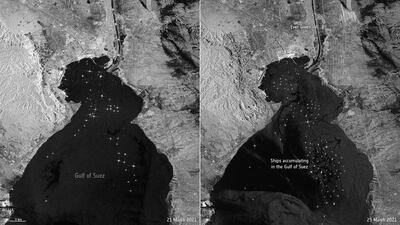
The image on the right shows regular traffic flow on the Suez Canal and the left one shows cargo pile up after Ever Given ran aground. European Space Agency -
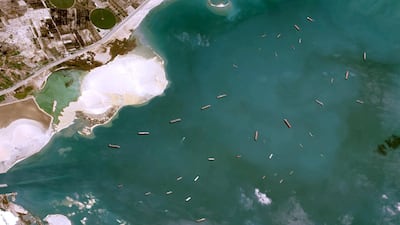
Satellite imagery shows the Suez Canal blocked after the Ever Given vessel ran aground. Airbus Space -
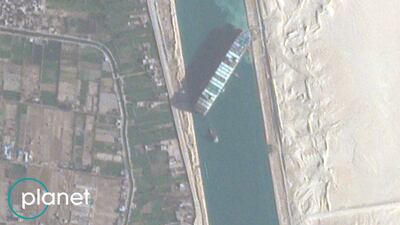
Around 10 per cent of global trade goes through the canal. Planet Labs -
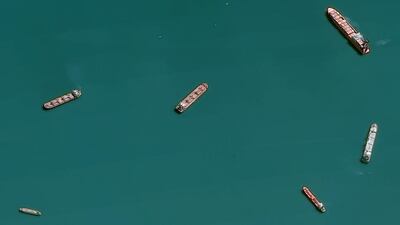
Cargo ships queued up in the canal while it was blocked. Airbus Space -
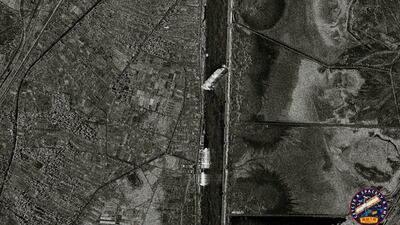
A massive effort eventually refloated the stricken vessel. Research Institute of China Electronics Technology Group Corporation -
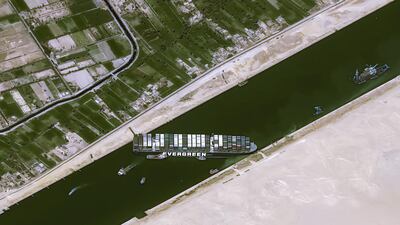
Satellite imagery capture the traffic jam at the Suez Canal caused by the 'Ever Given' container running aground. Airbus Space


Shoei Kisen Kaisha said the blockage was caused by the SCA’s mishandling of the situation.
But negotiations have taken a less combative tone in recent weeks, UK P&I Club said.
A court hearing in the Suez Canal city of Ismailia on June 20 concluded with the postponement of a final ruling in the hope the two sides can reach a more “amicable” agreement.
The blockage disrupted global shipping severely.
Hundreds of ships were forced to wait in place for the canal to be cleared, while others were forced to take the longer and more expensive route around the Cape of Good Hope, at Africa’s southern tip.
About 10 per cent of world trade flows through the canal, providing a vital source of foreign currency to Egypt.
Official figures showed about 19,000 vessels passed through the waterway last year.

