

The UN Security Council has called on the international community to help Lebanon tackle its worst-ever social and economic crisis, days after the government announced it would request an aid package from the IMF.
A statement published on Monday followed a Security Council briefing on Lebanon by UN Special Co-ordinator Jan Kubis and Under-Secretary General for Peace Operations Jean-Pierre Lacroix.
“The Members of the Security Council expressed support to Lebanon to help it exit the current crisis … and called the international community, including international organisations, to do so,” the statement read.
-
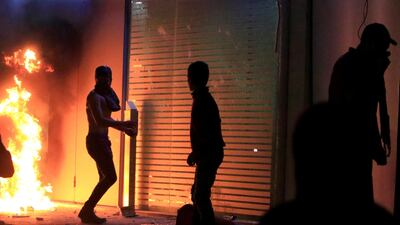
A demonstrator is seen next to a burning fire in front of a bank during a protest against growing economic hardship in Sidon, Lebanon. Reuters -
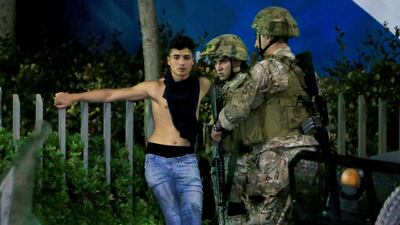
A detained demonstrator stands near Lebanese army soldiers during a protest against growing economic hardship in Sidon, Lebanon. Reuters -
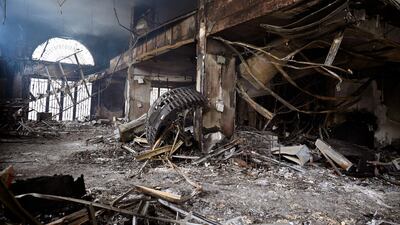
Interior view of a damaged bank that was set ablaze by protesters in Tripoli, northern Lebanon. EPA -
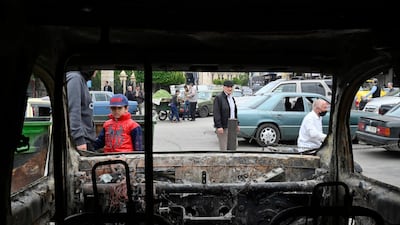
Lebanese people inspect a burnt out car of the Lebanese Internal Security Forces which was set ablaze by protesters in Tripoli, northern Lebanon. EPA -
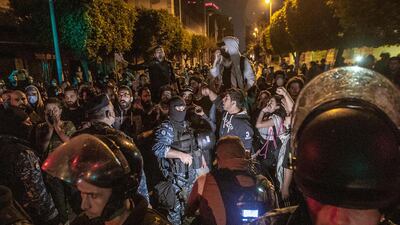
Anti-government protesters shout slogans during a protest against the collapsing Lebanese currency and the price hikes of goods, in front the central bank in Beirut, Lebanon. EPA -
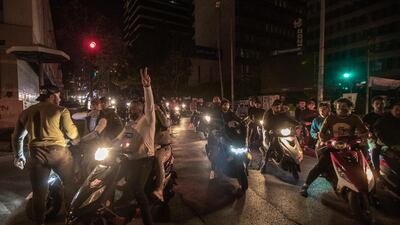
Anti-government protesters ride their motorcycles during a protest against the collapsing Lebanese currency and the price hikes of goods, in front the central bank in Beirut, Lebanon. EPA -

Lebanese men inspect a burnt out car of the Lebanese Internal Security Forces which was set ablaze by protesters in Tripoli, northern Lebanon. EPA -

Workers install metallic barriers on the facade of a bank as a protective measure against vandalism in Tripoli, northern Lebanon. EPA -
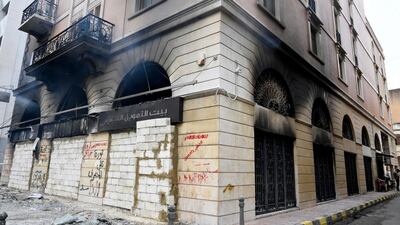
Exterior view of a damaged bank that was set ablaze by protesters in Tripoli, northern Lebanon. EPA -
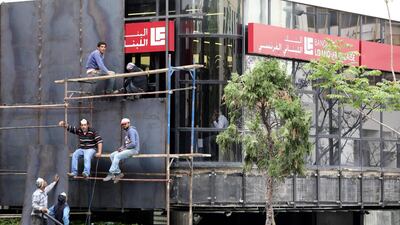
Workers install metallic barriers along the facade of a bank as a protective measure against vandalism in the Lebanese capital Beirut. AFP -

Anti-government protesters shout slogans during a protest against the collapsing Lebanese currency and the price hikes of goods, in front the central bank in Beirut, Lebanon. EPA -
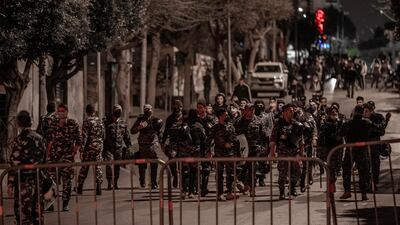
Lebanese riot control police watch as annti-government protesters gather during a demonstration against the collapsing Lebanese currency and the price hikes of goods, in Beirut, Lebanon. EPA -
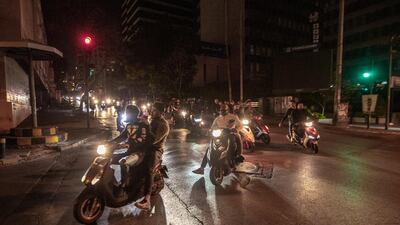
Anti-government protesters ride their motorcycles during a protest against the collapsing Lebanese currency and the price hikes of goods, in front the central bank in Beirut, Lebanon. EPA -
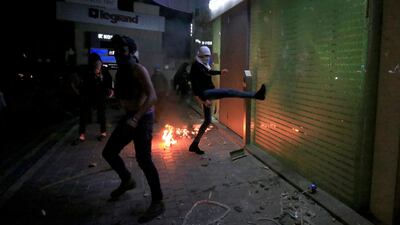
A demonstrator smashes a window of a bank during a protest against growing economic hardship in Sidon, Lebanon. Reuters


Lebanon officially requested IMF help on Friday, one day after Prime Minister Hassan Diab said his country needed $10 billion (Dh36.7bn) in international support. He said he hoped to find that cash in the $11 billion in soft loans and grants promised two years ago by the international community, including the World Bank, Saudi Arabia, the US and France, at a conference in Paris in April 2018.The funds were never disbursed as the previous government failed to implement the necessary reforms.
In its recovery plan, the government wrote that IMF support would provide “strong backing to the difficult decisions” that it would have to take, which include recovering $10 billion worth of public assets embezzled by officials over 5 years and restructuring the banking sector which has estimated losses of 154 trillion Lebanese pounds, or $44 billion at parallel market exchange rates.
Lebanon’s debt-to-GDP ratio is among the highest in the world, at 176 per cent, while inflation is expected to spike at 53 per cent this year, according to the government’s plan. The crisis has pushed nearly half of the Lebanese people into poverty and caused violent protests across the country since October.
Hassan Nasrallah, the leader of Lebanon’s influential Hezbollah party, said in a speech on Monday evening that he was not against Lebanon’s request for IMF assistance as long as the government controlled its implementation.
“We are not in principle against seeking assistance from any party in the world … but we refuse to surrender completely to conditions of the IMF,” he said.
In previous speeches, Mr Nasrallah has warned against the influence the US, which considers Hezbollah a terrorist organisation, has over the IMF. He fears the Trump administration through the IMF could try to impose conditions that would go against the party’s interests.
The government’s rescue plan, which has caused public friction between the banking sector and Mr Diab, will be discussed by MPs on Wednesday. They will not meet in Parliament as usual but at the presidential palace outside Beirut.
Former Prime Minister Saad Hariri's Future Movement said it would boycott the meeting after weeks of hostility between his party and the government, which has criticised him and his father, late Prime Minister Rafiq Hariri, for their bad management of the country's finances since the end of the civil war in 1990.

