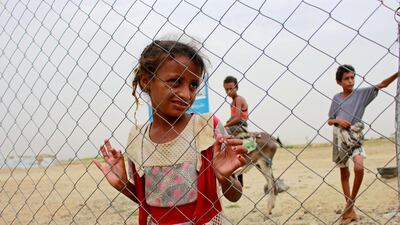
A girl looks through the fence of a closed clinic at a camp for internally displaced people near Abs of Hajjah province, Yemen, on August 19, 2020. Reuters

Coronavirus: Yemen’s crises will exacerbate disease spread, UN says


Mina Aldroubi
  • English
  • Arabic

The UN warned on Monday that Yemen’s fuel and financial crises will exacerbate the spread of the coronavirus, as infected cases neared 2,000.

Yemen, already devastated by years of war and famine, is the Arab world’s poorest country and experts say that its crippled health system is ill-equipped to handle the pandemic.

“The ongoing fuel and funding crises risk exacerbating transmission of the virus and threaten the broader Covid-19 and humanitarian responses,” a statement by the UN Office for the Co-ordination of Humanitarian Affairs (Ocha) said.

The fuel shortage in areas controlled by Houthi rebels has cut electricity supplies, halting water pumps that has led to people being stranded in need of medical care.

Energy scarcity is nothing new in the country but queues at the pumps have been getting longer by the day since mid-June indicating that the spreading of the virus might increase.

Many Yemenis rely on groundwater extracted with pumps, while millions displaced by fighting and living in camps survive on water brought in by diesel-powered lorries.

The internationally recognised government and the Saudi-led military coalition backing it have accused the Houthis of causing fuel shortages to boost their case for the lifting of the coalition's naval and air blockade, imposed to prevent the smuggling of weapons to the rebels.

The UN Envoy to Yemen, Martin Griffiths, said on Sunday that he was deeply concerned by the major fuel shortages in Houthi controlled areas.

Mr Griffiths called on the warring sides to work urgently with his team to reach a solution that guarantees Yemenis’ access to their basic needs of fuel and oil derivatives and the use of associated revenues to pay civil servant salaries.

“Fuel shortages have devastating and widespread humanitarian consequences for the civilian population. Life in Yemen is unforgiving enough without forcing Yemenis to struggle even harder for their everyday needs that are connected to fuel such as clean water, electricity and transportation,” Mr Griffiths said.

The UN official said that both parties must find a solution that will allow the flow of commercial imports of fuel into Yemen through the port of Hodeidah, which is under the control of the rebels.

The parties agreed to a temporary arrangement in November 2019 that successfully allowed the entry of an estimated 72 ships carrying more than 1.3 million tonnes of commercial fuel imports into Hodeidah port from November 2019 until April 2020, according to the UN envoy’s office.

“The Government of Yemen has issued clearances for several fuel ships to enter through the port since the suspension of the Temporary Arrangements. This is a step in the right direction; “however, more actions are needed,” Mr Griffiths said.

Yemen has so far recorded 1,953 confirmed coronavirus cases and 564 deaths since the outbreak of the virus earlier this year.

But the UN said the number of reported cases has recently slowed down due to lack of testing and official reporting.

"Indicators have suggested that the virus continues to spread and the number of confirmed cases and deaths fall below the actual numbers," Ocha said.

“The reasons for this include a lack of testing facilities and official reporting, and people delaying seeking treatment because of stigma, difficulty accessing treatment centres and the perceived risks of seeking care,” it said.


Australia (15-1): Israel Folau; Dane Haylett-Petty, Reece Hodge, Kurtley Beale, Marika Koroibete; Bernard Foley, Will Genia; David Pocock, Michael Hooper (capt), Lukhan Tui; Adam Coleman, Izack Rodda; Sekope Kepu, Tatafu Polota-Nau, Tom Robertson.

Replacements: Tolu Latu, Allan Alaalatoa, Taniela Tupou, Rob Simmons, Pete Samu, Nick Phipps, Matt Toomua, Jack Maddocks.

Who was Alfred Nobel?

The Nobel Prize was created by wealthy Swedish chemist and entrepreneur Alfred Nobel.

  • In his will he dictated that the bulk of his estate should be used to fund "prizes to those who, during the preceding year, have conferred the greatest benefit to humankind".
  • Nobel is best known as the inventor of dynamite, but also wrote poetry and drama and could speak Russian, French, English and German by the age of 17. The five original prize categories reflect the interests closest to his heart.
  • Nobel died in 1896 but it took until 1901, following a legal battle over his will, before the first prizes were awarded.
Who's who in Yemen conflict

Houthis: Iran-backed rebels who occupy Sanaa and run unrecognised government

Yemeni government: Exiled government in Aden led by eight-member Presidential Leadership Council

Southern Transitional Council: Faction in Yemeni government that seeks autonomy for the south

Habrish 'rebels': Tribal-backed forces feuding with STC over control of oil in government territory

COMPANY%20PROFILE
%3Cp%3E%3Cstrong%3EName%3A%20%3C%2Fstrong%3EYango%20Deli%20Tech%0D%3Cbr%3E%3Cstrong%3EBased%3A%20%3C%2Fstrong%3EUAE%0D%3Cbr%3E%3Cstrong%3ELaunch%20year%3A%20%3C%2Fstrong%3E2022%0D%3Cbr%3E%3Cstrong%3ESector%3A%20%3C%2Fstrong%3ERetail%20SaaS%0D%3Cbr%3E%3Cstrong%3EFunding%3A%20%3C%2Fstrong%3ESelf%20funded%0D%3Cbr%3E%3C%2Fp%3E%0A
The specs: 2018 Mercedes-Benz E 300 Cabriolet

Price, base / as tested: Dh275,250 / Dh328,465

Engine: 2.0-litre four-cylinder

Power: 245hp @ 5,500rpm

Torque: 370Nm @ 1,300rpm

Transmission: Nine-speed automatic

Fuel consumption, combined: 7.0L / 100km

Ireland (15-1):

Ireland (15-1): Rob Kearney; Keith Earls, Chris Farrell, Bundee Aki, Jacob Stockdale; Jonathan Sexton, Conor Murray; Jack Conan, Sean O'Brien, Peter O'Mahony; James Ryan, Quinn Roux; Tadhg Furlong, Rory Best (capt), Cian Healy

Replacements: Sean Cronin, Dave Kilcoyne, Andrew Porter, Ultan Dillane, Josh van der Flier, John Cooney, Joey Carbery, Jordan Larmour

Coach: Joe Schmidt (NZL)

Pharaoh's curse

British aristocrat Lord Carnarvon, who funded the expedition to find the Tutankhamun tomb, died in a Cairo hotel four months after the crypt was opened.
He had been in poor health for many years after a car crash, and a mosquito bite made worse by a shaving cut led to blood poisoning and pneumonia.
Reports at the time said Lord Carnarvon suffered from “pain as the inflammation affected the nasal passages and eyes”.
Decades later, scientists contended he had died of aspergillosis after inhaling spores of the fungus aspergillus in the tomb, which can lie dormant for months. The fact several others who entered were also found dead withiin a short time led to the myth of the curse.

Rebel%20Moon%20%E2%80%93%20Part%20Two%3A%20The%20Scargiver%20review%20
%3Cp%3E%3Cstrong%3EDirector%3A%3C%2Fstrong%3E%20Zack%20Snyder%3Cbr%3E%3Cstrong%3EStarring%3A%3C%2Fstrong%3E%20Sofia%20Boutella%2C%20Charlie%20Hunnam%2C%20Ed%20Skrein%2C%20Sir%20Anthony%20Hopkins%3Cbr%3E%3Cstrong%3ERating%3A%3C%2Fstrong%3E%202%2F5%3Cbr%3E%3Cbr%3E%3C%2Fp%3E%0A
About Okadoc

Date started: Okadoc, 2018

Founder/CEO: Fodhil Benturquia

Based: Dubai, UAE

Sector: Healthcare

Size: (employees/revenue) 40 staff; undisclosed revenues recording “double-digit” monthly growth

Funding stage: Series B fundraising round to conclude in February

Investors: Undisclosed

The five pillars of Islam

1. Fasting 

2. Prayer 

3. Hajj 

4. Shahada 

5. Zakat