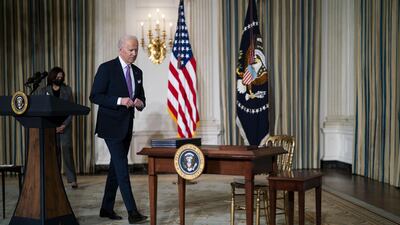
US President Joe Biden prepares to sign executive orders in the State Dining Room of the White House in Washington, January 26, 2021. The New York Times/Bloomberg

What Biden did during his first week as president


Bryant Harris
  • English
  • Arabic

President Joe Biden wrapped up his first full week as president on Wednesday. In a potential preview of the next two years, he signed 37 executive actions while the Senate confirmed his nominees more slowly than it has for previous presidents.

Mr Biden’s executive actions so far have largely reversed several of former president Donald Trump’s signature policies and are focused on combating the Covid-19 pandemic, the economy, immigration, racial equality and climate change.

The new president signed 17 executive actions on his first day alone. These orders included a repeal of the travel ban that affected several Muslim-majority countries, US re-entry into the World Health Organisation and Paris Climate Accord, and an end to the construction of Mr Trump's incomplete wall on the US-Mexico border.

That same day, the US Senate confirmed only one of Mr Biden's Cabinet nominees by an 84-10 vote: Intelligence Director Avril Haines. The lone Cabinet confirmation on day one marked a departure from Mr Biden's three immediate predecessors, all of whom had several Cabinet nominees confirmed the day they took office.

Since then, the Senate confirmed Secretary of State Antony Blinken, Defence Secretary Lloyd Austin and Treasury Secretary Janet Yellen.

The Senate is evenly split between Republicans and Democrats, meaning Vice President Kamala Harris will cast any tiebreaking votes, thereby handing nominal control to Mr Biden’s party.

But Republicans continue to control Senate committees during a drawn-out battle between Democrat Majority Leader Chuck Schumer and Republican Minority Leader Mitch McConnell over a rules package governing the evenly split chamber. House Speaker Nancy Pelosi also transferred the article of impeachment against Mr Trump on Monday, adding another ball for Mr Schumer to juggle, because it is the Senate's duty to carry out the former president’s trial.

Amid the congressional drama, Mr Biden signed additional executive actions to get the ball rolling on several of his other policy priorities. These include a freeze on oil and gas drilling on federal lands and waters, an end to US government reliance on private prisons and a series of actions intended to strengthen the federal response to the Covid-19 pandemic.

As part of the Biden administration's Covid-19 strategy, American citizens and non-citizens alike must now present proof that they have tested negative for Covid-19 or have previously recovered from the virus within three days of travelling to the United States.

The new administration’s drastically different policy priorities from its predecessor are already trickling down from the White House to federal agencies.

At the White House’s direction, the Pentagon repealed its Trump-era ban barring transgender people from serving in the US military. And Richard Mills, the acting US ambassador to the United Nations, announced that the Biden administration would restore economic and humanitarian aid to the Palestinians – something the Trump administration had eliminated.

The Treasury Department issued a sanctions licence allowing some humanitarian trade to take place in Houthi-controlled Yemen after the Trump administration designated the rebel group a terrorist organisation the day before Mr Biden’s inauguration. And the State Department issued a temporary freeze on Wednesday of arms sales initiated by the Trump administration to the United Arab Emirates and Saudi Arabia.

Mr Biden proposed a five-year extension on the New Start arms control treaty with Russia, which is set to expire next month. Moscow welcomed Mr Biden’s proposal after rejecting the Trump administration’s offer to extend the treaty last year, citing unacceptable US conditions.

In the meantime, Mr Biden has mostly prioritised close US allies and neighbours in his first calls with foreign leaders. His very first call went to Canadian Prime Minister Justin Trudeau, shortly after the prime minister criticised Mr Biden’s executive order that halted construction of the Keystone XL pipeline.

Mr Biden also spoke to Mexican President Andres Manuel Lopez Obrador, who said that the president had vowed to send $4 billion in aid to Honduras, El Salvador and Guatemala in an effort to stem the wave of migration through Mexico into the United States.

He also held calls with UK Prime Minister Boris Johnson, Russian President Vladimir Putin, Japanese Prime Minister Yoshihide Suga, German Chancellor Angela Merkel and Nato Secretary General Jens Stoltenberg.

White House press secretary Jen Psaki noted that Mr Biden will use some of his first calls with foreign leaders to address potential US re-entry into the Iran nuclear deal – on the condition that Tehran first returns to compliance with the accord.


If you go

The flights

There are direct flights from Dubai to Sofia with FlyDubai (www.flydubai.com) and Wizz Air (www.wizzair.com), from Dh1,164 and Dh822 return including taxes, respectively.

The trip

Plovdiv is 150km from Sofia, with an hourly bus service taking around 2 hours and costing $16 (Dh58). The Rhodopes can be reached from Sofia in between 2-4hours.

The trip was organised by Bulguides (www.bulguides.com), which organises guided trips throughout Bulgaria. Guiding, accommodation, food and transfers from Plovdiv to the mountains and back costs around 170 USD for a four-day, three-night trip.


The burning issue

The internal combustion engine is facing a watershed moment – major manufacturer Volvo is to stop producing petroleum-powered vehicles by 2021 and countries in Europe, including the UK, have vowed to ban their sale before 2040. The National takes a look at the story of one of the most successful technologies of the last 100 years and how it has impacted life in the UAE. 

Read part four: an affection for classic cars lives on

Read part three: the age of the electric vehicle begins

Read part two: how climate change drove the race for an alternative 

RESULT

Shabab Al Ahli Dubai 0 Al Ain 6
Al Ain: Caio (5', 73'), El Shahat (10'), Berg (65'), Khalil (83'), Al Ahbabi (90' 2)

Mubalada World Tennis Championship 2018 schedule

Thursday December 27

Men's quarter-finals

Kevin Anderson v Hyeon Chung 4pm

Dominic Thiem v Karen Khachanov 6pm

Women's exhibition

Serena Williams v Venus Williams 8pm

Friday December 28

5th place play-off 3pm

Men's semi-finals

Rafael Nadal v Anderson/Chung 5pm

Novak Djokovic v Thiem/Khachanov 7pm

Saturday December 29

3rd place play-off 5pm

Men's final 7pm

LAST-16 EUROPA LEAGUE FIXTURES

Wednesday (Kick-offs UAE)

FC Copenhagen (0) v Istanbul Basaksehir (1) 8.55pm

Shakhtar Donetsk (2) v Wolfsburg (1) 8.55pm

Inter Milan v Getafe (one leg only) 11pm

Manchester United (5) v LASK (0) 11pm 

Thursday

Bayer Leverkusen (3) v Rangers (1) 8.55pm

Sevilla v Roma  (one leg only)  8.55pm

FC Basel (3) v Eintracht Frankfurt (0) 11pm 

Wolves (1) Olympiakos (1) 11pm 

MATCH INFO

Schalke 0

Werder Bremen 1 (Bittencourt 32')

Man of the match Leonardo Bittencourt (Werder Bremen)

WHAT ARE NFTs?


Non-fungible tokens (NFTs) are tokens that represent ownership of unique items. They allow the tokenisation of things such as art, collectibles and even real estate.


An NFT can have only one official owner at one time. And since they're minted and secured on the Ethereum blockchain, no one can modify the record of ownership, not even copy-paste it into a new one.


This means NFTs are not interchangeable and cannot be exchanged with other items. In contrast, fungible items, such as fiat currencies, can be exchanged because their value defines them rather than their unique properties.


Mercer, the investment consulting arm of US services company Marsh & McLennan, expects its wealth division to at least double its assets under management (AUM) in the Middle East as wealth in the region continues to grow despite economic headwinds, a company official said.

Mercer Wealth, which globally has $160 billion in AUM, plans to boost its AUM in the region to $2-$3bn in the next 2-3 years from the present $1bn, said Yasir AbuShaban, a Dubai-based principal with Mercer Wealth.

Within the next two to three years, we are looking at reaching $2 to $3 billion as a conservative estimate and we do see an opportunity to do so,” said Mr AbuShaban.

Mercer does not directly make investments, but allocates clients’ money they have discretion to, to professional asset managers. They also provide advice to clients.

“We have buying power. We can negotiate on their (client’s) behalf with asset managers to provide them lower fees than they otherwise would have to get on their own,” he added.

Mercer Wealth’s clients include sovereign wealth funds, family offices, and insurance companies among others.

From its office in Dubai, Mercer also looks after Africa, India and Turkey, where they also see opportunity for growth.

Wealth creation in Middle East and Africa (MEA) grew 8.5 per cent to $8.1 trillion last year from $7.5tn in 2015, higher than last year’s global average of 6 per cent and the second-highest growth in a region after Asia-Pacific which grew 9.9 per cent, according to consultancy Boston Consulting Group (BCG). In the region, where wealth grew just 1.9 per cent in 2015 compared with 2014, a pickup in oil prices has helped in wealth generation.

BCG is forecasting MEA wealth will rise to $12tn by 2021, growing at an annual average of 8 per cent.

Drivers of wealth generation in the region will be split evenly between new wealth creation and growth of performance of existing assets, according to BCG.

Another general trend in the region is clients’ looking for a comprehensive approach to investing, according to Mr AbuShaban.

“Institutional investors or some of the families are seeing a slowdown in the available capital they have to invest and in that sense they are looking at optimizing the way they manage their portfolios and making sure they are not investing haphazardly and different parts of their investment are working together,” said Mr AbuShaban.

Some clients also have a higher appetite for risk, given the low interest-rate environment that does not provide enough yield for some institutional investors. These clients are keen to invest in illiquid assets, such as private equity and infrastructure.

“What we have seen is a desire for higher returns in what has been a low-return environment specifically in various fixed income or bonds,” he said.

“In this environment, we have seen a de facto increase in the risk that clients are taking in things like illiquid investments, private equity investments, infrastructure and private debt, those kind of investments were higher illiquidity results in incrementally higher returns.”

The Abu Dhabi Investment Authority, one of the largest sovereign wealth funds, said in its 2016 report that has gradually increased its exposure in direct private equity and private credit transactions, mainly in Asian markets and especially in China and India. The authority’s private equity department focused on structured equities owing to “their defensive characteristics.”

MATCH INFO

Newcastle 2-2 Manchester City
Burnley 0-2 Crystal Palace
Chelsea 0-1 West Ham
Liverpool 2-1 Brighton
Tottenham 3-2 Bournemouth
Southampton v Watford (late)