
The largest gathering of people spotted by Alexandra Cat as she cycled through the UK capital on Thursday morning were outside supermarkets where shoppers queued to stock up on supplies amid concerns of a London lockdown.
The streets were quieter than normal – the flood of commuters had dwindled to a trickle - and the mood was different.
“You could see on people's faces they looked like they were in shock,” said Ms Cat, 49, a trauma therapist. “It’s a face I’m familiar with seeing because of the work that I do. We’re just like deer in the headlights and just trying to hold our nerve.”
London is the epicentre of the coronavirus outbreak in Britain, where authorities have taken some of the most drastic measures to curb social contact in an effort to stem the spread of Covid-19. Its most famous resident, Queen Elizabeth, has left her Buckingham Palace residence for her castle at Windsor, a town just west of the capital.
-
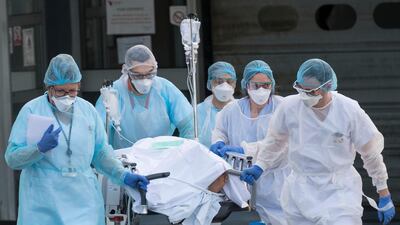
Medical staff push a patient on a gurney to a waiting medical helicopter at the Emile Muller hospital in Mulhouse, eastern France. AFP -
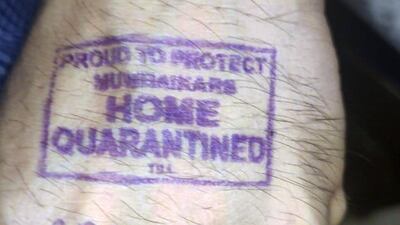
An Indian man shows his stamped hand, indicating that the person is under 'home quarantine', in Mumbai, India. EPA -

Judie Shape, centre, who has tested positive for the coronavirus, but isn't showing symptoms, presses her hand against her window after a visit through the window and on the phone with her daughter Lori Spencer, left, and her son-in-law Michael Spencer, at the Life Care Center in Kirkland. AP Photo -

A single worshipper wearing a surgical mask sits on a pew in Westminster Cathedral in central London. AFP -
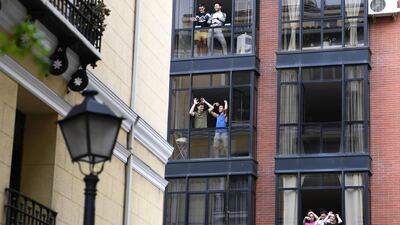
People confined at their homes sing and dance from their windows to bolster themselves up during a lockdown in Madrid. AFP -
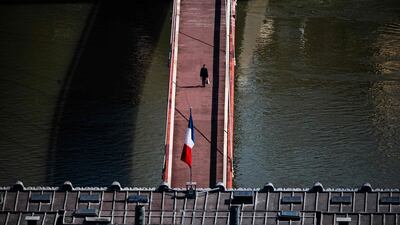
A person walks on the deserted Passerelle du Palais de Justice in Lyon, central eastern France as a strict lockdown comes into in effect. AFP -
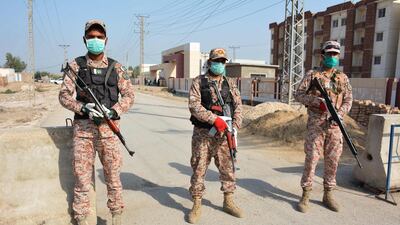
Soldiers stand guard on road leading to a quarantine faciltity for people returning from Iran via the Pakistan-Iran border town of Taftan, in Sukkur in southern Sindh province. AFP -

A passenger wearing protective clothing uses a self check-in machine at Incheon international airport, west of Seoul. AFP -
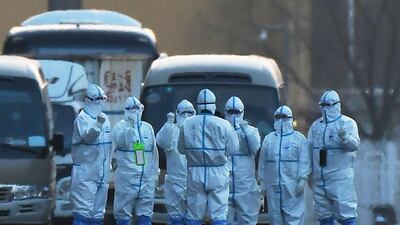
Workers cheer themselves after loading travellers onto buses outside the New China International Exhibition Centre, near Beijing Capital Airport in Beijing. AFP -
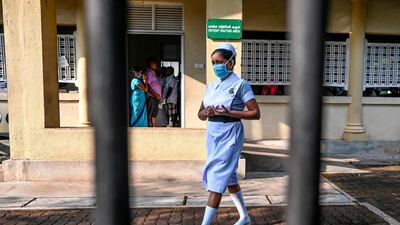
A nurse wearing a facemask walks outside the entrance of Sri Lanka's Infectious Diseases Hospital near Colombo. AFP -

People queue for groceries at a supermarket in Singapore. AFP -
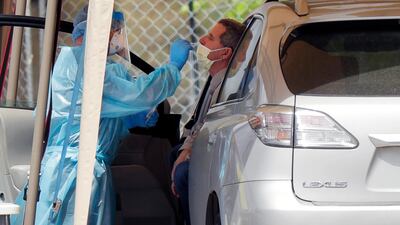
A medical worker tests a person for the coronavirus at a drive-through facility primarily for first responders and medical personnel in San Antonio. AP Photo -

A robot, developed by a start-up firm Asimov Robotics, holds a tray with face masks and sanitiser after the two robots were launched to spread awareness about the coronavirus, in Kochi, India, March 17, 2020. Reuters


Transport officials started closing dozens of underground stations on Thursday to restrict movements and to cope with the loss of staff who were self-isolating after showing coronavirus symptoms. Bus and train services were also being restricted as people tried to work from home.
Jordan Claridge, a 36-year-old assistant professor from the London School of Economics (LSE), said the centre of London was largely deserted as picked up some books in case of restrictions on his movements.
"In central London, by LSE where I work, there are virtually no humans around at all," he told The National.
The government, however, played down fears of a London lockdown sparked by concerns that 20,000 military were put on standby to assist with the outbreak.
At a press conference on Thursday, Mr Johnson said the UK could “turn the tide” of the coronavirus outbreak in the next 12 weeks if government advice is followed.
"If we feel that it isn't working and we need to bring forward tougher measures, nothing is ruled out," the prime minister added. He explained in some parts of London the people’s willingness to follow advice had been “patchy”.
His comments came as Boris Johnson’s administration published plans for a new emergency law in a 329-page document that gives officials sweeping powers to restrict movements across the United Kingdom.
They include powers to detain citizens suspected of being infected, increase the powers of the security services, allow an order to close borders in the event of too few border security officials being able to work.
The measures also seeks to make it easier for volunteers to help medical efforts to tackle the disease. The bill, which would allow measures that last for more than two years, allows the government to ban events on land, in the air and offshore and close buildings, according to guidance published alongside the Bill. Those that breach the rules can be fined.
The measures sparked concerns among civil liberties campaigners but are expected to secure enough support to pass into law.
The new proposals came as the latest figures revealed that a further 29 people who tested positive had died in England.
It took the UK total to 137. The government’s chief scientific adviser, Patrick Vallance, called for the end to socialising in pubs and clubs, amid reports that government advice had been widely flouted in the capital.
Dr Claridge said he had been expecting further government measures earlier. “My feeling is the government here has been a little behind the curve or chasing the ball for a while,” he said. “Maybe we should have done this two or even three weeks ago.”
The Canadian academic said the sudden movement of classes online for students had been jarring.
“We have students from all over the world, a lot of them, their families want them to come home,” he said.
Charlie Reith, a 29-year-old public relations consultant who lives in the centre of London, said the number of people he saw out and about had been dwindling since he started working from home on Monday.
"Nowhere is busy and restaurants are completely empty," he said. The number of commuters is non-existent and with schools set to close at the end of the week, even fewer people are expected to be out and about.
“Every morning we have a crocodile of about 50 school children that walk through this courtyard,” Mr Reith said.
“They have been easily the most number of people that we’ve seen walking through but obviously that will stop this week.”

