

France's drug safety agency on Monday gave a warning about potentially serious side-effects of treatments for the novel coronavirus that are being tested in the country, as a debate over the use of existing drugs to treat Covid-19 continues to rage.
The warning from the agency (ANSM) came after the deaths of three people possibly linked to self-medication with the controversial medicine.
Another 24 patients reported undesirable side effects after taking Plaquenil, a brand of hydroxychloroquine, as well as other medicine including the antiretroviral Kaletra, ANSM head Dominique Martin told the AFP news agency.
He said experts were trying to determine whether the drugs were linked to the side effects. Initial conclusions were expected by the end of the week.
Mr Martin did not reveal what side effects the affected patients had suffered, but ANSM has said the medicine can cause skin damage, psychiatric disorders and arrhythmias.
ANSM has in recent weeks heightened its surveillance of trials of medicine touted as treatments for Covid-19, "in particular when they are used outside of clinical trials", Mr Martin said.
"It's perfectly normal that treatments be tried, given the circumstances, but that doesn't mean we shouldn't observe surveillance ... of these substances."
-

Buddhist monks wearing face shields and mask to protect themselves from the coronavirus disease (COVID-19) collect alms in Bangkok, Thailand. REUTERS -

A man gets a shave outside closed shops during a government-imposed nationwide lockdown as a preventative measure against the COVID-19 novel coronavirus in the old quarters of New Delhi. AFP -

A countdown clock shows the adjusted time remaining for the postponed Tokyo Olympic Games outside Tokyo station, in Tokyo. The postponed Tokyo 2020 Olympics will open on July 23, 2021. AFP -
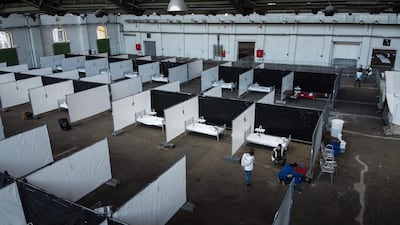
Workers install a temporary Doctors Without Borders (MSF) 50 places shelter for homeless people suspected of being infected with the novel coronavirus (COVID-19) in Brussels. AFP -

South African National Defence Force (SANDF) soldiers drive in an Armoured Personnel Carrier (APC) in the Cape Flats area of Cape Town during a patrol to enforce the 21-day nationwide lockdown in South Africa. AFP -
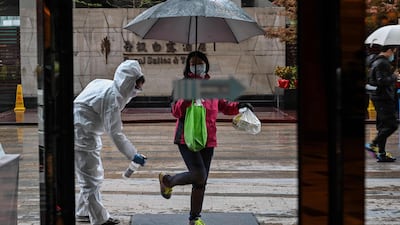
A hotel employee wearing a protective suit sprays disinfectant on an arriving guest, as a preventative measure against the COVID-19 coronavirus in Wuhan, China's central Hubei province, a day after travel restrictions into the city were eased following the outbreak. AFP -

An aerial photo showing deserted vending stalls on the first day of a 21 day lockdown in Bulawayo, Zimbabwe. AFP -

Homeless people sleep in a temporary parking lot shelter at Cashman Center, with spaces marked for social distancing to help slow the spread of coronavirus disease (COVID-19) in Las Vegas, Nevada, U.S. REUTERS -

Women wearing protective masks to prevent the new coronavirus outbreak chat with each other outside a Lego store at a re-opened commercial street in Wuhan in central China's Hubei province. AP -
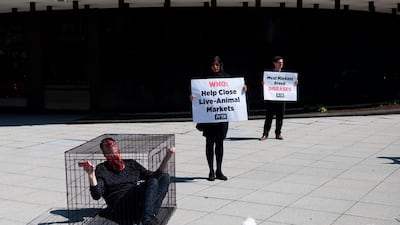
Members of PETA protest live markets outside the World Health Organization in Washington, DC. AFP -

Men wearing protective masks sit inside a bus that will take them to a quarantine facility, amid concerns about the spread of coronavirus disease (COVID-19), in Nizamuddin area of New Delhi, India. REUTERS -
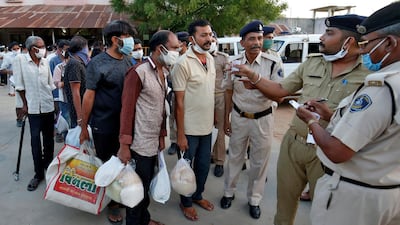
Police officers speak with prisoners after they were released on parole outside the Sabarmati Central Jail during a 21-day nationwide lockdown to slow the spreading of coronavirus disease (COVID-19), in Ahmedabad, India. REUTERS -

People are shown in social-distancing boxes at a temporary homeless shelter set up in a parking lot at Cashman Center in Las Vegas, Nevada. AFP -
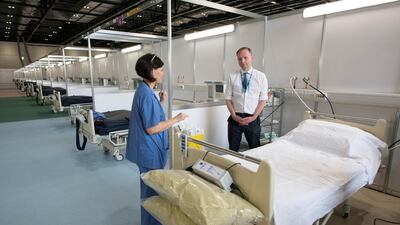
NHS England's Chief Executive Simon Stevens speaks with NHS staff at ExCel London, during its conversion into the temporary NHS Nightingale Hospital, comprising of two wards, each of 2,000 people, to help tackle the coronavirus outbreak, in Newham, London. REUTERS


Combining hydroxychloroquine with the antibiotic azithromycin has been in the spotlight since French researcher Didier Raoult published two studies that he said showed the treatment's effectiveness against the novel coronavirus.
The French microbiologist has become one of France’s best-known doctors in a matter of weeks after announcing his findings in a series of videos posted to YouTube.
Mr Raoult's studies have gained considerable traction both inside and outside of France, with US President Donald Trump pushing hard for the widespread use of the existing medicine to treat American coronavirus patients.
The debate stirred in France has posed a challenge to the government’s response to the crisis, and the proposed use of the drugs as a treatment has become a focal point for criticism of President Emmanuel Macron, both by his political opponents, including far-right leader Marine Le Pen, and by Mr Raoult’s 370,000-strong army of Facebook followers.
And a surge in demand for the drug – normally used to treat lupus patients – has raised fears of shortages and prompted officials to warn against the use of unproven medicines.
Experts across the world have been quick to question assertions of the drugs’ effectiveness, and the research is yet to be peer reviewed or formally published in a medical journal.
After Mr Raoult released his latest findings on the internet at the weekend, Prof Francois Balloux of University College, London, tried to dampen talk that the medicine could be a miracle cure.
"No, [this is] not 'huge' I'm afraid," he said on Twitter.
"This is an observational study (i.e. not controlled) following 80 patients with fairly mild symptoms. The majority of patients recover form #COVID19 infection, with or without #Hchloroquine and #Azithromycin treatment."
Statistician Tim Morris of the university's clinical trials unit was even more scathing.
"If hydroxychloroquine turns out to be useful," he tweeted, "it's a shame that this group will be praised as heroes and prophets instead of held to account for the misinformation and self-promotion they've been churning out at a critical time".
In the US, despite being hailed as potential “game changers” by President Trump, government experts remain unconvinced, with Anthony Fauci, the head of the US National Institute of Allergy and Infectious Diseases, calling the evidence supporting the use of the drug "anecdotal".
The treatment needs "particular attention", Mr Martin said, because using the two drugs together could provoke a heart attack.
This was "even more the case with patients suffering from Covid-19" because of metabolic problems associated with the disease, he said.
At least one person has already died in the US after self-medicating with a non-pharmaceutical version of the drug used for cleaning fish tanks.
A European clinical trial to evaluate four experimental treatments for the disease, including the combination of medicine at the centre of the coronavirus debate, is under way in France with about 800 patients who have suffered from severe symptoms of the virus.
The trial, named Discovery, is being led by infectious disease specialists at the Croix-Rousse Hospital in Lyon, in central-eastern France.
The drugs have been included on a World Health Organisation list of experimental treatments highlighted for examination under trial conditions.
Hospitals across the country, including in Lille, Nantes, Strasbourg and Paris are also taking part, as well as around 3,200 patients from neighbouring counties hit hardest by the virus.
As of Tuesday, France had confirmed more than 45,000 cases of the virus, with more than 3,000 deaths.

