

The world’s poorest countries are braced for major cuts in overseas funding when the British government announces its new aid budget this week.
Nations such as Lebanon, Sudan and Yemen, will experience cutbacks of more than three quarters of their current aid when the UK Foreign Office's decisions are made public, likely on Thursday.
Many politicians and analysts have roundly condemned the cuts in aid, telling The National that they could not "come at worse time" for the world's poorest people and calling the reduction "unacceptable" during a pandemic.
There are also concerns that the cuts will significantly reduce the UK’s leverage as a “soft power” nation that uses its development grants to assist countries in crisis.
Whitehall sources disclosed that the cuts are expected to be announced to Parliament on Thursday. At the same time, Foreign Secretary Dominic Raab will appear before the International Development Committee where he will be fiercely questioned by MPs.
"Cutting aid to the world's poorest people cannot come at a worse time," International Development Committee chairwoman Sarah Champion told The National.
-
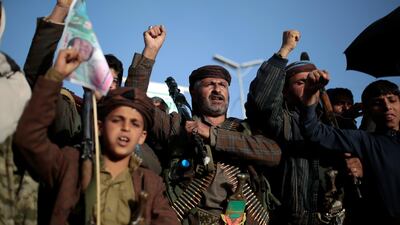
Houthi supporters chant slogans as they attend a demonstration against the United States over its decision to designate the Houthis a foreign terrorist organization in Sanaa, Yemen. AP Photo -
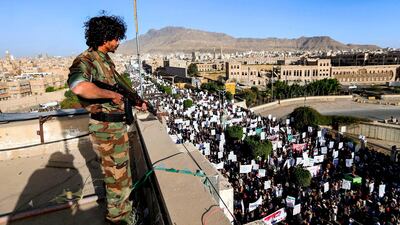
A member of security forces loyal to Yemen's Houthi rebels stands guard as supporters attend a rally denouncing the United States and the Trump administration's decision to apply the "terrorist" designation to the Iran-backed movement. AFP -
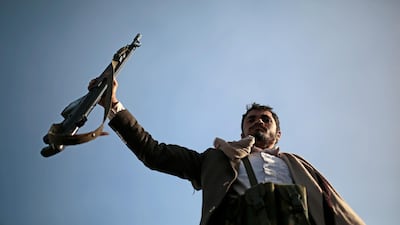
A Houthi supporter holds his weapon during a demonstration against the United States over its decision to designate the Houthis a foreign terrorist organization in Sanaa, Yemen. AP -
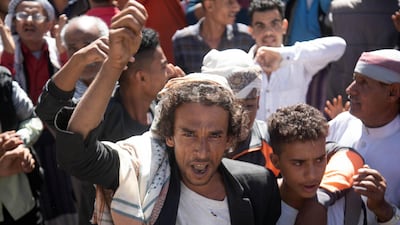
Opposers of Yemen's Houthi rebels shout slogans during a rally in support of the United States and the Trump administration's decision to apply the "terrorist" designation to the Iran-backed movement, in Yemen's third city of Taez. AFP -
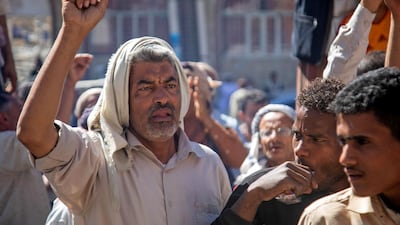
Opposers of Yemen's Houthi rebels shout slogans during a rally in support of the United States and the outgoing Trump administration's decision to apply the "terrorist" designation to the Iran-backed movement, in Yemen's third city of Taez. AFP -
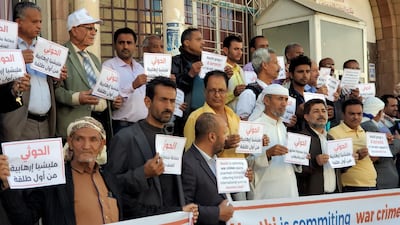
Yemenis opposed to the country's Houthi rebels take part in a rally in support of a recent decision by the United States' outgoing administration blacklisting the Houthi group as a "terrorist" organisation in Yemen's third city of Taez. AFP -
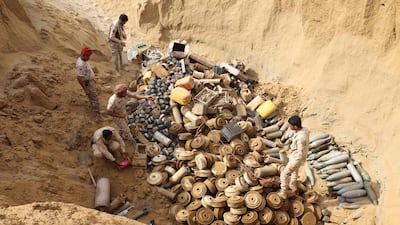
A joint Saudi-backed Sudanese-Yemeni force removes landmines, which they said were planted by the Iran-aligned Houthi rebels in Yemen's northern coastal town of Midi, in the Hajjah governorate. AFP -
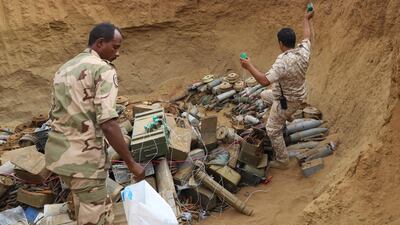
The Saudi-backed Sudanese-Yemeni force removes and de-activates landmines in the Hajjah governorate near the border with Saudi Arabia on the Red Sea. AFP -
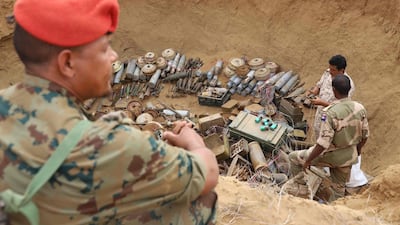
The force collected some 5,000 landmines. AFP -
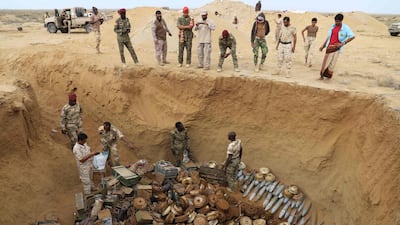
A shot shows landmines collected by the Sudanese-Yemeni force. AFP -
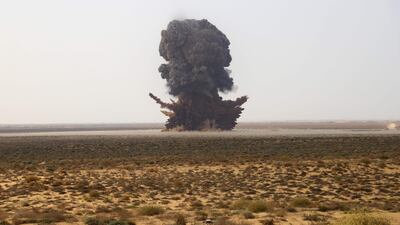
An expAFP


“In the year where all eyes are on the UK with G7 and Cop26, the logic to cut £5 billion ($6.92bn) from the aid budget compared to 2019 astounds me. Will cutting 0.2 per cent of gross national income really make that much difference to the UK?”
She said that the secondary impact of coronavirus was likely to “set back development progress exponentially”, with famines, increased gender-based violence and depleting health care.
The country facing the biggest cut with a potential 88 per cent reduction is expected to be Lebanon, which is still recovering from the Beirut port explosion and hosts more than 1.5 million Syrian refugees.
South Sudan will likely lose its entire Conflict, Stability and Security Fund, and along with Syria and Libya faces a significant two-thirds reduction. Other countries that face major cutbacks are the Democratic Republic of Congo, Nigeria and several west Balkan countries.
It was thought Yemen’s aid would shrink from £197m to £87m. UN Secretary General Antonio Guterres described the reduction in aid for Yemen as “a death sentence”.
Ms Champion called the 60 per cent shortfall for Yemen “appalling”, and said her committee would quiz Mr Raab at length over the cuts “which will harm so many around the world”.
Britain is one of the few countries that previously enforced the commitment of 0.7 per cent of gross domestic product to overseas aid, and this was reinforced in the Conservative Party manifesto pledge.
But last year Boris Johnson’s government said it would temporarily reduce the amount to 0.5 per cent due to the economic crisis caused by the Covid-19 pandemic. As such, the UK's international development aid budget will be cut from £14.5bn to £10bn this year.
The response from MPs across the political divide was one of widespread condemnation.
“These unacceptable cuts leave a gaping hole in support to the world's poorest,” MP Layla Moran, the Liberal Democrats' Foreign Affairs Spokeswoman said. “Critical humanitarian support to countries like Lebanon, Yemen, Sudan and Libya has been decimated. Furthermore, the reduction of essential aid to address famines in Yemen and Sudan will see a direct increase in preventable deaths. This is utterly appalling.”
The MP, of Palestinian heritage, said many Middle Eastern countries would suffer, and that government claims that the cuts were necessary “are all lies”.
“The truth is that these cuts will make us all less safe, they are not in our national interest and betray a lack of a moral compass in this government's heart,” she said.
Whitehall sources indicated that there will be “huge cuts”, with the harshest coming in Africa and the Middle East. A previous leak of Foreign Office documents showed that the budget for the Sahel region, where ISIS extremists are resurgent, will fall from £340m to £23m.

While the government still insists it is a “development superpower”, others believe that the reduction will reduce Britain’s global soft power and influence.
Laura Round, a former special adviser to the government's International Development Secretary, said that overseas aid contributed significantly to Britain’s soft power. “Covid-19 is forcing the government to make very difficult decisions, but in a year where the UK is hosting the G7, the Global Education Summit and Cop26, cuts to the aid budget risk undermining our soft power which is crucial in securing successful outcomes at these summits,” said Ms Round, now at Freuds PR.
“The overseas aid funding speaks volumes in terms of our soft power,” said Tobias Ellwood MP, a former foreign minister. “Cutting it would be a short-sighted move that fails to appreciate how well-targeted aid can strengthen international relationships.”
In its defence, the British government said it was a “world leader on international development” as the third biggest international aid donor.
“The seismic impact of the pandemic on the UK economy has forced us to take tough but necessary decisions, including temporarily reducing the overall amount we spend on aid,” a British government spokeswoman said. “We will still spend more than £10 billion this year to fight poverty, tackle climate change and improve global health.”
She added that the government was considering what this would mean for individual programmes with a decision expected soon.
More on UK aid
Rollout of UK aid cuts threatens work on climate change
UK’s foreign aid cuts likely to hinder vaccination and climate change efforts

