

Refugees and migrant workers in Lebanon are at risk of missing out on Covid-19 shots, a rights group said on Tuesday.
Government data shows the vaccination rate among Palestinians, Syrians and migrant workers, who collectively make up a third of Lebanon's population, is so low that it could jeopardise nationwide efforts to fight the disease, Human Rights Watch reported.
"As we know from a year of Covid prevention measures, none of us are safe until we all are. A failure to implement a vaccination plan that reaches a third of the population grossly undermines Lebanon's nationwide efforts," Nadia Hardman, a refugee and migrant rights researcher at Human Rights Watch, told The National.
“The government needs to invest in targeted outreach to build trust with long-marginalised communities or the Covid-19 vaccination effort is doomed to fail.”
UN data shows that Syrian and Palestinian refugees have died from Covid-19 at a rate more than four and three times the national average, respectively.
Yet, according to the government’s online Covid-19 vaccine registration and tracking platform, only 2.86 per cent of those immunised and 5.36 per cent of those registered to receive the shots are non-Lebanese, Human Rights Watch found.

The government said it would vaccinate people living in Lebanon regardless of nationality.
It has stated its intention to buy seven million doses, enough for about half the country’s population. The private sector recently began importing additional vaccines to speed up the vaccine programme.
But the prospect of being inoculated remains elusive for Syrians and Palestinians, who represent two of the country’s most marginalised groups.
A Palestinian woman, 39, living in Rashidieh refugee camp in south Lebanon, told Human Rights Watch there was no effort to raise awareness about the virus or the vaccine.
“Instead, rumours are spreading on WhatsApp. Nothing has been explained properly,” she said.
“Even I didn’t trust the vaccine and it was only when I knew someone who received the vaccine overseas that I changed my mind.”
-
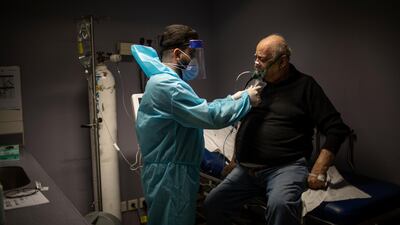
A patient with Covid-19 symptoms is checked by a staff member at Saint George Hospital in Lebanon's capital Beirut. Getty -
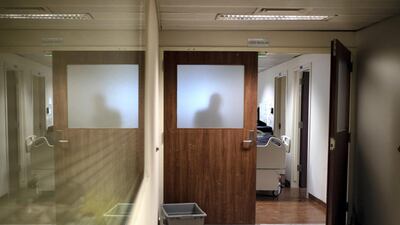
A person is silhouetted behind a door near the coronavirus intensive care unit at the American University of Beirut (AUB) Hospital. Tom Nicholson for The National -
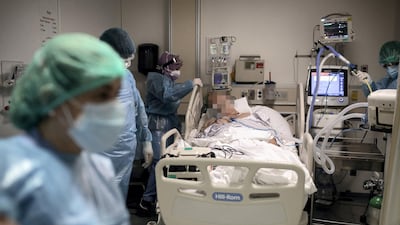
A patient in the Emergency Room at the American University of Beirut (AUB) Hospital. Tom Nicholson for The National -
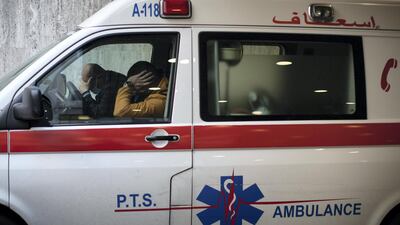
Paramedics rest in an ambulance parked outside the Emergency Department at the American University of Beirut (AUB) Hospital. Tom Nicholson for The National -
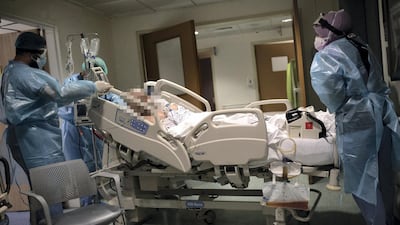
A patient is moved in the Coronavirus Emergency Room at the American University of Beirut (AUB) Hospital. Tom Nicholson for The National -
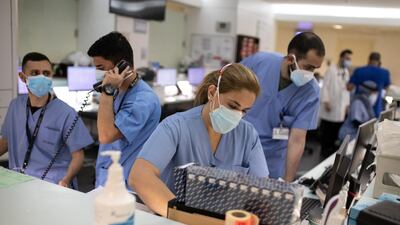
Staff members work in the Emergency Room at the American University of Beirut (AUB) Hospital. Tom Nicholson for The National -
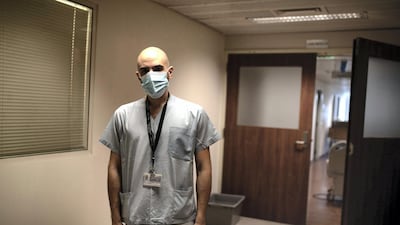
Oday Hamad, a nurse at the Coronavirus intensive care unit at the American University of Beirut (AUB) Hospital poses for a portrait. Tom Nicholson for The National -

Tatiana Chahine, a nurse at the Coronavirus intensive care unit at the American University of Beirut (AUB) Hospital poses for a portrait. Tom Nicholson for The National -
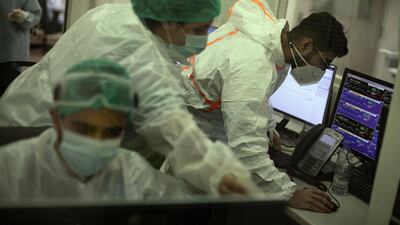
Staff members work in the Emergency Room at the American University of Beirut (AUB) Hospital. Tom Nicholson for The National -

A patient is moved in the Emergency Room at the American University of Beirut (AUB) Hospital. Tom Nicholson for The National


A UN representative told Human Rights Watch the low registration rate among Palestinian refugees could be attributed to a lack of trust in the vaccine and a reluctance to take the vaccine in centres outside the country’s 12 official camps.
The size of Lebanon’s Palestinian population is unknown. The government estimated their number at 174,000 in 2017, whereas the UN agency for Palestinian refugees says there are as many as 450,000.
Close to one million Syrian refugees are registered with the UN, but Lebanese officials believe the total number of Syrians in the country to be closer to 1.5 million.
Lebanon’s economic crisis, which started in mid-2019, has left 89 per cent of Syrian refugees living in extreme poverty, up from 55 per cent the year before.
As of April 5, only 17,891 Syrians had registered to have the vaccine, and only 1,159 had received one, Human Rights Watch wrote.
Most of the Syrian refugees interviewed by the organisation did not know that they were entitled to register, believing the government’s online platform was for Lebanese citizens only.
“Nearly all expressed fears regarding the consequences of registering with a government-led application that could lead to arrest, detention or deportation for lacking legal residency,” Human Rights Watch wrote.
Because of restrictive residency policies, only 20 per cent of Syrians have the legal right to live in Lebanon.
The government has sent mixed messages about the country’s migrant workers, most of whom are from the Philippines, Ethiopia or Bangladesh.
They number at least half a million, but the Health Ministry said it cannot afford to inoculate them.
The Anti-Racism Movement, a Lebanese grassroots collective which collaborates with migrant workers, told Human Rights Watch this group lacks information about the vaccine.
“Some migrant workers told ARM that they fear the Lebanese government will not give them the “good vaccine”, demonstrating the low trust between the community and the government,” Human Rights Watch wrote.

