

While there were those in the Middle East who must have welcomed the Republican setbacks in US Congressional elections, assuming this lowered the probability that President Donald Trump would resume the war with Iran, this reaction was not necessarily shared by all. Lebanese President Joseph Aoun, for example, wagered on Mr Trump’s support for securing an Israeli withdrawal from Lebanon. Now that wager has probably been lost.
In truth, Mr Aoun always expected too much from the American President and his Secretary of State, Marco Rubio. It was never probable that Mr Trump would put real pressure on Israel over Lebanon, and even less so Mr Rubio. It’s unknown how long the Secretary of State will remain in the administration, as he may resign to pursue his presidential ambitions for 2028, but whatever his calculations, pressing Israel is certainly not going to be part of them.
That said, in the face of Israel’s preference to not conclude any agreement with Lebanon that could limit its latitude to unilaterally implement its security conditions in Lebanon, some kind of US framework at least allowed for the limited containment of Israel. With Mr Trump weakened, and Mr Rubio managing Lebanese-Israeli negotiations from a distance, it may soon be inevitable that Israel will seek to impose new facts on the ground.
Making matters worse, the mandate of Unifil, the UN force in Lebanon, expires at the end of the year, and there is no agreement yet on what might replace it. Lebanon would like to see a new force made up of European and other countries, but Mr Rubio mentioned a “civil” replacement last week. This raised questions about whether he favours private contractors, similar to the ones used in Gaza with the so-called Gaza Humanitarian Foundation.
-
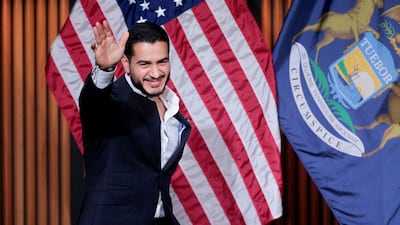
Abdul El-Sayed, who has become the first Muslim to be elected to the US Senate, celebrates his milestone victory in Detroit, Michigan. Reuters -
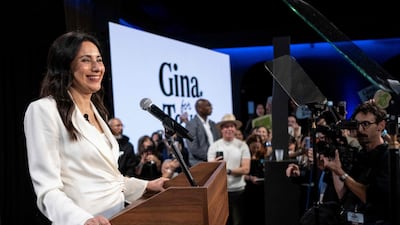
Gina Hinojosa, who has been elected as the first Latina governor of Texas, addresses supporters. AFP -
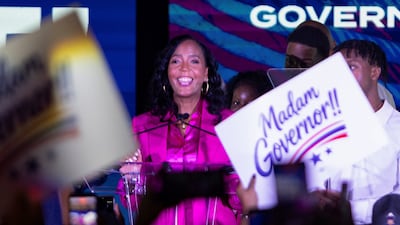
Democrat Keisha Lance Bottoms addresses supporters in Atlanta, Georgia, after becoming the first African American woman to be elected governor of a state. Reuters -
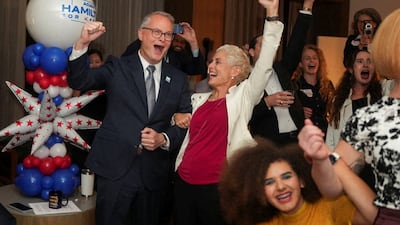
Adam Hamilton, Democratic Senate candidate for Kansas, celebrates in Overland Park as the results pour in. Reuters -
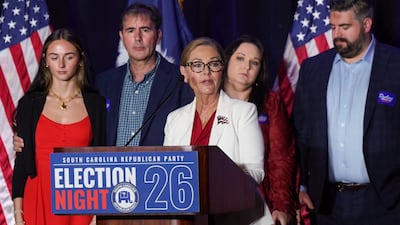
Republican Senator Darline Graham concedes defeat to Annie Andrews in the South Carolina race. AFP -

Annie Andrews, the Democratic Senate candidate for South Carolina, celebrates with her family in Charleston as results pour in. Senate. AFP -
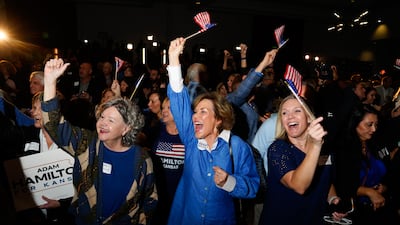
Supporters of Adam Hamilton, the Democratic Senate candidate for Kansas, cheer during an election night event in Overland Park. Bloomberg -

Roy Cooper, Democratic Senate candidate and former North Carolina governor, attends an election night rally. Reuters -
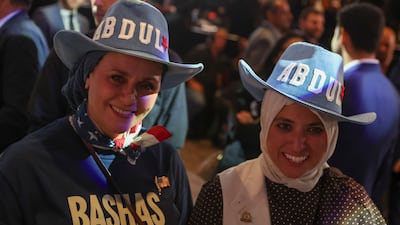
Supporters of US Senate candidate Abdul El-Sayed attend the Michigan Democrats' election night watch party in Detroit. EPA -
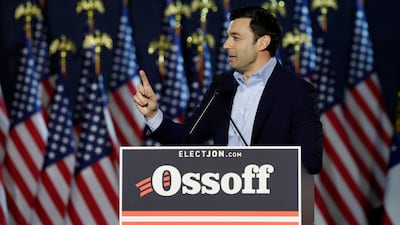
US Senator Jon Ossoff, Democrat from Georgia, speaks in Atlanta after winning re-election. AFP -
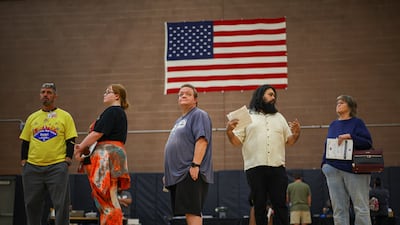
People stand in line to vote in the US midterm elections at Boulder City High School in Boulder City, Nevada. Reuters -
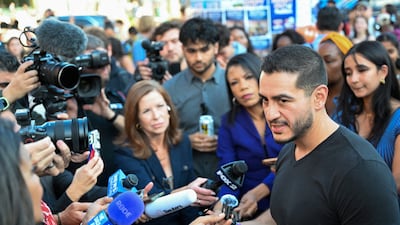
Democratic candidate for US Senate, Abdul El-Sayed, speaks to the media as he visits a polling site in Ann Arbor, Michigan. Reuters -
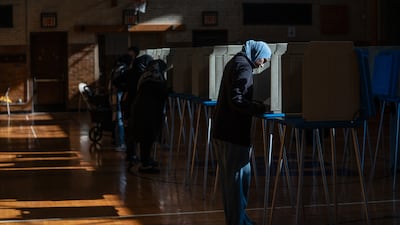
Voter cast their ballots in Dearborn, Michigan. Bloomberg -
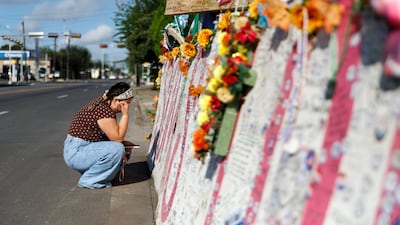
A voter cries after placing their "I Voted" sticker on a memorial for Lorenzo Salgado Araujo, who was shot dead by an Immigration and Customs Enforcement officer in July, in Houston, Texas. Bloomberg -
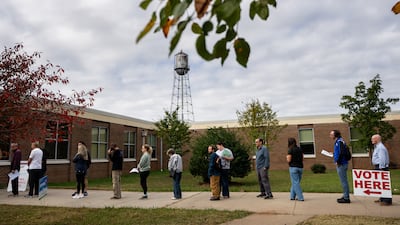
Voters wait in line to cast their ballots in Durham, North Carolina. Bloomberg -
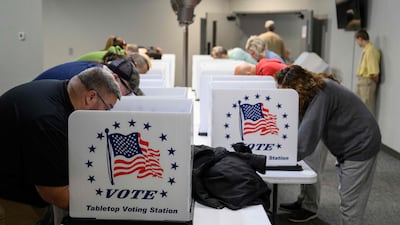
Voters cast their US midterm election ballots at a polling station at the Bridge of Hope Church in Youngstown, Ohio. AFP -
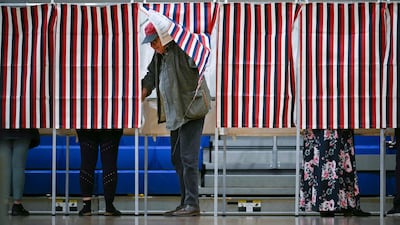
Voters in South Portland, Maine. AFP -
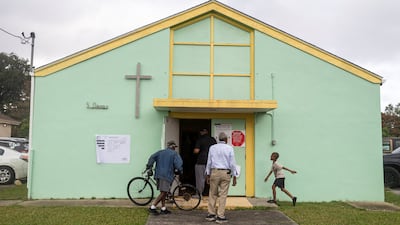
Orleans parish election commissioner Calvin Alexander stands outside St David Baptist Church, as residents arrive to vote in New Orleans, Louisiana. Reuters -
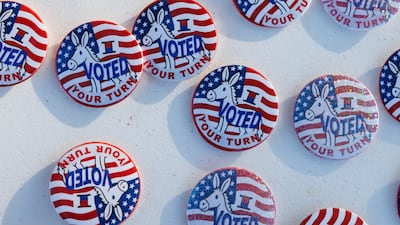
Badges at a polling site in Clayton, North Carolina. Bloomberg -
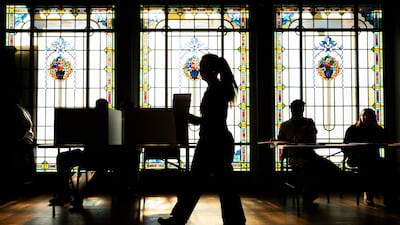
US voters cast their ballots at the Museum of Contemporary Art in Arlington, Virginia. EPA -
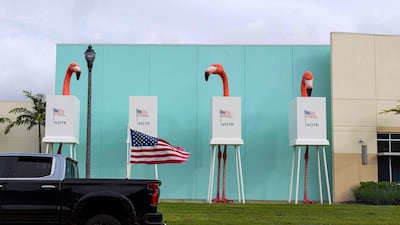
Flamingos created by artist Matthew Mazzotta outside the Supervisor of Elections building in West Palm Beach, Florida. AFP -
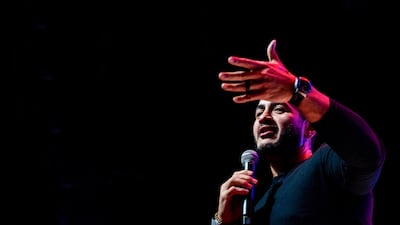
Abdul El-Sayed, Democratic US Senate candidate, from Michigan, speaks during a campaign event at the Majestic Theatre in Detroit. Bloomberg -
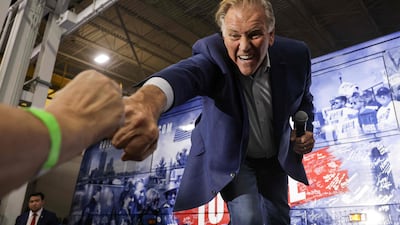
Republican Senate candidate Mike Rogers greets supporters as he takes the stage at a campaign rally in Rochester Hills, Michigan. AFP -
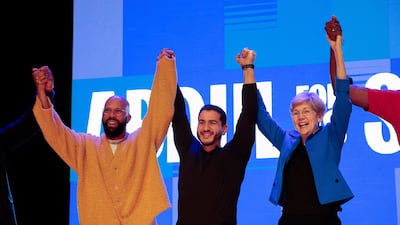
Mr El-Sayed attends a campaign rally with rapper Common and US Senator Elizabeth Warren ahead of the midterm elections, in Detroit, Michigan. Reuters -
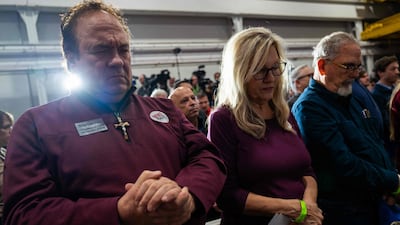
People pray during a rally for Michigan Republican Senate candidate Mike Rogers, in Rochester Hills. AFP -
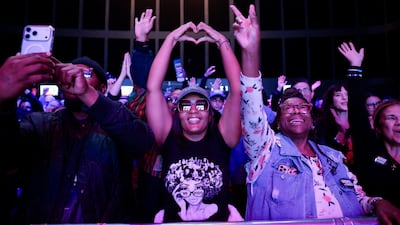
Supporters attend Mr El-Sayed's campaign rally with Common, in Detroit. Reuters -
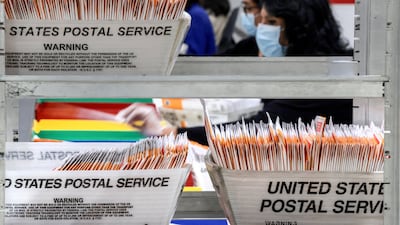
Midterm election ballots are extracted from envelopes at the Los Angeles County Ballot Processing Centre, in City of Industry, California. Reuters -
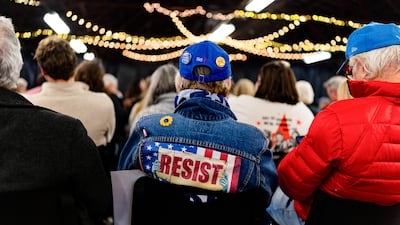
An attendee wears a "Resist" jacket during a campaign event with Abdul El-Sayed, Democratic US Senate candidate from Michigan. Bloomberg -
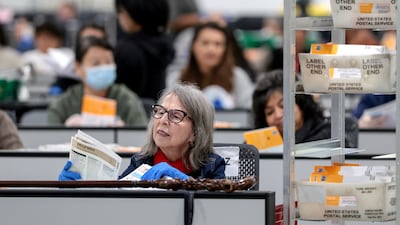
Election staff at work at the LA County Ballot Processing Centre. Reuters -
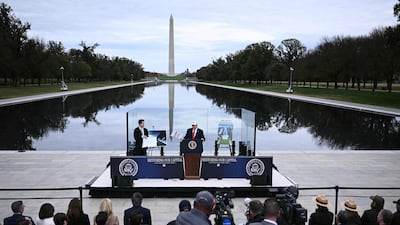
US President Donald Trump delivers a speech marking the end of the midterm election campaign, in Washington DC, the day before voting starts. AFP


This would be highly controversial, however, as such a force would need to be approved by Israel and, therefore, is bound to be amenable to Israeli conditions in a way that national governments are not. Regardless of what happens, what is looming in southern Lebanon is a very real possibility there will soon be no international eyes to report on Israeli actions.
Both inside Lebanon and in the US, there has also been increasing criticism of the Lebanese army’s unwillingness to disarm Hezbollah by force. It reached the point where the leader of the leading Christian party, the Lebanese Forces, said he had raised the possibility of replacing the armed forces commander, Rodolphe Haykal. The commander has resisted launching a military operation, understanding this would lead to conflict against a principal representative of one of Lebanon’s largest religious communities, in which the army would not prevail.
Moreover, Mr Haykal realises that a combination of factors only affirms the folly of seeking an armed showdown with Hezbollah. The US is too tied up in domestic political disputation to give much thought to Lebanon, while Israel’s new security doctrine appears to be based on a belief, among other things, that its Arab neighbours are collections of ethnic groups lacking foundational national visions, therefore that Israel has a vested interest in fragmenting them.

In light of this, no Lebanese official is foolish enough to embark on an internal conflict to satisfy the Americans and Israelis, who are either indifferent to Lebanon’s fate or seek to undermine the country’s cohesiveness. Yet at the same time, if there is no movement, the situation will deteriorate and Lebanon will be even more a prisoner of proxy conflicts.
Mr Trump’s defeat in the US elections must have reinforced the Iranians in their belief that they are winning in the ongoing war in the Gulf. The results of Israel’s elections, too, have promised weeks of uncertainty there that create openings for Iran and its allies to regroup. As the Iranians regain the initiative in Lebanon, the credibility of the Lebanese state will continue to erode, ensuring the country enters a prolonged period in the political doldrums.
No one doubts the desire of Mr Aoun and Prime Minister Nawaf Salam to improve the situation in Lebanon. However, the country is weak and divided, held in check by a political class that seeks to preserve its power at all costs. These factors have all contributed to undercutting the work of a government made up of genuinely credible ministers.
Worse, Lebanon is navigating in a highly divisive and destructive regional environment, emerging from the US and Israeli attack on Iran. This followed a Gaza war that Israel viewed as an opportunity to assert regional hegemony. Lebanon has become a playing field in the Iranian-Israeli rivalry, much as Syria has in the Turkish-Israeli rivalry. In this kind of environment, the cards are stacked against Lebanon to reassert state control.
It’s easy to blame the Lebanese for their misfortunes, but it’s surprising how superficial has been US thinking on the region, and how one-dimensional is their reading of the Lebanese reality. Lebanese officials, too, have made many promises that they were unable to keep, and now see their country once again buffeted by outside powers.
In times of doubt, the Lebanese have adhered to a dated belief that all salvation comes through the Americans. Former president Amin Gemayel thought so in 1982, and Mr Aoun has repeated the same mistake today. There is no American silver bullet for Lebanon’s situation. Officials in Beirut should formulate an alternative approach that, at least, preserves internal stability amid the regional storm, because circumstances in the country will not soon improve.

