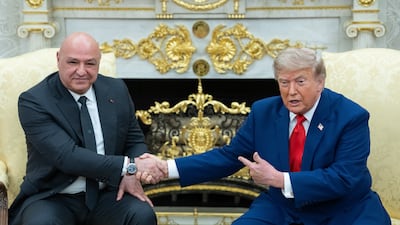

When Lebanese President Joseph Aoun visited the White House in July, he told US President Donald Trump of the “urgent need for a complete Israeli withdrawal from Lebanese territory”, describing it as “an essential step to consolidate stability and enable the Lebanese state to extend its full sovereignty exclusively through its own forces”.
Mr Aoun’s remarks affirmed the extent to which he was relying on US pressure to persuade the Israelis to make concessions in Lebanon, and ultimately leave the country. He underlined to Mr Trump that such an outcome “will be your legacy”.
Perhaps the Lebanese President didn’t have a choice other than to appeal to the Americans, since only Washington has leverage over Israel. However, it’s probably also true that little will come of this, since the Trump administration played a central role in mediating a Lebanon-Israel framework agreement last June that placed all conditions of implementation on Beirut, with no Israeli commitment to pull out of Lebanon.

The situation in Lebanon has entered what appears to be a long stalemate, or worse. Mr Trump is the prisoner of a war with Iran that he is not winning, and his margin of manoeuvre is limited. Recently, he reportedly rebuffed the Saudis who had asked for assistance against Yemen’s Houthis rebels – yet another moment when Washington has failed to come to the Saudis’ assistance after the attack against the Abqaiq-Khurais oil facility in 2019.
Moreover, this is a key political moment in the US, with Mr Trump facing tricky midterm elections in the House of Representatives and Senate in November. Therefore, he will not anger major donors who support Israel by putting pressure on the Israelis to be more accommodating in Lebanon, especially when the deal his administration helped negotiate was so favourable to Israel. The Israelis could simply cite the accord to push back against any US requests.
Mr Aoun not only overestimated Mr Trump’s desire and latitude to secure a deal in Lebanon, but he also appears not to have grasped that the US has no Lebanon policy.
-

Smoke rises after an Israeli strike near the southern Lebanese city of Tyre. AFP -

A woman makes her way through the rubble of a residential building hit in an Israeli attack, near Burj Al Shamali, on the outskirts of Tyre. AFP -

The aftermath of bombing by Israeli jets in the city of Nabatieh. AFP -

Civil defence members search for victims in the rubble in Burj Al Shamali. AFP -

Strikes near Beaufort Castle, seen from Marjayoun. Reuters -

Lebanese soldiers in Burj Al Shamali. AFP


The Americans do have a desire to see Hezbollah disarmed and its areas taken over by the Lebanese army, but that represents a wish list more than a policy. There is no serious thinking about mechanisms to bring this about or how to preserve internal stability. Nor is there much thought about engaging with Iran, or about Lebanese reforms that may give more power to the Shiite community in exchange for Hezbollah’s disarmament.
Interestingly, two US envoys to Lebanon – the ambassador in Beirut, Michel Issa, and the ambassador in Turkey, Tom Barrack – are on record as saying that a solution in Lebanon either has to involve Iran or is tied to regional dynamics, including talks between Washington and Tehran. Both men were criticised for such statements, particularly by Israel’s supporters in the US, but they weren’t wrong.
However, neither Mr Issa nor Mr Barrack is a major mover in Washington, even less so when their recommendations hit up against Israeli preferences. While they are both friends of Mr Trump, and of Lebanese origin, there is no way that they will be able to turn Lebanon into a priority for the President if he senses this will place him on a collision course with powerful political funders close to Israel.
Sensing that Lebanon’s negotiations with Israel are stalled – negotiations on which he has staked much of his reputation – Mr Aoun has sought alternative ways to generate momentum. Last week, at a meeting in Paris, the Lebanese President urged donors to accelerate their efforts to hold an international conference to help the Lebanese army and internal security forces, allowing for the establishment of a strong state in Lebanon “for the first time”. He added: “The opportunity may not repeat itself.”

The constraints the President and his Prime Minister, Nawaf Salam, face are very real when it comes to talking to Israel. They entered into these negotiations to contain the Israeli onslaught of Lebanon, which killed more than 350 people and injured over a thousand others on the single day of April 8. One small achievement is that they managed to obtain US protection for the capital, Beirut, which the Israelis have not bombed massively since then. But other than that, Israel has wantonly pursued its destruction of southern Lebanon.
Mr Aoun went out on a limb to engage the Israelis, and now he seems to be stuck on that limb as Israel refuses to withdraw forces from additional areas in Lebanon, because it says that the Lebanese army is not disarming Hezbollah. The army rejects disarming Hezbollah by force, fearing this may provoke civil war and divide the institution.
There is a larger message, however, in the Trump administration’s inability or unwillingness to put pressure on the parties. It is that the US is diplomatically incoherent these days – unable to define clear political objectives, let alone the role of negotiations in helping to achieve them. This was apparent in the administration’s acceptance of the framework agreement with Iran last June, a decision that Mr Trump subsequently reversed before resuming bombing.
Lebanon’s negotiations with Israel, similarly, seemed a rare bright light in the calamitous US campaign to bring Tehran to heel, until the US President apparently lost interest. There is little diplomatic consistency in Washington, and no clear-eyed secretary of state to take matters in hand. Lebanon is falling through the cracks in this shipwreck of an approach, and Mr Aoun must be getting anxious about how this will affect his future in office.

