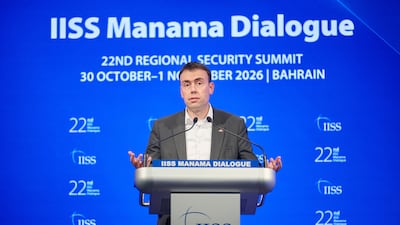

Germany is committed to maintaining a presence in Lebanon after the end of the UN peacekeeping mission Unifil, as European countries discuss a possible successor force, deputy defence minister Nils Schmid has told The National.
The UN Security Council voted unanimously in August 2025 to extend Unifil's mandate for a final time until December this year, after which the force will begin an orderly withdrawal of its personnel.
Established in 1978, the mission has operated in southern Lebanon, monitoring the Blue Line separating Lebanon and Israel and supporting the Lebanese army in extending state authority in the south.

Beirut has called for Unifil's mandate to be extended, while discussions continue with international partners over possible arrangements to maintain security and monitoring responsibilities after its departure.
Germany has contributed to Unifil for years, particularly through its naval component, providing training and assistance to the Lebanese navy. It has a frigate serving as part of the mission's maritime force, which is headed by a German commander.
“We will continue after the end of Unifil to train and assist,” Mr Schmid said in an interview on the sidelines of the Manama Dialogue in Bahrain, referring to his country's long-standing support for the Lebanese military.
He said the precise structure of a future international presence remained undecided, with discussions under way among European countries over whether it would operate under a new UN mandate or an EU framework.

Italy, France and Spain are leading the discussions, he said, but other European nations are also expected to participate. “Germany will also be a full part of this,” he added. “There's a strong commitment not only by Germany but by major European nations to continue a presence in Lebanon.”
Mr Schmid said his country would not deploy ground troops to Lebanon, with its contribution continuing to focus on the maritime domain. Other European countries were prepared to contribute soldiers to a future mission, although the details had yet to be worked out.
Last month, Italy's Defence Minister Guido Crosetto told The National in an interview in Rome that Italy was planning a new international mission to replace Unifil, but it would need US approval.
Separately, EU foreign ministers agreed in October to establish a three-year civilian-military mission to bolster Lebanon's security institutions through advisory and training support for its armed forces and internal security services. The initiative is distinct from Unifil and is not intended to assume its peacekeeping and monitoring role in southern Lebanon.
State authority
Mr Schmid said Germany had assured the Lebanese government of its continued support for the army, stressing the importance of ensuring that the state remains the sole authority responsible for security.
“We strongly encourage the Lebanese government to continue this plan of disarming militias and non-state actors inside Lebanon,” he said. “We know from European history how important it is to have a sole provider of security in states.”
Lebanon has committed to disarming non-state groups, particularly the powerful Iran-backed Hezbollah. However, those efforts have repeatedly stalled, hampered by Hezbollah's military strength, its backing from Iran and the Lebanese army's limited capabilities.
Lebanese officials have also said that Israel's continued military presence in the south is preventing the Lebanese army from completing its deployment there.
Mr Schmid said Germany fully supports the territorial sovereignty and integrity of Lebanon. “It is an independent state and its borders need to be respected.
"At the same time, Israel has legitimate security interests in protecting itself against attacks from neighbouring states.”
Germany's Aspides role
Germany is not planning to increase its current level of participation in the EU's Operation Aspides naval mission for the time being, Mr Schmid said, although it would maintain its existing support.
Berlin‘s contribution consists of staff personnel and an aircraft providing aerial maritime reconnaissance. It had previously deployed a warship.
“We have continuously supported Aspides and we will maintain our support at the current level,” he said.
The EU launched Operation Aspides in 2024 to protect commercial shipping in the Red Sea and Gulf of Aden from attacks by Yemen's Iran-aligned Houthi rebels.
As the conflict in Yemen escalated again in July, threats to shipping through the Bab Al Mandeb strait increased. The waterway has taken on added importance as a route for vessels seeking to bypass the Strait of Hormuz during the Iran war.
EU foreign policy chief Kaja Kallas has recently called for an expansion of Operation Aspides to meet growing demand for naval escorts in the Red Sea. Last month, she told AFP the bloc was expanding the mission.

Mr Schmid said discussions were under way in Brussels about closer co-ordination between Operation Aspides and the Saudi-led Multinational Maritime Defensive Coalition, including the possibility of establishing a liaison office. No decision had been taken, he added.
Gulf co-operation
Mr Schmid said the security challenges facing Europe and the Gulf were increasingly interconnected, pointing to military co-operation between Russia and Iran, including the transfer of drone technology.
“The last year has shown us that theatres are very much interconnected,” he said. “I think this should bring us closer together in terms of security co-operation as well.”
On defence exports, Mr Schmid said Germany had authorised more arms sales to the region under its current government, with air defence a particular priority. Approvals continued to be assessed on a case-by-case basis, he said.
“Especially when it comes to air defence, we understand that this is of course needed, and German companies are available for having a debate with authorities here about the delivery of systems,” he added.
He also pointed to a new government-to-government purchasing framework, under which Gulf partners can negotiate arms purchases directly with Berlin. The Defence Ministry has established a dedicated unit to prepare such agreements, he said.
“Our partners in the Gulf can count on us to promote diplomatic solutions to these ongoing conflicts,” said Mr Schmid, stressing that deterrence and military strength must go hand in hand with political efforts.
“Another round of warfare in the Gulf would be dramatic, not only for the region but for the whole of the world economy,” he said, pointing to the economic repercussions already felt in Europe, including higher inflation and slower growth.

