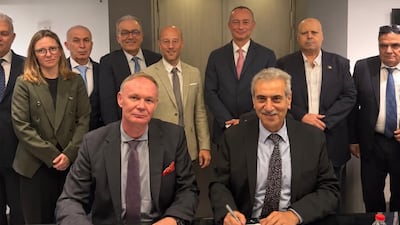

The Palestinian committee set up to administer Gaza has signed an agreement with Germany’s international development agency GIZ to support the coastal strip's postwar recovery and reconstruction, although Israeli objections continue to prevent the body from entering the territory.
The pact, signed on Tuesday at the National Committee for the Administration of Gaza’s temporary headquarters in Cairo, establishes a framework for technical assistance on reconstruction, public institutions and essential services, the committee said.
It was formed in January under US President Donald Trump's peace plan and UN Security Council Resolution 2803. Mr Trump's plan brought about a shaky ceasefire between Israel and Hamas last October after two years of fighting and also established a Board of Peace to oversee its implementation.
Led by Ali Shaath, a former Palestinian Authority deputy minister, the committee is intended to restore public services and oversee civilian administration and reconstruction under the supervision of the Board of Peace.
Mr Shaath and GIZ country director Alexander Zschocke signed the agreement at the committee’s temporary headquarters in Cairo. Bulgarian diplomat Nikolay Mladenov, the Board of Peace’s high representative, attended alongside German officials.
Under the agreement, GIZ will provide technical expertise, advisory services, needs assessments and training to strengthen the committee’s planning and implementation capabilities. Co-operation will cover municipal services, social protection, education, employment, water, agriculture and energy.
The statement did not mention a funding commitment, specific projects or a timetable for implementation.
Mr Shaath called for the agreement to be translated into practical measures that improve living conditions. He said the committee would lead its implementation according to Gaza’s urgent needs and in co-ordination with Palestinian institutions.
However, Israel refuses to allow the committee to enter Gaza or to proceed with the second stage of Mr Trump's peace plan until Hezbollah disarms. Its restrictions on the entry of equipment and supplies are also hampering recovery efforts.
Gaza needs extensive reconstruction of homes and infrastructure. A European Union and UN assessment released in April estimated the cost of recovery and rebuilding at $71.4 billion over the next decade.

