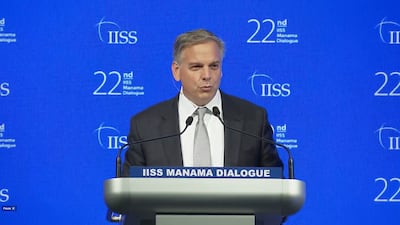

Syria and Lebanon are entering a new phase, with attention shifting to how they can rebuild their futures, said US Assistant Secretary of State for Near Eastern Affairs Donald Blome.
"Both are turning a corner, and the question is no longer whether they can be rebuilt but how and on what foundation," he told a panel at Bahrain's Manama Dialogue on Sunday.
His remarks come as both countries grapple with years of conflict, destruction and economic hardship.

Syria is seeking to attract foreign investment following the lifting of US sanctions, while Lebanon is struggling to recover from its devastating war with Israel, caused by Hezbollah's attacks in support of Hamas after October 7, 2023. Recovery prospects remain clouded by the threat of wider regional conflict.
Mr Blome described President Donald Trump's lifting of US sanctions on Syria as a catalyst for renewed economic interest, saying it had already helped attract investment.
Syria, under President Ahmad Al Shara, has been attempting to attract greater US business interest. In September, a delegation of more than 50 US companies visited Damascus in a bid to rebuild economic ties. The World Bank estimates that reconstruction will cost about $216 billion.
Mr Blome also highlighted trilateral talks between the US and Israel to "dismantle Hezbollah's infrastructure and open a path towards reconstruction and recovery".
The talks have been viewed with both optimism and scepticism. Some officials have described them as fruitful, while others see them as a means of allowing Israel to entrench its occupation of the country's south.
'Bright future'
Conference officials have emphasised the need to diversify regional economies and strengthen connectivity between countries following the disruption caused by the Iran war. This includes addressing the impact on shipping through the Strait of Hormuz, which normally accounts for 20 per cent of global energy trade. Mr Blome pointed to opportunities for trade and investment in the Gulf and Iraq.
"We feel that the future of this region is bright in many ways," he said.
However, he was asked how he could speak of regional economic growth amid rising fears of a return to war, particularly after Mr Trump had repeatedly threatened to resume strikes on Iran and Tehran had warned it would respond on a larger scale to any US attack.
"We have to be talking about it – an alternative vision for this region that for too long has been torn apart by Iran's use of proxies," Mr Blome said.
Despite the recent rhetoric from Washington and Tehran, Mr Blome said channels for diplomacy remained "open and active", without ruling out the prospect of war. The US is ready to go in "another direction" if needed, he added.

