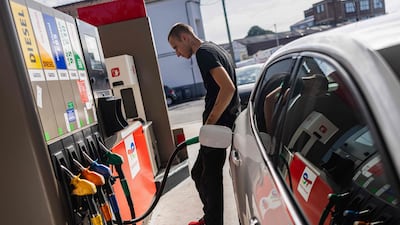

France's deal to buy diesel from Saudi Arabia, the UAE and Bahrain will not make the fuel “cheap overnight” for the European country although it will also not make it more expensive, according to experts.
The three Gulf states are to sell France the equivalent of 10 per cent of its usual diesel consumption in the coming weeks, French government sources said on Tuesday during President Emmanuel Macron's regional tour.
The aim is to reduce European energy prices, which have drawn protests and public anger in France and elsewhere.

The deal “will not make French diesel cheap overnight, but it can stop it [from] becoming scarcer and even more expensive”, said Naeem Aslam, chief investment officer at Zaye Capital Markets.
“The bigger value is psychological: France is no longer buying in a panic,” Mr Aslam added. “Gulf supply gives refiners, distributors and traders confidence that physical barrels are coming, which can compress the scarcity premium before it fully reaches the pump.”
European diesel has reached about $200 a barrel amid the war in Iran and Ukrainian attacks on Russian oil refineries. That compares with about $80 at the start of 2026, with refined products rallying much harder than crude prices this year.
Temporary easing of supply
While the deal can temporarily ease France’s diesel supply shortage, it is unlikely to drive a sustained decline in fuel prices, according to Vijay Valecha, chief investment officer at Century Financial.
“The additional diesel arriving in France would ease competition among importers for limited supplies. This could reduce the scarcity premium that buyers pay for immediately available fuel, particularly if inventories are low,” he added.
France previously obtained guarantees from Saudi Arabia to sell the country 95,000 tonnes of diesel in both October and November, totalling 190,000 tonnes. The UAE and Bahrain are in the coming weeks expected to separately sell 100,000 tonnes of diesel to France for an unknown duration.
The duration of the supply agreements matter – if UAE and Bahrain shipments continue for several months, they could have a longer-lasting effect on supply security and prices, Mr Valecha said.
“If they are temporary or cargoes are delayed, the relief could be short-lived. The wider diesel shortage is a significant driver. The diesel supply squeeze remains severe. The International Energy Agency has warned that shortages could persist well into 2027.”
On October 2, G7 leaders pledged to accelerate the IEA's co-ordinated emergency stock release, prioritising diesel supplies. About 96 million barrels of the 400 million pledged in March have yet to be released.
The IEA expects higher refinery output to return the diesel market to a seasonal surplus by early next year but said the recovery would be insufficient to replenish inventories depleted during the conflicts in the Middle East and Ukraine.
European commercial gasoil inventories fell to a 25-year low in July, while US diesel stocks reached a 14-year seasonal low by September.
Combined gasoil exports from Russia and the Middle East dropped by more than 60 per cent, equivalent to 1.3 million barrels per day.
With Mr Macron’s current Gulf visit, the focus would remain on making fuel more affordable at the petrol station rather than just securing France’s fuel supply security, Mr Valecha said.
“Analysts estimate that a large release of diesel reserves could lower wholesale prices by $20 to $30 per barrel, or about €0.10 to €0.15 per litre, at the pump, with prices possibly dropping within a few days,” he added.
Market signal
The latest deal’s importance “lies in the signal it gives to market”, Norbert Rucker, head of economics and next generation research at Julius Baer, said.
“Despite the recent escalations, oil products find their way out of the Middle East. One should look beyond this specific deal. More supplies from the Middle East ease oil products tightness globally, irrespective if the buyers of single cargoes are in Europe or elsewhere, as this is a global market,” he said.
There is indication that oil product exports from the Middle East are picking up and that refineries in Asia are putting more oil products on the market, he added.
However, according to Mr Valecha, diesel exports are not expected to pick up any time soon from the Middle East in a way that could bring down costs significantly.
“This is because oil product markets are expected to remain tight through mid-2027, even if current war-related disruptions ease. The reason for this being [that] global supply is constrained by an unusually large upswing in refinery maintenance,” he said.
Even when Middle East diesel exports rise again, the price effect will lag the headline, agreed Mr Aslam.
“The constraint is not only production – it is secure shipping, insurance, tanker availability and the ability to move refined products reliably into Europe,” he said.
“The UAE, Saudi Arabia and Bahrain are showing why dependable Gulf suppliers matter: sustained cargoes, rather than one-off emergency shipments, are what would truly pull diesel prices down.”
What next?
Europe could diversify imports to reduce reliance on a single source, with potential deals with the US or Asian suppliers helping to ease the current crunch, according to Mr Valecha.
“Fuel tax cuts and price subsidies may also offer immediate relief, but they are costly and risk sustaining demand when supplies are tight,” he said.
While there have been suggestions that consumers curb demand by shifting to electric vehicles or car pooling, Europe cannot solve a diesel shortage by simply asking consumers to drive less, said Mr Aslam.
“Diesel is the bloodstream of its freight, construction, farming and industry. France and its neighbours need a three-part response: co-ordinated reserve releases, guaranteed supply contracts with reliable producers, and a faster shift of freight toward rail and electrified alternatives,” he said.
“The mistake would be treating this as a temporary oil price spike. It is a refining and logistics security problem.”

