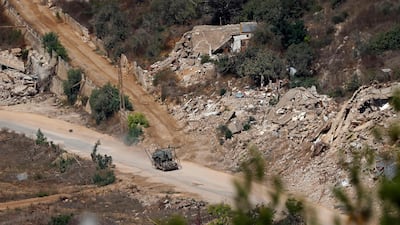
A security vacuum in south Lebanon, a stronghold of the Iran-backed Hezbollah, appears increasingly likely in the coming months as a UN mission prepares to withdraw with no replacement agreed, sources have told The National.
Talks are expected to intensify at the UN General Assembly this week, with France leading diplomatic efforts alongside Italy to increase support for the Lebanese army and contain a deterioration of the security situation in south Lebanon, which is in part occupied by Israel.
But Israel's October 27 elections have hardened its position on appearing to give concessions to Lebanon or its army, which it accuses of lacking the will to disarm Hezbollah. The group's powerful military arsenal and continued support in parts of Lebanon have raised fears of civil war should disarmament be done by force.


"There are few reasons to be optimistic," Karim Bitar, a Middle East expert at Sciences Po Paris, told The National. "One should hope that the proactive position of France, the involvement of the Vatican, and the involvement of Italian diplomacy will end up convincing a few other countries and convincing Israel to accept the presence of international troops in South Lebanon. But I doubt that Israel, unless there is a radical change after the elections, is at this stage ready to accept this."
Three tracks
With the Unifil withdrawing on December 31, three possible scenarios have been under discussion for the past months in Paris, Rome and Brussels. The idea is that they would be implemented simultaneously, but there has so far been limited progress.
The first would be to expand the UN political mission in Beirut, known as Unscol, to take on some of Unifil's responsibilities, including work on the delimitation of the land and maritime borders between Israel and Lebanon, which have never signed a peace agreement. This mission could possibly be accompanied by some residual uniformed UN presence for Blue Line monitoring, liaison and deconfliction, Mr Bitar said.
The second is for an EU mission to advise and train Lebanese armed forces, in the hope that they become strong enough to establish their sovereignty across Lebanese territory, including in Hezbollah strongholds. More than 10 countries expressed interest at a meeting of EU foreign ministers in Ireland earlier this month, including historic Unifil contributors such as Ireland and Spain.

Yet the most important and most difficult talks are focused on Hezbollah's disarmament, which was required after the 2006 Israel-Hezbollah war but did not happen. The movement has since been weakened by Israeli warfare that decimated its leadership, but it continues to reject concessions over its presence and weapons in southern Lebanon.
"Six months on, none of this has really crystallised into a coherent post-Unifil architecture," Mr Bitar said.
A UN diplomat stressed that the peacekeeping force could not simply withdraw without another mechanism taking its place. The diplomat told The National the impression from Washington was that the US was open to individual countries stepping in but did not want any successor force operating under a UN mandate.
Unifil’s departure would also have implications for the Unscol mission, which currently relies on the peacekeeping operation for a range of services, the diplomat said.
Security zone
Israel's latest military action in Lebanon, which started in March against the backdrop of hostilities against Iran, has killed more than 4,300 Lebanese people and led to the destruction of a large number of border towns.
Israel's destruction two weeks ago of two large Hezbollah tunnels beneath the strategically important Ali Al Taher ridge completed the establishment of a security zone in south Lebanon, Israel's Prime Minister Benjamin Netanyahu said.
Israel has created a buffer zone stretching 6km to 10km inside Lebanon by demolishing villages and infrastructure and making the area uninhabitable. Speaking after the destruction of the tunnels, the Hezbollah leader Naim Qassem called for "resistance" to Israel and the "liberation of Palestine".
Lebanese observers fear a long-term Israeli presence similar to the 22-year occupation that ended in 2000.
Functional gap
The best bet to avoid this scenario, European diplomats say, is a rapid disarmament of Hezbollah conducted in parallel to the strengthening of the Lebanese army.
France has led these efforts for the past several years and views Israel's latest escalation as a setback. Speaking in Paris last week during a meeting with President Emmanuel Macron and Jordan's King Abdullah II, the Lebanese President Joseph Aoun called for a "long-term partnership", not "temporary fixes".

At this stage, there is no clear agreement on mandates and the sequencing or division of labour. France and Italy are waiting for an action plan from Beirut to create a support framework that is accepted by the US, which largely backs Israel's positions on increasing pressure on Lebanon.
This will be a delicate balancing act, as Europeans fear that too much pressure will cause a historically weak Lebanese state to collapse entirely. As of now, the Lebanese leadership appears not to have formulated a clear request of what it wants from the new mechanism.
"The French-Italian idea is not a mission that would itself try to disarm Hezbollah," Mr Bitar said. "It would be an ad hoc international mechanism supporting the Lebanese army, and potentially helping to verify implementation, including both the army’s disarmament efforts and the corresponding Israeli withdrawal."
The central issues remain interlinked, Mr Bitar said: Israeli refusal to withdraw, difficulties in the deployment of the Lebanese army, the disarmament of Hezbollah stalled and remaining questions surrounding an international verification mechanism.
"I would not necessarily predict a complete security vacuum on January 1, since Unifil will still be in the process of drawing down. But there could certainly be a serious functional gap if no successor monitoring and support arrangements are operational by then," Mr Bitar said.

