


If war is the continuation of politics by other means and every conflict is a symptom of a deeper unresolved contradiction, the violence of the past year – as well as the current direct confrontation between Israel and Iran – are the result of two deep and unresolved political problems.
These are the denial of Palestinians’ basic rights amid long-term Israeli occupation and Iran’s rejection of the basic rules of international law, as well as its insistence on maintaining a string of militias in broken Arab states from Lebanon to Yemen.
A Middle East in which a secure Palestine and Israel live side by side, embedded in a harmonious Arab and Muslim world, as well as an Iran that has pivoted away from its interventionist foreign policy to focus on the security and welfare of its own people, is a Middle East that would be on the road to true stability and prosperity.
Is this a pipe dream, or does every crisis indeed create an opportunity? Are these goals too big to pursue, or the only ones worth pursuing? Can leaders pursue such large visions? I believe they can and many in the region have done so before. Indeed, what the region needs is a Vision 2030 for the Middle East. Below are two key elements of a bold way forward.
A two-state solution to the Palestinian-Israeli conflict was largely dead before October 7, and had only minority support in Israel. After October 7, Israeli public opinion has dramatically hardened against it. At the same time, the devastation of the past year has brought the Palestinian issue back to the forefront of regional public opinion; Saudi Arabia’s Foreign Minister Prince Faisal bin Farhan recently made clear that the kingdom would not proceed with normalisation without a resolution to it.
Although Israel has been scoring battlefield victories – at great human cost – against Hamas, Hezbollah and Iran, it also does not have a rational or sustainable plan for the day after in Gaza and the West Bank, other than reinforced occupation and oppression. But this is not a secure and successful plan for Israel in the 21st century, let alone for Palestinians who will not leave their ancestral lands.
Israel can use its reinforced military superiority to re-establish and intensify the unsustainable conditions of the status quo, or it can forge a new way from a position of confidence and regional partnership in which the Palestinians are offered a political path forward rather than the destructive options of repression or extremism.
Such a pathway will not come from Washington or other global capitals – it must be built in this region. It requires regional engagement with Israeli figures of all stripes to emphasise the alternative future that lies before us, and engagement with Palestinians to find a route to rebuilding political legitimacy and institutions. This is critical to building the framework for a Palestinian state, one that is not penetrated by Iranian or other armed non-state actors outside legitimate Palestinian institutions.
Up until three weeks ago, Iran was doing well. One of its minor proxies, Hamas, had dealt Israel the most crushing blow in its recent history, and Hezbollah – its main ally – was holding Israel to a prolonged retaliatory war across the Lebanese-Israeli border. But since September 17, Israel has dealt a staggering blow to Hezbollah, robbing Iran of its main proxy deterrent; Israel is now taking the war directly to Tehran.
Since the end of the Iran-Iraq War in 1988, Tehran has fought its battles far away from its borders through proxy wars in Arab lands. With Israel’s blow against Hezbollah, and the rage in Israel since October 7, that strategy is failing. There are two pathways ahead: either the war between Israel and Iran escalates out of hand to engulf both countries or the crisis creates an opportunity for political exits that would avoid further escalation and put the region on a sounder footing.
-

Israel's missile-defence systems intercept rockets above the city of Ashkelon. Reuters -
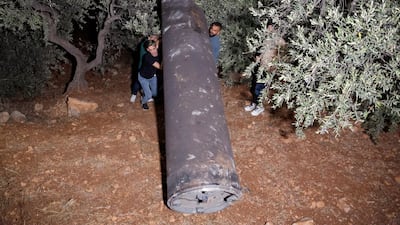
Palestinians investigate a missile shell in Tubas, in the West Bank. Reuters -
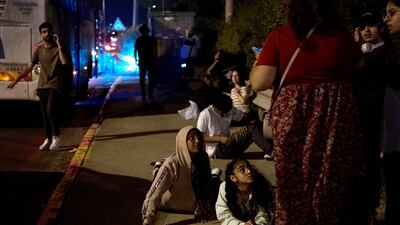
Israelis wait to reboard their bus after missiles launched from Iran were intercepted in the skies over Rosh Haayin. AP -

A resident shows the Tzofar incoming rocket alert app on their phone in Tel Aviv. Getty Images -

A man takes cover behind a car in Tel Aviv. AFP -
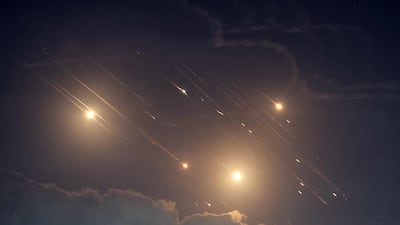
Missiles are intercepted near the city of Baqa Al Gharbiya in northern Israel. AFP -
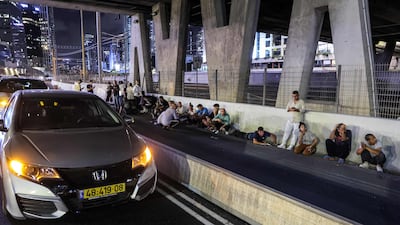
People take cover under a bridge in Tel Aviv. AFP -

People take shelter during the air raid alert in central Israel. Reuters -

Missiles are intercepted over Tel Aviv. AFP -
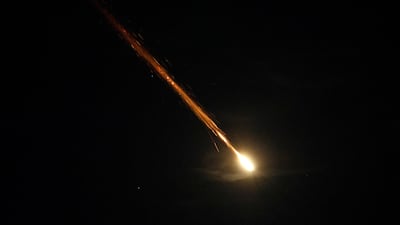
A rocket flies in the sky above Ashkelon. Reuters -
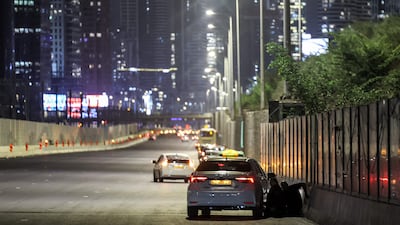
People take cover behind a car in Tel Aviv. AFP -

Missiles are intercepted above Tel Aviv. AFP


Iran has no interest in an all-out war with Israel, especially one in which US forces are already deployed to play a strong supportive role. It has already largely lost both Hamas and Hezbollah as effective deterrents against Israel. President Masoud Pezeshkian and supreme leader Ayatollah Ali Khamenei are aware of young Iranians’ sentiment and their need for a positive future.
As with Israel, there is scope for continued regional engagement with Tehran to show that Iran has a secure and prosperous future in the Middle East, but that maintaining its policies of permanently violating the sovereignty of Arab states and open-ended hostility to Israel and the US – with or without a two-state solution – is neither working nor sustainable.
Big conflicts require big solutions and big solutions require long-term vision and commitment. Israel and the region will not know long-term security and prosperity without according the Palestinian people their rights. Iran will not know security and prosperity without respecting the rights of Arab states and international law. Nor will it build a future for its people with the dreams of ideological or imperial fanatics. The region has thought big before; now is the moment to do so again.
Live updates: Follow the latest on Israel-Gaza

