


The departure of US forces from a key base in Syria marks an important moment for the Pentagon as it looks to Damascus and Baghdad to take the lead on fighting against ISIS.
US troops left the remote Al Tanf base in the Syrian desert on Wednesday, more than a decade after it was established, and were replaced by Syrian army units – a move that would have been unthinkable until former president Bashar Al Assad's regime was toppled in December 2024 and replaced by a government led by President Ahmad Al Shara.
The handover came days after members of the Global Coalition to Defeat ISIS met in Riyadh to discuss the future of the mission. Coalition officials praised Iraq and Syria for their efforts to protect their territories against a possible resurgence of ISIS.
Retired Gen Joseph Votel, distinguished military fellow at the Middle East Institute and former head of US Central Command, said he viewed Iraq and Syria's expanding roles as the natural progression of a mission born amid the chaos of ISIS advances in 2014.
"In many respects, this was always what we wanted to have: local partners controlling the fight, taking responsibility for their own sovereignty, for their own operations against [ISIS], with some assistance from the US and from the coalition," he told The National. "I see this as the kind of natural maturing of the campaign."
The Defeat-ISIS, or D-ISIS, mission was formed after the group seized large areas of Iraq and Syria. Until it was toppled in 2017, ISIS ruled using its own extreme version of Islam, committing atrocities against minority ethnic and religious groups, destroying cultural heritage sites and carrying out terrorist attacks abroad.
With the US attempting to redefine its relationship with the Middle East, questions remain as to how Washington's role in the D-ISIS mission will evolve.
Syria and Iraq step up
Baghdad and Mr Al Shara's government in Damascus appear to be taking on bigger roles in the D-ISIS mission.
A recent UN report estimated that ISIS maintains about 3,000 fighters across the broader Syria-Iraq region, most of them in Syria.
Iraq has agreed to take in thousands of ISIS prisoners from detention centres and camps in Syria, and has begun the arduous task of processing those people.

Damascus, meanwhile, is now integrating the Kurdish-led Syrian Democratic Forces into its ranks, after clashes with the formerly US-backed group that conducted the lion's share of anti-ISIS fighting in the country.
Many Syria observers are concerned about a possible resurgence of ISIS amid tension between the SDF and Damascus. But Gen Votel, who led Centcom from 2016 to 2019, expressed confidence that Syria can control the extremists. He travelled to the country in November and met members of the government.
"We were pretty impressed with their focus on solving the internal problems of Syria and the seriousness with which they assess the situation [with ISIS]," he said. "So, from my perspective, that was positive. That gave us an indication that we were dealing with serious people here – certainly much more than the Assad regime."
During Mr Al Shara's visit to Washington in November, the Syrian government announced it had become the 90th member of the anti-ISIS coalition.
Devorah Margolin, senior fellow at the Washington Institute, said the Iraqi government was facing a daunting task in taking in thousands of ISIS detainees, but also expressed optimism.

"It seems [in the media] like this was an overnight decision by the Iraqis – it wasn't," she told The National. "The Iraqi government for a while, really since last year with the fall of the Assad regime, has been creating contingency plans for what happens with these individuals."
She said that while it was unlikely to be a perfect process, there was a system in place for dealing with the detainees. "Their judges have been trained by some of the best international judges on these issues," Ms Margolin said. "But it's not their burden to carry alone."
US steps back
How the US role in the D-ISIS mission will change is unclear. President Donald Trump has long wanted to take US troops out of Syria, bemoaning their presence there since his first term in office.
He has enacted sweeping foreign aid cuts and severed ties to several multilateral organisations, raising concerns he might want to abandon the anti-ISIS coalition.
In addition to beginning to pull its remaining troops out of Syria, the US is in the final stages of a full withdrawal from Iraq. The White House has said the regional focus is shifting from a military and security stance to one of investment and economic opportunity.
Still, Gen Votel believes the Trump administration will continue to "take a very deliberate look" at the ISIS situation and support the campaign in other ways.
After a suicide bombing in Palmyra in December, the US began a series of strikes on the group's positions in Syria. Centcom on Thursday said more than 50 ISIS fighters were killed or captured over the course of two months of operations.
"One of the things we have seen with this administration is their continued focus on going after some of these ISIS leaders and fighters," Gen Votel said. "We've seen a series of strikes over the last several months here that are not as frequent as they perhaps once were, but they're nonetheless deliberate and focused on ISIS leadership."
He added it was important to "not forget about those who helped us when we were waging this campaign", and expressed hope the US would continue to share intelligence, provide training and – in situations where Washington's interests are at risk – assist in counter-terrorism operations.
With the closure of USAID and other foreign aid cuts, the future role of the US at ISIS detention camps is unclear. The US funded the building and staffing of detention camps in Syria, as well as repairs and some repatriation efforts in Iraq.
The detention sites started out as displacement camps housing Syrians and Iraqis on the run from ISIS. Now, they hold a mix of displaced people, former ISIS fighters from Syria and Iraq, and citizens of other countries, including fighters and family members of militants.
"It looks like the US is still financially carrying the detention facility burden, but it could be by moving it to Iraq that other countries will be willing to carry on that financial burden as well," Ms Margolin said.
The question of repatriating inmates, continuing to hold them or putting them on trial is an ongoing issue. "The Syrians themselves have made it very clear that they would like to close the detention camps," Ms Margolin said. "Just because you move or close detention sites doesn't mean the problem goes away. But how that problem is handled and by who is also going to evolve again."
She emphasised that all groups need to be handled "with nuance and understanding" over how they ended up in the camps, how they might be aligned and how complicit they were in the atrocities carried out by ISIS. Misinformation over all detainees being victims or all hardliners complicates matters. "The truth is somewhere in between," she added.
She highlighted that efforts were being made to reintegrate ISIS families and fight against ISIS propaganda, but that funding cuts threatened those endeavours.
Ongoing threat
As the US role evolves, Gen Votel warned against taking "our eye off the ball" with regard to terrorism. "We always have to be concerned about organisations like ISIS and Al Qaeda. These are incredibly adaptable, long-term organisations," he added.
-

Empty cells at Al Shaddadi prison after inmates, mostly ISIS members, fled following the withdrawal of the Syrian Democratic Forces, whose fighters had guarded the prison for years. Reuters -

The SDF says prisoners escaped as its fighters fled Syrian government attacks, in Hasakah. Reuters -

The Syrian army says it has taken control of the city and re-arrested dozens of the 120 ISIS members who escaped from the prison. EPA -

An open gate at the prison after inmates escaped. Reuters -
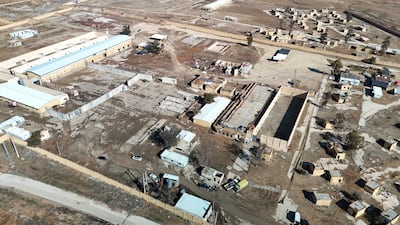
Some witnesses claim local tribes released the prisoners and insisted they had been wrongfully accused of being members of ISIS. EPA -
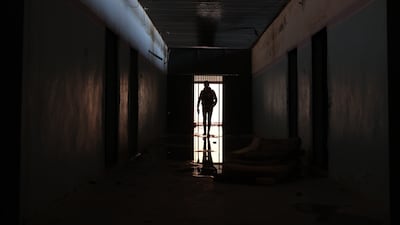
Others say the SDF freed the detainees and that it was the only force able to access the highly-secured facility. EPA -
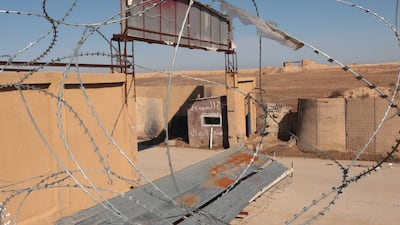
Barbed wire at the prison. Some of those released gathered in the town’s mosque, where their relatives met them, residents say. EPA -
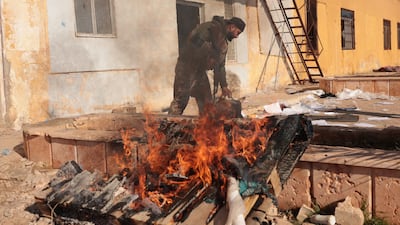
A soldier stands inside the prison, after government troops took it over. EPA -

Clothes and other belongings left by inmates as they fled. Reuters -
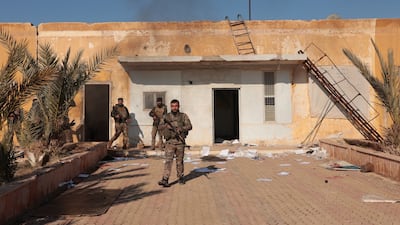
Soldiers stand guard inside the prison complex after the government takeover. EPA


"Terrorism is always changing and it only has to be successful one time to have an impact on our policymaking and on the psyche of the American public."
Ms Margolin pointed out that, since the collapse of the ISIS caliphate, the group has not given up its territorial ambitions. She said its ability to recruit in Syria has declined owing to the trauma experienced by the country's diverse ethnic and religious population - but Iraq is a different story.
"In Iraq, where it is a little bit more in past memory ... there is almost a romanticisation of the Islamic State again, which is very, very terrifying to think about," she said.
The biggest threat may no longer be in the Middle East. ISIS-Khorasan Province in Afghanistan has carried out attacks against the rival ruling Taliban, while more than half of global terrorism deaths have occurred in the Sahel region, where ISIS offshoots have attacked government forces and civilians. The US carried out strikes on ISIS targets in Nigeria in December.
"We see the soldiers on the ground in the Middle East, but really a lot of the other efforts – counter-financing, strategic communications and other efforts put on by the D-ISIS coalition – the majority of D-ISIS members are focusing their attention outside the Middle East right now," Ms Margolin explained.

