


For the UAE, the UN’s 80th high-level debate is not just another annual gathering, but an opportunity to revive multilateralism as the world faces several pressing challenges.
Mohamed Abushahab, the UAE's Permanent Representative to the UN, told The National that it is “a very important moment”, as the world body confronts mounting global discord and a cash crunch.
Sheikh Abdullah bin Zayed, Deputy Prime Minister and Minister of Foreign Affairs, will lead the UAE delegation.

“As we look to the next eight decades, the work ahead will require a UN that is more resilient, efficient, and effective – one that leads collective action, unites global efforts, and transforms today’s challenges into opportunities for a better world for generations to come,” Sheikh Abdullah said in a statement on Sunday.
The UAE plans to work with partners on its priorities at the upcoming gathering: artificial intelligence, tolerance, peace and security, gender equality, and preparations for the 2026 UN Water Conference.
Mr Abushahab cited the UAE’s tenure on the UN Security Council, when it shepherded in 2023 a unanimously adopted resolution that recognised, for the first time, a direct link between the role of hate speech, racism, extremism and other forms of intolerance in fuelling conflict.
Jointly drafted by the UAE and UK, the resolution highlighted the adverse effects of gender discrimination and acts of extremism on global peace and stability.
“It was historic in that it advocated for prevention, for tolerance, pluralism, diversity and peaceful coexistence as ways to build resilience in societies,” he said. “It’s a way of making our youth less susceptible to being radicalised and falling prey to efforts that aim to divide societies and polarise communities and bring instability to many countries”.
But Mr Abushahab said that while new technologies can play a positive role, they also risk undermining those gains.
“Generative AI has supercharged the risks by spreading hate and disinformation online,” he said. “There’s much more need now for the international community to look at how to counter those threats and to use the same tools that are being abused to instead promote tolerance, and peaceful coexistence.”
Leaders arrive ahead of UNGA's General Debate - in pictures
-
Syria's President Ahmad Al Shara lands in New York for the UN General Assembly – the first Syrian president to attend since 1967, a gap of 58 years. Sana -
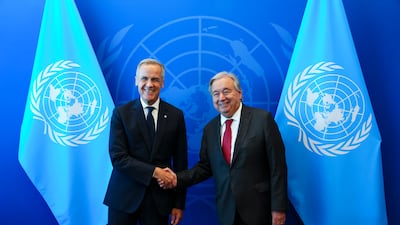
Canada's Prime Minister Mark Carney, left, meets UN Secretary General Antonio Guterres in the secretariat building at the UN headquarters. AP -
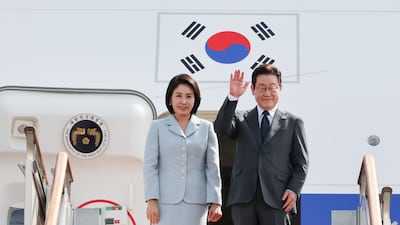
South Korean President Lee Jae Myung and his wife Kim Hea Kyung at Seoul Air Base in Seongnam, South Korea, before heading to New York to attend the UN General Assembly. EPA -

President Recep Tayyip Erdogan of Turkey arrives. AP -
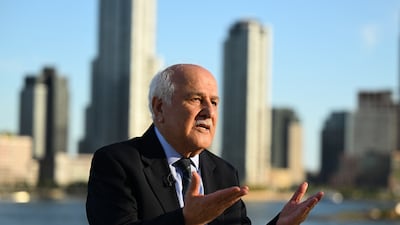
Riyad Mansour, the Palestinian ambassador to the UN, speaks during a TV interview at the UN headquarters. EPA -

Police block a street near the UN headquarters. AP -
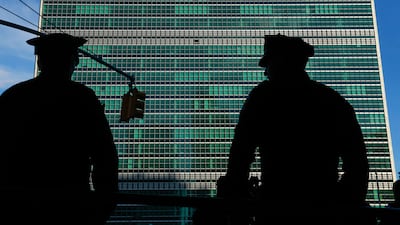
Police patrol outside the UN headquarters, before the UN General Assembly, in New York. AFP -

US Secret Service personnel outside the UN headquarters. AFP -
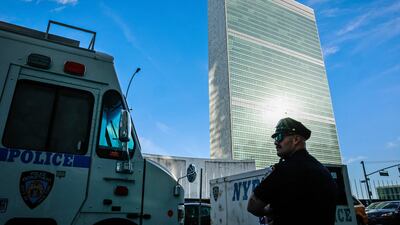
Police patrol outside the UN headquarters. AFP -

Police block a street near the UN headquarters. AP


International collaboration on water challenges will also be central to the Emirates' message, as the UAE is preparing to host, alongside Senegal, the 2026 UN Water Conference, scheduled for December of that year.
The conference, designed to speed progress towards the UN’s Sustainable Development Goal on clean water and sanitation, comes amid growing global stress on water resources.
One quarter of the world’s population lacks access to safe drinking water and half to basic sanitation, according to UN data. The World Meteorological Organisation says 3.6 billion people already face water shortages at least one month each year – a number forecast to rise to five billion by 2050.
“We will be working to ensure the water conference delivers in an inclusive and action-orientated way,” Mr Abushahab said.
Palestinian-Israeli conflict
He pointed to the September 22 high-level conference on the two-state solution to the Palestinian-Israeli conflict as a significant moment at this year's UNGA.
“It is an important step to reaffirm the international community’s commitment to an independent, sovereign Palestinian state living side by side in peace and security with Israel,” he said.
On Gaza, Mr Abushahab said “it’s critical … for the assault on the Palestinian people, for the starvation, and relentless military campaign by Israel to end”, adding that the UAE has been calling for a ceasefire “from day one”.
He warned that any attempt by Israel to annex Palestinian territory represents “a red line”. Israel's government has, in recent weeks, threatened to annex parts of the occupied West Bank and legalise Israeli settlements.

Mr Abushahab added that escalatory actions, including attacks against Qatar, threaten wider regional stability. Israel launched a strike on Hamas officials meeting in Doha last week, which the UAE immediately condemned.
“The UAE put very clear public messaging to Israel and its people that some of these steps are compromising the vision that we have for the region,” Mr Abushahab said.
UN reforms
For the UAE, reform efforts must prioritise strengthening the UN’s role in conflict resolution and in upholding international law and the principles of the UN Charter.
“We see it as a really an opportunity not to be squandered, because we do see that the UN has the potential to be a lot more effective, efficient, and fit for purpose to current global challenges,” he said.
“It was set up for a different time, and the challenges of today are very different than those from 80 years ago.”
He added that he hoped member states will “engage constructively and very actively” on the UN reform initiative.

