


Abdalla Hamdok, former prime minister of Sudan, has called for urgent action in the country, where more than 25 million face famine and hunger, nearly 10 million are internally displaced and there is “suffering beyond imagination”.
In an exclusive interview with The National, Mr Hamdok, chairman of the Co-ordination of Civilian Democratic Forces (Taqaddum), warned that “people could die from hunger and starvation more than from bullets”.
He also spoke about “so many battles all over the country” as the army and the paramilitary Rapid Support Forces wage war. He stressed that the fighting in El Fasher, the capital of North Darfur that has been under siege for weeks, represents a “catastrophe beyond imagination”, but he added that El Fasher cannot be seen in isolation from the rest of the country.
Mr Hamdok was in Oslo recently as part of discussions to mediate an end to the war in Sudan, where he spoke to The National about the need for a political solution in the country. He explained that “the Sudan crisis of today is not new; the first war in Sudan started in 1955, just before independence, and it continued in protracted wars”.
“Two million people died in the civil war, the genocide in Darfur [killed] over 300,000, according to estimates of the UN, many [died] in the Nuba Mountains and South Kordofan, to the point where nobody knows even how many died in that war," he said. However, he believes the difference with the current conflict is that “it started in the centre and quickly engulfed the entire country”.
Mr Hamdok served as prime minister between 2019 and the end of 2021, taking office shortly after long-time president Omar Al Bashir was removed by the Sudanese armed forces (SAF) amid protests, and had been keen to see a civilian leadership take hold. He is adamant the current government in Sudan, led by Gen Abdel Fattah Al Burhan is not a legitimate one.
On October 25, 2021, Gen Al Burhan, who leads the armed forces, broke with a civilian-military coalition charged with transitioning Sudan to full civilian rule. Mr Hamdok described the move as a “coup” and went on to say that “there is no military path to victory by either side, whether it is SAF or RSF. And it is extremely important for this to be concluded through political dialogue that will address the root causes of the war: issues of marginalisation, underdevelopment and fixing the ills of the country which lasted for close to 70 years”.
The former prime minister spoke of the “paradox” of Sudan not having a permanent constitution since 1956. “We are ruled with temporary constitutions … close to 60 years of military rule messed up the country and we want to put an end to this ... we'd like to see this war as the last one.”
However, with the armed forces and RSF waging war, with arms and external support fuelling the conflict, an end to the violence in incredibly difficult to get to. Mr Hamdok explained that “the only assured way of putting pressure [on the generals], besides the leverage that can be exercised on them by neighbours and by the international community, is by the Sudanese people themselves”. Mr Hamdok, with a coalition of civilian leaders, is calling for the “widest possible front against the war ... if [it] managed to unite the civilian landscape and political space, civil society, people in all walks of life and affiliations against the war, the moment both sides realise that there is no hiding place, and enough is enough, let us cut our losses and stop this war today”.
-
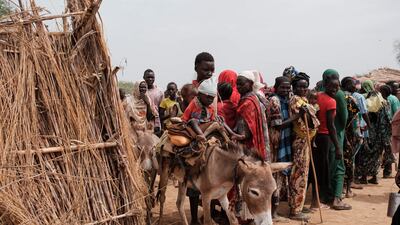
Malnourished Sudanese children are carried by a donkey through a camp in North Kordofan state for people displaced by the war raging across the country. All photos: AFP -
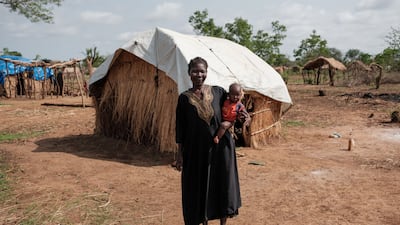
The conflict has displaced more than 10 million people within Sudan, the International Organisation for Migration says. -
The UN estimates that five million Sudanese are suffering from extreme hunger, with countries hosting refugees from the war also facing a lack of food. -
The US has warned hunger in Sudan could reach levels last seen in Ethiopia in the 1980s, when famine killed 1.2 million. -
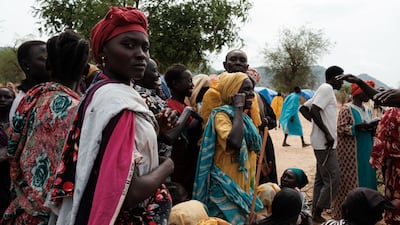
People wait to receive food cards a camp for internally displaced people in North Kordofan. Sudan's military and the paramilitary Rapid Support Forces have been fighting since April last year. -
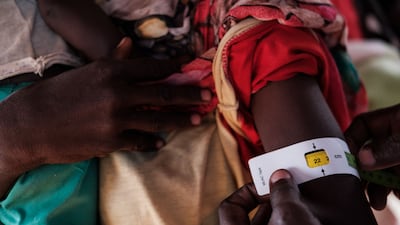
The UN refugee agency has called for humanitarian access to Sudan to be increased, as the threat of famine looms. -
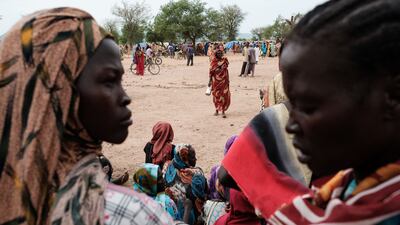
The UN has warned Sudan faces the world's worst displacement crisis, with little progress in efforts to secure a ceasefire. -
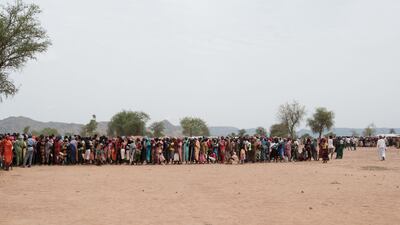
People queue to register for a potential food aid delivery in North Kordofan. Doctors Without Borders says there are 'extreme levels of suffering' across Sudan. -
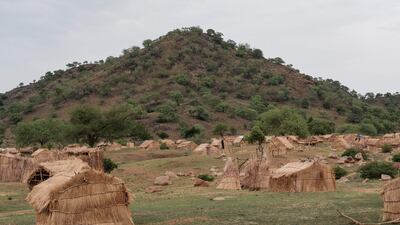
Huts to provide shelter for displaced people in Rabang. The war has killed tens of thousands in Sudan. -
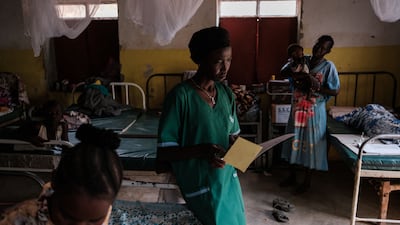
More than 7.2 million have fled their homes since the war broke out between the military and the RSF, International Organisation for Migration says. -
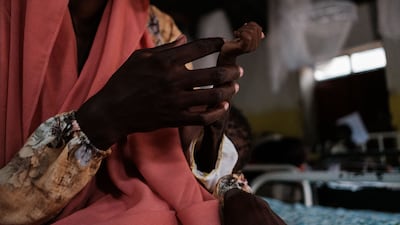
The US recently pledged $315 million in aid to Sudan and warned the country faces a historic famine. -

A woman braids her sister's hair in the Rabang displacement camp. -
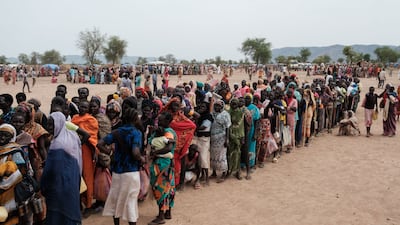
The US is among the countries to push to restart ceasefire talks. -
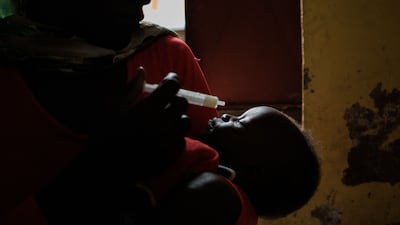
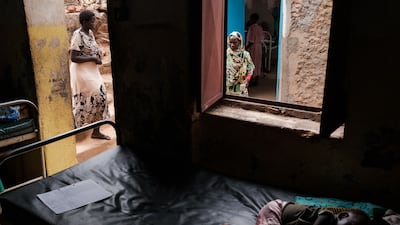
A child is fed at the malnutrition ward of a hospital in the Nuba Mountains. Sudan is facing the world's worst humanitarian crisis in decades, Doctors Without Borders has warned. -
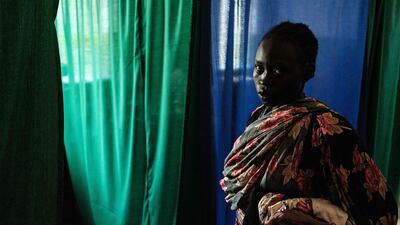
Global agencies have warned millions are on the brink of starvation in Sudan. -
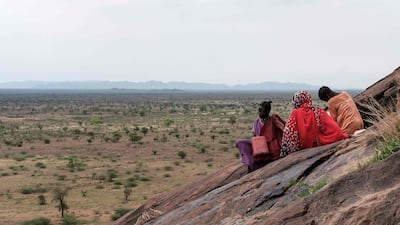
Girls collect water from a hill after heavy rain near the Rabang displacement camp. -

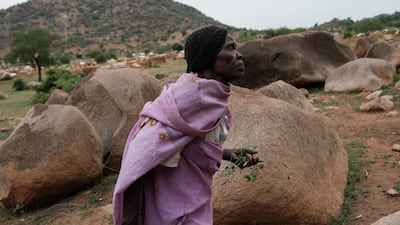
The family of a bride celebrate in the Nuba Mountains as they prepare to deliver a dowry of porridge and a fermented beverage known as merisa. -
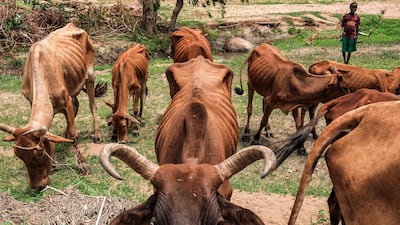
Sudan's worsening hunger crisis has also affected livestock. -
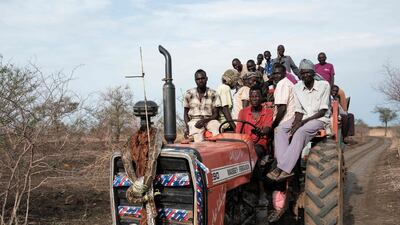
People take the body of a large snake to the Rabang camp. International agencies have issued dire warnings about the threat of famine in Sudan. -
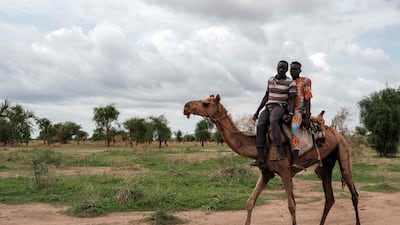
Men ride a camel in South Kordofan state. UN High Commissioner for Refugees Filippo Grandi says more food and aid is needed to help people 'that otherwise risk starvation'.


Mr Hamdok says he is working to create this front under the banner of Taqaddum, a coalition formed in October 2023 to create pressure on the warring parties and develop civilian governance structure.
The first meeting was held in Addis Ababa and was followed by an “establishment conference” last month involving 600 participants. “We were pleasantly surprised ... the majority came from grassroots organisations” and it led to the establishment of a “non-partisan taskforce” to continue working.
He aims to galvanise internal Sudanese communities and those in the diaspora, in addition to mobilising regional and global public opinion, against the war. “When we fought the dictator of Al Bashir for 30 years, the diaspora played an important role … there was a huge and rich solidarity campaign across the globe and we want to rekindle and bring that spirit back”. He stressed that Taqaddum is born out of a belief that “if we are not united, we are not going to get anywhere”.
While seeking to be the “largest alliance possible of political forces”, Mr Hamdok adds “we also do not claim that we are the only force in town, we are appealing to others and accepting them with open arms”. Some of those who attended the conference were armed groups such as the Sudan People’s Liberation Movement-North, led by Abdelaziz Al Hilou, which led to criticism from some civilian groups.
“It was the climax of the meeting, because SPLM-North is an armed group that has never worked directly on politics," Mr Hamdok said, in response to the criticism. "Their presence in the meeting actually gave them an opportunity to be able to link to other groups, to talk to people whom they would never have been able to even shake hands with ... that assisted in having an environment where a lot of ice melted because of just the meeting and shaking hands and ability also to engage and discuss differences and also discuss the different issues religion, state, citizenship issues of marginalisation because of whether it is ethnicity, race, culture, everything.”
He said his door is open to anyone willing to work for a political solution in the country. “We don’t want to put conditions, but we are saying anyone who agrees to a democratic dispensation, to civilian rule, and is against the war, is welcome.”
Mr Hamdok has also been criticised for meeting the head of the RSF, Gen Mohamed Dagalo, in Addis Ababa in January, especially as the RSF face allegations of war crimes, as are SAF. Mr Hamdok responded to the controversy around the meeting by explaining that he and Taqaddum leaders wrote to Gen Al Burhan and Gen Daglo last December to request a meeting.
“Hemedti [Gen Dagalo] responded, we met him early this year and we signed with him the Addis Declaration, which is a fantastic document, on how to stop the war, on the protection of civilians, and it has very broad principles of preserving the unity of the country, one army and all issues”.
But Gen Al Burhan did not respond to the invitation for talks. “In fact, when the meeting [with Gen Dagalo] concluded, Al Burhan contacted me saying, how can you meet with the rebels? I told him we wrote to you and we're happy to meet you any time soon," Mr Hamdok said. That meeting has not happened, in part because Gen Al Burhan has insisted on meeting in Port Sudan, but Mr Hamdok has refused, explaining: “Port Sudan is in a far corner of the country, if you were operating from the State House in Khartoum, I would come to see you tomorrow”.
Mr Hamdok’s preference is to meet outside Sudan, on neutral ground.
His message to Gen Al Burhan is: “Let us cut our losses. And let us stop the suffering of our people. You are a de facto government today, although not recognised by many people because of the coup, not only the war, and Sudan is still suspended by the African Union.” Mr Hamdok stressed that “the African Union suspends any country that has a government that has come to power in an unconstitutional takeover. And what Al Burhan did in 2021 was an unconstitutional takeover of power. And that's why they're suspended from the African Union … and from that time onwards, there is no legitimate government, with all its complications”.
As for the role of the Muslim Brotherhood in Sudan, Mr Hamdok said the group “ruled the country for over 30 years; they were well entrenched in the state institutions, but more so in the security apparatus, the army, police and intelligence”. His criticism of the Muslim Brotherhood was clear as he said: “You cannot talk about a democratic dispensation when one party controls the [security] sector, it is the recipe for disaster.”
In his eyes, a viable solution would be “to restructure this institution and dismantle the one-party state, in the interest of a nation-state”. Mr Hamdok is advocating a re-establishment of state institutions based on a national constitution. He explained that after the removal of Al Bashir, there was an effort to eliminate Islamist control of the state, in addition to recovering stolen assets “and that is probably one of the reasons why they fought and plotted the coup, because there was a check on their power whether in the military or economy”.
Sudan has suffered from external interference by powers near and far. Mr Hamdok stressed that “our interests as Sudanese can only be served by the region and the international community working towards stopping any intervention in our internal affairs” and added that “we do not want to see our country as a ground for proxy wars … we have no interest in fighting wars of others”.
Mr Hamdok called on regional and international powers “to help us create an environment for the civilian political process to address this, anything beyond this is counterproductive, it will not resolve the war”. He added that “no amount of weapons supplied by any side will help them win ... there is no victory. The biggest question is what is victory on the corpse of your own people; this is senseless”.
Asked about foreign interference in Sudan, Mr Hamdok said “the new element in the Sudanese conflict is the Iranian factor, the Houthis are supported by them and the proximity from the Red Sea to Port Sudan” is playing a role. Iran had strong ties with Al Bashir. Mr Hamdok said Iran’s involvement in Sudan stopped “for a while” after Al Bashir was toppled, but “they have re-established that relationship with the war”.
He went on to say that, with Iranian influence in the east of the Red Sea through the Houthi rebels in Yemen, “I guess they wanted to establish a base in the west. This is part of their strategy in the entire region. They have affiliates all over, from Iraq to Syria and Hezbollah, all this seems like a circle. So I guess that probably is the motive for them to be present in Sudan, and maybe an entry point to the continent”.
Saudi Arabia and the US mediated talks in Jeddah in an effort to bring an end to the war in Sudan. "We were very hopeful, they started on the right track but very quickly they stopped and we are not getting anywhere," Mr Hamdok said. “One of the things probably which was not perceived right from the beginning was the issue of the structure of it. There were all good intentions by Saudi Arabia in the US, but it could have achieved better results if it was expanded a little bit by having, for instance, Egypt and the UAE present, which happened when they went to Manama.”
He went on to say that “for Jeddah to succeed, we need to revisit the actors, you need to have people who could have leverage on both sides”.
Mr Hamdok dismissed reports about the UAE having a nefarious role in Sudan, amid allegations of its support for the RSF. Responding to a question about the UAE’s role, he said “the UAE has always been supportive of Sudan, and there is a lot of links and ties in the history”. Mr Hamdok spoke at length of how the Sudanese community has grown in the UAE and sees the country as a “force for good in Sudan”. He added: “We look forward to not only the UAE but Saudi Arabia, Qatar, Kuwait, to help us rebuild Sudan when this war stops”.
He remarked that “the world has changed” and the only way to develop in the future will be for “productive investment, which creates a win-win situation for both sides”.
Mr Hamdok stressed the importance of countries paying attention to Sudan and working to end the war. He lauded the International Humanitarian meeting that took place in Paris last April organised by France, Germany and the EU. He said the meeting “came at the right time, as we Sudanese felt that our cause was neglected by the world ... it was an excellent meeting”.
A number of states and organisations, including the African Union, League of Arab States, IGAD, Saudi Arabia, UAE, Egypt, US, Kenya, Norway and others committed to a ‘declaration of principles’ calling for an end to the war and urging “all foreign actors to cease providing armed support or materiel to the warring parties and to refrain from undertaking any action which would heighten tensions and fuel the conflict”.

