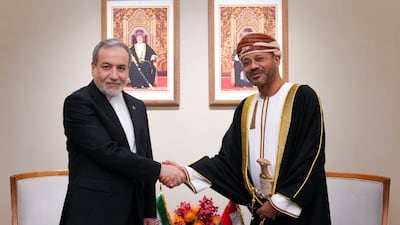

Iranian Foreign Minister Abbas Araghchi met his Omani counterpart Badr Al Busaidi in Muscat on Tuesday for talks focused on regional tension, maritime security and efforts to revive diplomatic channels, Oman's Foreign Ministry said in a statement.
Meanwhile, Bahrain said it had intercepted Iranian attacks after Tehran's Islamic Revolutionary Guard Corps claimed to have attacked a US military radar system at the kingdom's Sheikh Isa Air Base with drones.
The meeting in Muscat comes as shipping through the Strait of Hormuz remains disrupted amid escalating tension between Tehran and Washington and increasing attacks on commercial vessels.

The two ministers discussed ways to revive dialogue and negotiations to prevent further escalation and limit the repercussions of the crisis, the statement said.
They also stressed the importance of protecting maritime routes and ensuring the uninterrupted flow of international shipping and trade, as well as maintaining channels of political and diplomatic communication.
"These efforts aim to expand areas of mutual understanding among the concerned parties and prevent the widening of the crisis and its repercussions," the ministry said.
The discussions come against the backdrop of growing security concerns in the strait, through which about a fifth of global energy supplies passed before the conflict erupted following US and Israeli strikes on Iran on February 28.
Attacks on tankers and restrictions on maritime traffic have threatened energy supplies and disrupted international trade, with Washington maintaining a naval blockade on Iran as Tehran continues to disrupt shipping through the waterway.
A tanker was attacked off the coast of Oman while transiting the strait overnight, the UK Maritime Trade Operations agency said.
A third party reported that the attack disabled the vessel and caused an engine-room fire, UKMTO said on X. The crew are unaccounted for, while the extent of the damage and any environmental effects were not known. The statement did not identify the vessel, the attacker or the weapon used.
The IRGC Navy claimed, meanwhile, that two vessels – a supertanker carrying more than two million barrels of crude oil and a liquefied gas carrier – struck naval mines in the strait, causing huge explosions and fires.
Oman, which shares control of the strait's southern coastline with Iran, has played a diplomatic role in efforts to de-escalate tensions and enable negotiations between the parties.
Tehran and Muscat have also maintained consultations on maritime navigation through the strait, with the two sides previously discussing arrangements to restore the passage of vessels.
The visit follows Mr Araghchi's participation in the 30th meeting of the Economic Co-operation Organisation's Council of Ministers in Islamabad, where regional connectivity, trade and economic integration were among the issues discussed. Mr Araghchi also met several Pakistani representatives, including Foreign Minister Ishaq Dar and the country's army chief, Field Marshal Asim Munir.
Pakistan said it was awaiting a US response to the latest proposals by Iran to end the nine-month regional war. Mr Dar, who is also Pakistan's Deputy Prime Minister, said the latest US response was delayed but that "we have not given up hope or efforts. We are still doing our best".
Rising hostilities
The IRGC said the attack on Bahrain – home to the US Navy's Fifth Fleet – was in response to what they described as continued violations of Iranian airspace by US military drones. Earlier on Tuesday, Bahrain warned of an unspecified threat and urged citizens and residents to head to the nearest safe location.
On Sunday, Bahrain said its air defences had intercepted several Iranian attacks. Tehran said it had launched six drones at a US air-defence radar system at Al Riffa helicopter base, in response to what it described as hostile US actions.
US Secretary of State Marco Rubio condemned Sunday's strikes during a phone call with Bahraini Foreign Minister Abdullatif Al Zayani, the State Department said. "The Secretary condemned Iran's attacks on Bahrain and reaffirmed the commitment of the United States to the security of Bahrain and all our Gulf partners," it said in a statement.
Two days earlier, the IRGC said it attacked a US early-warning radar site in Bahrain. The kingdom is designated as a major non-Nato ally of the US.
Tension between Washington and Tehran remains high, with negotiations deadlocked and attacks continuing.
Tehran has threatened to retaliate against civilian infrastructure near US or Israeli military bases if those countries attack similar sites in Iran.
“New rule: any dam, port, or power plant near a US or Israeli base is dual-use,” Iran’s Parliament Speaker and lead negotiator with the US, Mohammad Bagher Ghalibaf, said on X.
He was responding to a New York Times report, quoting analysts, that said many water infrastructure sites in Iran “may have been developed to support the country’s military build-up”.
“We’ll apply your logic consistently and even-handedly,” Mr Ghalibaf said.
Separately, CNN quoted seven US officials as saying that Iran is developing plans for a potential dirty bomb or chemical weapon attack in Washington targeting senior members of President Donald Trump's administration.

