

Hossam Jabbour starts his 15-hour shift at 5am every day, waiting for passengers to pile into his bus at one of the busiest transport hubs north-east of the Lebanese capital Beirut. He usually leaves when his 33-seater is roughly half full and heads for the touristic coastal town of Jbeil.
But with the country’s ever-worsening financial crisis, passengers are scarce, and they are less willing to pay bus fares. On Thursday, one passenger jumped out minutes after Mr Jabbour had pulled out towards the busy coastal highway to Jbeil, telling the driver he was 1,000 Lebanese pounds short of the fare.
Later, another passenger exited the bus silently, leaving only 2,500 pounds in Mr Jabbour’s hands instead of the usual fare of 3,000. The driver did not protest, even though this meant that he might not be able cover his expenses for the day.
Hossam Jabbour, bus driver
"It's a shame, but I couldn't ask him for 3,000. I know that people don't have work," Mr Jabbour, 31, told The National as he drove, his soft voice almost drowned by the din of the bus.
Amid rising fuel prices and a rapid depreciation of the local currency, the government approved an increase in public transport fares on Wednesday for the second time in less than a year. A statement released on the state-run National News Agency said that increase would only apply until the end of Covid-19 lockdown, scheduled for March 22.
According to details of the new fares provided to The National by the Transport Ministry, the cost of a bus journey to Jbeil has risen by 33 per cent, from 3,000 pounds to 4,000 pounds.
The price of shared taxis, locally known as “service”, minivans and large buses went up by 30 per cent after a 50 per cent increase last summer.
But Mr Jabbour is reluctant to charge the new fare. “Let’s wait and see. Some people make only 30,000 pounds a day. They can’t even buy a sandwich,” he said.
He knows how hard it is to ask the impoverished Lebanese, whose purchasing power has plummeted along with the currency, to pay more. Although officially still pegged at 1,500 Lebanese pounds to the US dollar, the pound has lost more than 80 per cent of its value. Protests broke out across the country when it breached the symbolic threshold of 10,000 pounds last week.
-
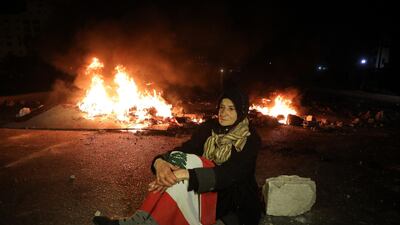
A demonstrator sits on the ground near burning fire during a protest against the fall in Lebanese pound currency and mounting economic hardship, in Beirut. Reuters -

A demonstrator clad in mask coloured with the Lebanese flag reacts as she stands next to flaming tires cutting off a road in the centre of Lebanon's capital Beirut. AFP -
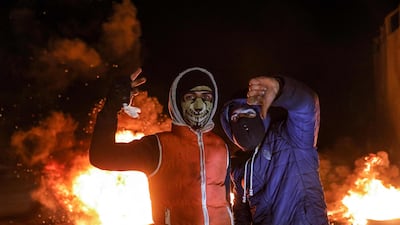
Demonstrators gesture as they stand by flaming tires cutting off a road in the centre of Lebanon's capital Beirut. AFP -
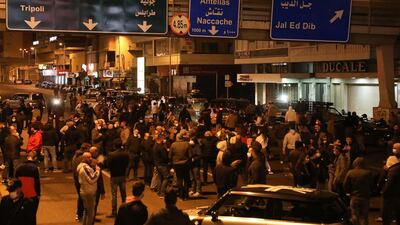
Demonstrators gather during a protest against the fall in Lebanese pound currency and mounting economic hardship, in Jal el-Dib. Reuters -
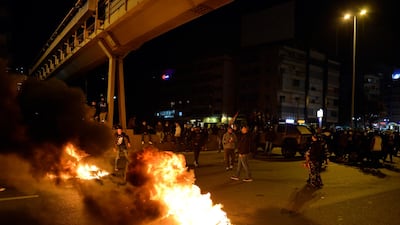
Anti-government protesters burn tires to block a main road during a protest against the power cuts, the high cost of living, the low purchasing power of the Lebanese pound, in Jal El Dib area north Beirut. EPA -
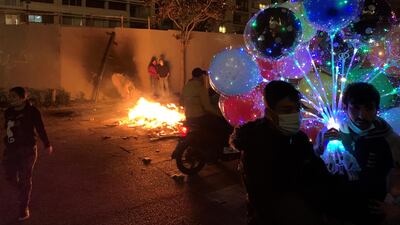
A street vendor holds his balloons during a protest against the fall in Lebanese pound currency and mounting economic hardship, in Beirut. Reuters -
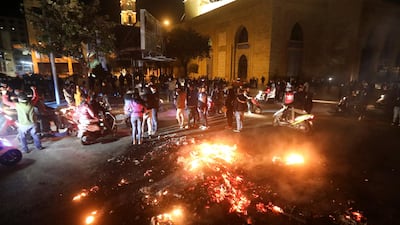
Demonstrators gather and ride on motorbikes during a protest against the fall in Lebanese pound currency and mounting economic hardship, in Beirut. Reuters -
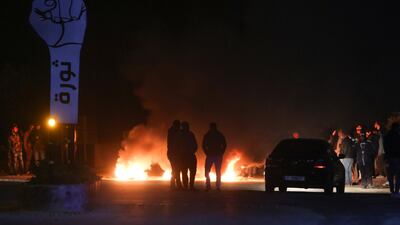
Demonstrators stand near burning tires during a protest against the fall in Lebanese pound currency and mounting economic hardship, in the town of Hasbaya, Lebanon. Reuters -
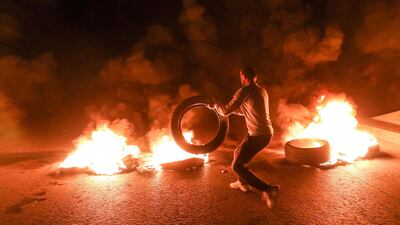
A demonstrator sets a tire aflame while cutting off a road in the centre of Lebanon's capital Beirut late. AFP


The number of Mr Jabbour’s passengers is dwindling. A large portion of low-income foreign workers, who made up the bulk of his clientele, have returned to their home countries such as Ethiopia and Bangladesh. On Thursday, his bus was barely one-third full.
“Asking for 4,000 Lebanese pounds is impossible,” said Thaer, another bus driver who greeted Mr Jabbour at a traffic stop. “We already have a lot of problems. Some passengers leave without paying, others say they cannot pay."
“I’m going home,” yelled the driver of another bus. “There’s no work, no clients.”
Mr Jabbour’s passengers were unaware of the price hike and criticised the move when told about it, saying they should not be the ones bearing the brunt of the financial losses for the public transport sector.
“I’d rather walk than pay over 3,000 pounds,” said Nassib, a car driver in a private company who got off the bus in the northern suburb of Jal El Dib on his way to work. Walking there from his home in the town of Mkalles would take an hour and a half. “Get a bicycle!” laughed Mr Jabbour.
In an informal transport system such as Lebanon's, decisions taken on the ground often vary from official ones, said Chadi Faraj, co-founder of civil society organisation Riders' Rights. “The system is organic. It’s good that some drivers do not insist in increasing prices, knowing that they do not have another income and incurred losses during lockdown,” he said.

Lebanon’s public transport system is not homogenous, explained Mira Tfaily, a doctoral candidate at the School for Advanced Studies in the Social Sciences in France where she is researching Beirut’s bus networks.
The state operates only a few dozen buses; most are privately owned. "On some lines, the driver owns his own van, and on others, the driver rents the bus from its owner," she told The National.
Mr Jabbour falls in the latter category. A Syrian national from the coastal town of Tartous, he moved to Lebanon in 2013 to avoid military conscription two years into Syria's ongoing civil war. He had just completed a master’s degree in economics and hoped to work in the banking sector. Instead, he worked in a company selling hair products in Jbeil, earning $600 a month.
He was laid off in 2019 as the worsening economy sparked nationwide protests. He found a new job driving a bus that he rents from its Lebanese owner for 100,000 pounds a day. He must also cover fuel costs of 70,000 pounds a day.
“Some days I lose money. Some days I make only 50,000 pounds,” he said.
Despite regular protests by local unions and skyrocketing unemployment rates among the Lebanese, most bus drivers are Syrian. “The Lebanese don’t want to work long hours for low pay like us,” Mr Jabbour said. Most Syrians in Lebanon have fled the civil war and now make up roughly a quarter of the small Mediterranean country’s population.
Mr Jabbour’s bus is decorated with teddy bears and Christian prayer beads. Like many of his passengers who live in the coastal region north of Beirut, he is a Christian. Many depend on help from the church – financial or in kind – to make ends meet, said Nadine, a 26-year-old cashier at a supermarket. The state is absent despite the urgent need.
“Everything is expensive. People are tired,” Nadine said.
Her monthly salary of 750,000 pounds, which used to be worth $500, or slightly more than the minimum wage, is now the equivalent of $75. She is relieved that she does not have a family to provide for. “I don’t think I want children in this country,” she said.

