
This National Day, use the long weekend to make something to have and to hold. A little crafting not only encourages cognitive liveliness while learning new skills, but also provides an activity over which family and friends can share time and conversation.
On a quest to "make happy", Meredith Huston, the founder of Turquoise Boutique Studio, has been leading a range of socially distanced and digital craft workshops in the UAE. Here, she shares three DIY projects to celebrate National Day, which are simple enough to be tackled by children and beginners, while also having scope to challenge more experienced crafters to achieve professional-looking results.
A National Day macrame keychain
Macrame’s form is developed by knotting string or rope to produce decorative designs. Early examples of the practice can be found in traditional Middle Eastern costumes; in fact, the linguistic root of the term is derived from the Arabic word for fringe, or migramah.
This flag-themed keychain can be made by beginners using a basic half square knot. As skills develop, progress to square knots, diagonal half hitch knots and more for increasingly complex designs.
Materials
Macrame cords of 3 millimetre or 5mm thickness in the colours of the UAE flag (yarnsdubai.com is a good source)
Key ring
A pair of scissors
Method
Take two macrame cords of equal length. Fold each in half and make a loop with one on the far side of the keychain, then thread through the two ends and pull firmly to secure. Repeat for the second cord. The two outer cords are knotting cords, while the middle pair are filler ones and remain static. For additional thickness, you can add further static cords in other colours.
Move the left cord to the right side (over the two middle filler cords) and thread it under the right knotting cord (to look like a figure four).
-
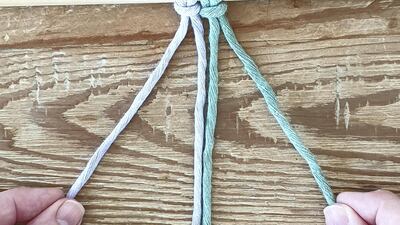
Take two macrame cords of equal length. Fold each in half and make a loop with one on the far side of the keychain, then thread through the two ends and pull firmly to secure. Repeat for the second cord. All photo courtesy: Turquoise Boutique Studio and Similitude Photography -

Move the left cord to the right side (over the two middle filler cords) and thread it under the right knotting cord (to look like a figure four). -
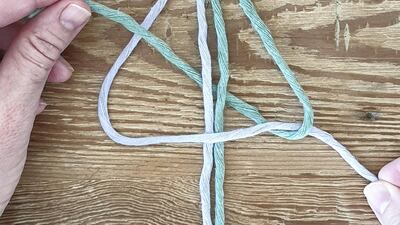
Bring the right knotting rope to the left side by going behind the two centre filler cords and through the four-shaped loop made by the first left knotting cords. -
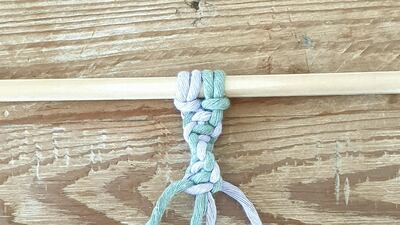
This will evolve into a spiral shape – continue to the desired length, then bind the end piece and trim.


Bring the right knotting rope to the left side by going behind the two centre filler cords and through the four-shaped loop made by the first left knotting cords. This will evolve into a spiral shape – continue to the desired length, then bind the end piece and trim.
The process can be repeated with additional cords in alternative colours, which can then be bound together.
A flag-themed terrarium

Ensconced in a glass orb, a terrarium is a type of aquarium, but for plants. The decorative miniature garden can spruce up any space, and once you get the hang of it, you can experiment with types of plants (always choose those that can all thrive in the same environment), plus decorative rocks, pine cones or even little figurines and ornaments.
Materials
Most of these will be available at garden centres and aquarium suppliers:
Sand
Pebbles and coloured stones in red, white, green and black
Potting soil
Coral pieces and shells
Glass vase or jar
Small succulent or cactus plants
Method
Start with a layer of sand at the base of the vase and then add a layer of pebbles to allow for drainage. Around the outside of your glass container, layer decorative pebbles while simultaneously building up soil in the middle to accommodate planting – ideally, use larger exterior pebbles to disguise the soil within.
Add water to the root balls of the plants before hollowing out space in the soil, and gently press into place ensuring firm contact with the surrounding soil. Use a soft brush to clean any soil off the plants or inside the glass before adding the top layer of pebbles and coral over the soil. Tweezers or a little stick can help position any stray pieces in the design.
Add a little water to the soil, never directly on plants – but don’t overwater if you’re using succulents (ferns and mosses, on the other hand, prefer a moist, closed environment). An ice cube left on top of the soil about once a week is all that’s needed for aftercare.
Emirates-inspired string art

A retro craft from the 1970s that’s making a comeback, string or pin art involves stringing up coloured threads between points to form a design of your choice, working off a silhouette of the pattern in question.
Materials
Small wooden board (Speedex Tools is a good source)
Embroidery-weight cotton threads
Box of ¾ inch brass nails or pin tacks
Hammer
A pair of scissors
Paper plan of the desired design
Google your source image and print out a design or draw your own on a sheet of paper, sizing it to fit your board.
Method
Create a dotted outline plan of your design, leaving about 1cm between each dot for evenly spaced nails. If they’re too close together, it’s difficult to get your fingers around for threading. If your design has sides running parallel, alternate the nails so they do not sit directly opposite one another as it’s better to have angles rather than straight lines if you’re infilling.
Hammer the nails firmly into place up to a third in, and ensure there is no wobble.
Remove the paper and get stringing. Tie your first string to the starting point and work around the outside sequentially, winding the thread around each nail in a clockwise direction. Then repeat in an anticlockwise direction. You’re aiming for the outside border to look like a mini train track with a double thread.
The design can be infilled with criss-crossing threads of same or contrasting colours across the design. As you build up layers, you may find it simpler to tie the thread to a new anchor nail and then continue working in a new area.

Visit Turquoise Boutique Studio’s YouTube channel for step-by-step videos

