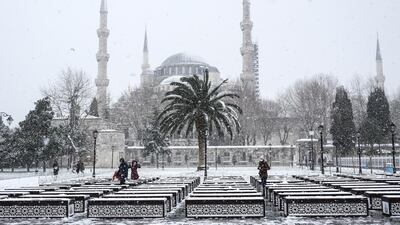
Turkey has signalled at the start of the new year that it wishes to come in from the cold. EPA

Is Turkey about to come in from the cold?


  • English
  • Arabic

The UAE and Cyprus signed a defence co-operation deal last week, a month after the UAE became a permanent observer member of the EastMed Gas Forum and two months after the Emirates and Athens agreed to broader defence co-operation. The international body, widely seen as a bulwark to Turkish influence in the Mediterranean, appears to be gaining strength.

Yet there have also been signs of an opening to Ankara. “We want to tell Turkey that we want normal relations with it that respect mutual sovereignty,” UAE Minister of State for Foreign Affairs Dr Anwar Gargash told Sky News Arabia just before the UAE-Cyprus deal. “We don’t have any problems with Turkey.”

A few days earlier, Saudi Arabia, the UAE, Bahrain and Egypt announced the end of a three-and-a-half-year freeze on diplomatic, trade and travel ties with Qatar – a move that could potentially clear the way for improved relations between Gulf states and Turkey, an ally of Doha.

A hopeful Turkey, meanwhile, has put on its flirtiest smile. After pushing each other to the brink of war last summer, Ankara and Athens are set to launch exploratory talks next week, to address conflicting maritime claims and drilling rights in the eastern Mediterranean.

Retired naval officer Cihat Yayci, the architect of Turkey's regional Blue Homeland doctrine, has warned that talks with Greece could destroy Turkey's position in Libya and the eastern Mediterranean. But Turkish President Recep Tayyip Erdogan has hailed the negotiations as "a harbinger of a new era", and last week hinted at a possible meeting with his Greek counterpart.

Turkey's historic rivalry with Greece has added to tensions in the Eastern Mediterranean. AP

A new era may also be on the wing for Cyprus, which since a 1974 invasion by Turkish forces has been divided between the Greek-backed Republic of Cyprus, an EU member, and the Turkish Republic of Northern Cyprus, recognised only by Turkey. Several rounds of reunification talks have failed, most recently in 2017.

UN Secretary General Antonio Guterres plans to meet next month with Greek-and Turkish-Cypriot leaders, and representatives from Greece, Turkey and the UK to determine whether talks can resume. Since Ersin Tatar became TRNC president in October, Turkey and Turkish Cypriots have more strongly backed a two-state solution, as opposed to reunification.

Ankara has also been hinting at rapprochement with Egypt. Relations between the two regional powers have been frosty since 2013 saw the fall of Mohammed Morsi's Muslim Brotherhood government in Cairo and Turkey’s welcoming of the extremist organisation's exiled leaders. Writing for the European Council on Foreign Relations, ECFR pan-European junior fellow Matteo Colombo urged European states to encourage Ankara-Cairo talks to help reduce tensions in Libya and the eastern Mediterranean. “They should look to build on the Turkish government’s reported outreach to its rival behind closed doors in recent weeks,” writes Mr Colombo.

There have been reports in recent weeks that Muslim Brotherhood leaders have begun leaving Turkey. Over the past month, Ankara has also sent several signals – including a comment from Mr Erdogan – that it seeks to strengthen relations with Israel. Israeli officials plan to meet Turkish counterparts in private, but have expressed concerns that Ankara’s newly friendly stance is mainly about winning points with incoming US president Joe Biden.

Tensions between Turkey and some of its fellow Nato allies have been high in the Mediterranean. Reuters

Israel has kept Turkey at arm's length thus far, and will surely avoid any move that might undermine its increased co-operation with Greece and Cyprus. On Monday, Ynet News, an Israeli outlet, reported that for normalisation to occur, Israel has said it would require Turkey to shutter its Hamas branch.

One of the main reasons Mr Erdogan has shifted to a more conciliatory tone in recent weeks is, of course, money. He hopes to attract foreign capital to boost Turkey's troubled economy, which in the days ahead must overcome US sanctions and, potentially, harsher EU sanctions. Last week, he said Turkey is ready to put its frayed relations with the EU back on track.

The Ides of March may decide Turkey’s fate, when the EU will meet to weigh harsher sanctions against Turkey for its aggressions in the eastern Mediterranean and Israeli Prime Minister Benjamin Netanyahu will face yet another election. Looking to calm the waters, Turkish Foreign Minister Mevlut Cavusoglu plans to meet EU foreign policy chief Josep Borrell in Brussels this week, before Mr Erdogan meets European Commission President Ursula von der Leyen later this month.

Israel suspects Turkey's newly friendly stance is about winning points with Joe Biden

If the EU holds off on stronger sanctions and the increasingly hardline Mr Netanyahu fails to hold on to power, Turkey could gain ground in the eyes of European and eastern Mediterranean rivals, as well as the US. Mr Erdogan could use all the help he can get with Mr Biden, who is preparing to take office on January 20 and has reportedly ignored the longtime Turkish leader’s request to talk.

Mr Erdogan’s first chance to boost his international standing in the Biden era comes next Monday, when Turkey and Greece sit down for their first diplomatic talks in five years. A breakthrough is highly unlikely, but a measure of open-mindedness and a willingness to engage from the Turkish side could begin to change the narrative.

David Lepeska is a Turkish and Eastern Mediterranean affairs columnist for The National

Why it pays to compare

A comparison of sending Dh20,000 from the UAE using two different routes at the same time - the first direct from a UAE bank to a bank in Germany, and the second from the same UAE bank via an online platform to Germany - found key differences in cost and speed. The transfers were both initiated on January 30.

Route 1: bank transfer

The UAE bank charged Dh152.25 for the Dh20,000 transfer. On top of that, their exchange rate margin added a difference of around Dh415, compared with the mid-market rate.

Total cost: Dh567.25 - around 2.9 per cent of the total amount

Total received: €4,670.30 

Route 2: online platform

The UAE bank’s charge for sending Dh20,000 to a UK dirham-denominated account was Dh2.10. The exchange rate margin cost was Dh60, plus a Dh12 fee.

Total cost: Dh74.10, around 0.4 per cent of the transaction

Total received: €4,756

The UAE bank transfer was far quicker – around two to three working days, while the online platform took around four to five days, but was considerably cheaper. In the online platform transfer, the funds were also exposed to currency risk during the period it took for them to arrive.

COMPANY%20PROFILE
%3Cp%3E%3Cstrong%3ECompany%20name%3A%3C%2Fstrong%3E%20Revibe%20%0D%3Cbr%3E%3Cstrong%3EStarted%3A%3C%2Fstrong%3E%202022%0D%3Cbr%3E%3Cstrong%3EFounders%3A%3C%2Fstrong%3E%20Hamza%20Iraqui%20and%20Abdessamad%20Ben%20Zakour%20%0D%3Cbr%3E%3Cstrong%3EBased%3A%3C%2Fstrong%3E%20UAE%20%0D%3Cbr%3E%3Cstrong%3EIndustry%3A%3C%2Fstrong%3E%20Refurbished%20electronics%20%0D%3Cbr%3E%3Cstrong%3EFunds%20raised%20so%20far%3A%3C%2Fstrong%3E%20%2410m%20%0D%3Cbr%3E%3Cstrong%3EInvestors%3A%20%3C%2Fstrong%3EFlat6Labs%2C%20Resonance%20and%20various%20others%0D%3C%2Fp%3E%0A
Fixtures

Tuesday - 5.15pm: Team Lebanon v Alger Corsaires; 8.30pm: Abu Dhabi Storms v Pharaohs

Wednesday - 5.15pm: Pharaohs v Carthage Eagles; 8.30pm: Alger Corsaires v Abu Dhabi Storms

Thursday - 4.30pm: Team Lebanon v Pharaohs; 7.30pm: Abu Dhabi Storms v Carthage Eagles

Friday - 4.30pm: Pharaohs v Alger Corsaires; 7.30pm: Carthage Eagles v Team Lebanon

Saturday - 4.30pm: Carthage Eagles v Alger Corsaires; 7.30pm: Abu Dhabi Storms v Team Lebanon

MATCH INFO

Euro 2020 qualifier

Fixture: Liechtenstein v Italy, Tuesday, 10.45pm (UAE)

TV: Match is shown on BeIN Sports

Company%20Profile
%3Cp%3E%3Cstrong%3EName%3A%3C%2Fstrong%3E%20Neo%20Mobility%3Cbr%3E%3Cstrong%3EStarted%3A%3C%2Fstrong%3E%20February%202023%3Cbr%3E%3Cstrong%3ECo-founders%3A%3C%2Fstrong%3E%20Abhishek%20Shah%20and%20Anish%20Garg%3Cbr%3E%3Cstrong%3EBased%3A%3C%2Fstrong%3E%20Dubai%3Cbr%3E%3Cstrong%3EIndustry%3A%3C%2Fstrong%3E%20Logistics%3Cbr%3E%3Cstrong%3EFunding%3A%3C%2Fstrong%3E%20%2410%20million%3Cbr%3E%3Cstrong%3EInvestors%3A%3C%2Fstrong%3E%20Delta%20Corp%2C%20Pyse%20Sustainability%20Fund%2C%20angel%20investors%3C%2Fp%3E%0A

Mercer, the investment consulting arm of US services company Marsh & McLennan, expects its wealth division to at least double its assets under management (AUM) in the Middle East as wealth in the region continues to grow despite economic headwinds, a company official said.

Mercer Wealth, which globally has $160 billion in AUM, plans to boost its AUM in the region to $2-$3bn in the next 2-3 years from the present $1bn, said Yasir AbuShaban, a Dubai-based principal with Mercer Wealth.

Within the next two to three years, we are looking at reaching $2 to $3 billion as a conservative estimate and we do see an opportunity to do so,” said Mr AbuShaban.

Mercer does not directly make investments, but allocates clients’ money they have discretion to, to professional asset managers. They also provide advice to clients.

“We have buying power. We can negotiate on their (client’s) behalf with asset managers to provide them lower fees than they otherwise would have to get on their own,” he added.

Mercer Wealth’s clients include sovereign wealth funds, family offices, and insurance companies among others.

From its office in Dubai, Mercer also looks after Africa, India and Turkey, where they also see opportunity for growth.

Wealth creation in Middle East and Africa (MEA) grew 8.5 per cent to $8.1 trillion last year from $7.5tn in 2015, higher than last year’s global average of 6 per cent and the second-highest growth in a region after Asia-Pacific which grew 9.9 per cent, according to consultancy Boston Consulting Group (BCG). In the region, where wealth grew just 1.9 per cent in 2015 compared with 2014, a pickup in oil prices has helped in wealth generation.

BCG is forecasting MEA wealth will rise to $12tn by 2021, growing at an annual average of 8 per cent.

Drivers of wealth generation in the region will be split evenly between new wealth creation and growth of performance of existing assets, according to BCG.

Another general trend in the region is clients’ looking for a comprehensive approach to investing, according to Mr AbuShaban.

“Institutional investors or some of the families are seeing a slowdown in the available capital they have to invest and in that sense they are looking at optimizing the way they manage their portfolios and making sure they are not investing haphazardly and different parts of their investment are working together,” said Mr AbuShaban.

Some clients also have a higher appetite for risk, given the low interest-rate environment that does not provide enough yield for some institutional investors. These clients are keen to invest in illiquid assets, such as private equity and infrastructure.

“What we have seen is a desire for higher returns in what has been a low-return environment specifically in various fixed income or bonds,” he said.

“In this environment, we have seen a de facto increase in the risk that clients are taking in things like illiquid investments, private equity investments, infrastructure and private debt, those kind of investments were higher illiquidity results in incrementally higher returns.”

The Abu Dhabi Investment Authority, one of the largest sovereign wealth funds, said in its 2016 report that has gradually increased its exposure in direct private equity and private credit transactions, mainly in Asian markets and especially in China and India. The authority’s private equity department focused on structured equities owing to “their defensive characteristics.”

Mental%20health%20support%20in%20the%20UAE
%3Cp%3E%E2%97%8F%20Estijaba%20helpline%3A%208001717%3Cbr%3E%E2%97%8F%20UAE%20Ministry%20of%20Health%20and%20Prevention%20hotline%3A%20045192519%3Cbr%3E%E2%97%8F%20UAE%20Mental%20health%20support%20line%3A%20800%204673%20(Hope)%3Cbr%3EMore%20information%20at%20hope.hw.gov.ae%3C%2Fp%3E%0A

Innotech Profile

Date started: 2013

Founder/CEO: Othman Al Mandhari

Based: Muscat, Oman

Sector: Additive manufacturing, 3D printing technologies

Size: 15 full-time employees

Stage: Seed stage and seeking Series A round of financing 

Investors: Oman Technology Fund from 2017 to 2019, exited through an agreement with a new investor to secure new funding that it under negotiation right now. 

EPL's youngest
  • Ethan Nwaneri (Arsenal)
    15 years, 181 days old
  • Max Dowman (Arsenal)
    15 years, 235 days old
  • Jeremy Monga (Leicester)
    15 years, 271 days old
  • Harvey Elliott (Fulham)
    16 years, 30 days old
  • Matthew Briggs (Fulham)
    16 years, 68 days old
