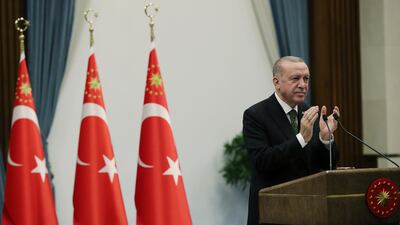
Turkey’s future participation in the Nato alliance is likely to come under renewed scrutiny following Washington’s decision this week to impose sanctions against Ankara over the recent purchase of a sophisticated, Russian-made S-400 anti-aircraft missile system.
Tensions were already growing between the US and Turkey, both major players in the military alliance, ever since Turkish President Recep Tayyip Erdogan announced in 2017 that he was negotiating a major arms deal with Russia, which included the purchase of the missile system.
The deal is particularly problematic for Nato as the system was specifically designed to destroy the new F-35 stealth fighter jet, which has been developed by the US in conjunction with a number of key allies, including Britain. Indeed, Turkey was one of a few countries – including the UAE – that have secured approval from Washington to purchase the state-of-the-art aircraft. The administration of US President Donald Trump has since cancelled Turkey’s participation in the F-35 programme over the Russian deal.
Now the row has moved to another level, after US Secretary of State Mike Pompeo earlier this week announced that Washington was imposing sanctions on key elements of the Turkish defence industry. The move prompted an angry reaction from both Ankara and Moscow, which claimed it was intended to punish the defence sectors of both of their nations at once.
Moreover, the imposition of sanctions by one Nato member state against another raises serious questions about the alliance's future. After joining the alliance in the 1950s at the height of the Cold War, Turkey’s geo-political significance has played a key role in Nato’s strategic calculations. During the Cold War, its proximity to the southern Soviet states of Georgia and Armenia meant that the alliance was able to deny the Soviet Union access to the Mediterranean at the Bosphorus strait, as well as enable the US to station ballistic missiles on Turkish soil.
More recently, the US has used its air bases in Turkey to prosecute the air campaign to destroy ISIS strongholds in Syria and Iraq.
Turkey’s membership of the alliance, though, has not been without its challenges. Questions were first raised about its continued participation in Nato in the 1970s when it went to war with Greece – another key Nato state – during the 1974 Cyprus crisis.
But while Turkey’s conduct over the Cyprus issue, which resulted in the Turkish invasion and occupation of northern Cyprus, was disturbing, it did not result in Ankara siding with a hostile state, which is how Mr Erdogan’s deepening relationship with Moscow is now being viewed by the rest of Nato.
During the Cold War, it was unthinkable that a key Nato ally would link up with Moscow. But Mr Erdogan clearly has no qualms today about deepening that relationship, even as Russia is regarded by other Nato members as posing a significant strategic threat to their security.
Apart from signing the arms deal with Moscow, the level of co-operation between Turkey and Russia has developed to a level where the two countries have even conducted joint operations in Syria. Although, their forces have clashed there, too.
But Turkey’s burgeoning relationship with Russia is far from the only issue that has strained its relations with the West. Mr Erdogan’s support for the radical Islamist cause, with Ankara supporting a variety of militant groups in countries like Syria and Libya, has put him on a collision course with former allies, as has his opposition to the recently signed Abraham Accords.
Mr Erdogan’s deep-seated antipathy towards the West most recently provoked a diplomatic row with Paris after he accused French President Emmanuel Macron of needing "mental treatment" following his attempts to tackle insurgent Islamism at home in the wake of a series of Islamist-inspired terror attacks in France.
Another major dispute between Turkey and the rest of Europe has been Ankara’s insistence of conducting gas drilling operations in Cypriot-claimed waters, which resulted in a dramatic escalation in tensions between Ankara and Athens in the summer, raising fears that it might result in a naval clash between them.
Tensions were already growing between the US and Turkey
The EU this week responded to what it regards as Turkey’s provocative conduct in the eastern Mediterranean by imposing sanctions on an unspecified number of Turkish officials and entities involved said to be involved in the gas drilling operations. Moreover, there is the prospect of harsher sanctions to come if the incoming US administration of Joe Biden decides that it wants to take US measures further.
In short, Turkey has been playing fast and loose with the Nato alliance on a number of key issues, to the extent that serious questions are now being raised about its continued membership.
One of the main factors that still weighs in Ankara’s favour, though, is that, under the existing Nato charter, no mechanism exists for expelling errant member states. Article 13 of the alliance's founding treaty declares that a country may leave voluntarily, but does not cover expulsion.
That could change, however, if, as a result of Mr Erdogan’s conduct and to protect the interests of other members, the alliance decides to alter the founding document. Changing Nato's membership rules in order to eject Turkey would certainly be a dramatic move – one that would cause serious disquiet in many European capitals. But it could reach the point where Nato leaders feel they have no alternative if Mr Erdogan persists with his provocative conduct.
Con Coughlin is a defence and foreign affairs columnist for The National

The%20specs
%3Cp%3E%3Cstrong%3EEngine%3A%20%3C%2Fstrong%3E3.5-litre%20twin-turbo%20V6%20%0D%3Cbr%3E%3Cstrong%3EPower%3A%20%3C%2Fstrong%3E456hp%20at%205%2C000rpm%0D%3Cbr%3E%3Cstrong%3ETorque%3A%20%3C%2Fstrong%3E691Nm%20at%203%2C500rpm%0D%3Cbr%3E%3Cstrong%3ETransmission%3A%20%3C%2Fstrong%3E10-speed%20auto%20%0D%3Cbr%3E%3Cstrong%3EFuel%20consumption%3A%20%3C%2Fstrong%3E14.6L%2F100km%0D%3Cbr%3E%3Cstrong%3EPrice%3A%20%3C%2Fstrong%3Efrom%20Dh349%2C545%0D%3Cbr%3E%3Cstrong%3EOn%20sale%3A%20%3C%2Fstrong%3Enow%3C%2Fp%3E%0A
PROFILE OF SWVL
Started: April 2017
Founders: Mostafa Kandil, Ahmed Sabbah and Mahmoud Nouh
Based: Cairo, Egypt
Sector: transport
Size: 450 employees
Investment: approximately $80 million
Investors include: Dubai’s Beco Capital, US’s Endeavor Catalyst, China’s MSA, Egypt’s Sawari Ventures, Sweden’s Vostok New Ventures, Property Finder CEO Michael Lahyani
Anghami
Started: December 2011
Co-founders: Elie Habib, Eddy Maroun
Based: Beirut and Dubai
Sector: Entertainment
Size: 85 employees
Stage: Series C
Investors: MEVP, du, Mobily, MBC, Samena Capital
Three ways to boost your credit score
Marwan Lutfi says the core fundamentals that drive better payment behaviour and can improve your credit score are:
1. Make sure you make your payments on time;
2. Limit the number of products you borrow on: the more loans and credit cards you have, the more it will affect your credit score;
3. Don't max out all your debts: how much you maximise those credit facilities will have an impact. If you have five credit cards and utilise 90 per cent of that credit, it will negatively affect your score.
The BIO:
He became the first Emirati to climb Mount Everest in 2011, from the south section in Nepal
He ascended Mount Everest the next year from the more treacherous north Tibetan side
By 2015, he had completed the Explorers Grand Slam
Last year, he conquered K2, the world’s second-highest mountain located on the Pakistan-Chinese border
He carries dried camel meat, dried dates and a wheat mixture for the final summit push
His new goal is to climb 14 peaks that are more than 8,000 metres above sea level
Seemar’s top six for the Dubai World Cup Carnival:
1. Reynaldothewizard
2. North America
3. Raven’s Corner
4. Hawkesbury
5. New Maharajah
6. Secret Ambition
The specs
Engine: 3.9-litre twin-turbo V8
Power: 620hp from 5,750-7,500rpm
Torque: 760Nm from 3,000-5,750rpm
Transmission: Eight-speed dual-clutch auto
On sale: Now
Price: From Dh1.05 million ($286,000)
Who is Mohammed Al Halbousi?
The new speaker of Iraq’s parliament Mohammed Al Halbousi is the youngest person ever to serve in the role.
The 37-year-old was born in Al Garmah in Anbar and studied civil engineering in Baghdad before going into business. His development company Al Hadeed undertook reconstruction contracts rebuilding parts of Fallujah’s infrastructure.
He entered parliament in 2014 and served as a member of the human rights and finance committees until 2017. In August last year he was appointed governor of Anbar, a role in which he has struggled to secure funding to provide services in the war-damaged province and to secure the withdrawal of Shia militias. He relinquished the post when he was sworn in as a member of parliament on September 3.
He is a member of the Al Hal Sunni-based political party and the Sunni-led Coalition of Iraqi Forces, which is Iraq’s largest Sunni alliance with 37 seats from the May 12 election.
He maintains good relations with former Prime Minister Nouri Al Maliki’s State of Law Coaliton, Hadi Al Amiri’s Badr Organisation and Iranian officials.
More coverage from the Future Forum
Winners
Best Men's Player of the Year: Kylian Mbappe (PSG)
Maradona Award for Best Goal Scorer of the Year: Robert Lewandowski (Bayern Munich)
TikTok Fans’ Player of the Year: Robert Lewandowski
Top Goal Scorer of All Time: Cristiano Ronaldo (Manchester United)
Best Women's Player of the Year: Alexia Putellas (Barcelona)
Best Men's Club of the Year: Chelsea
Best Women's Club of the Year: Barcelona
Best Defender of the Year: Leonardo Bonucci (Juventus/Italy)
Best Goalkeeper of the Year: Gianluigi Donnarumma (PSG/Italy)
Best Coach of the Year: Roberto Mancini (Italy)
Best National Team of the Year: Italy
Best Agent of the Year: Federico Pastorello
Best Sporting Director of the Year: Txiki Begiristain (Manchester City)
Player Career Award: Ronaldinho
Jetour T1 specs
Engine: 2-litre turbocharged
Power: 254hp
Torque: 390Nm
Price: From Dh126,000
Available: Now
%20Ramez%20Gab%20Min%20El%20Akher
%3Cp%3E%3Cstrong%3ECreator%3A%3C%2Fstrong%3E%20Ramez%20Galal%3C%2Fp%3E%0A%3Cp%3E%3Cstrong%3EStarring%3A%3C%2Fstrong%3E%20Ramez%20Galal%3C%2Fp%3E%0A%3Cp%3E%3Cstrong%3EStreaming%20on%3A%20%3C%2Fstrong%3EMBC%20Shahid%3C%2Fp%3E%0A%3Cp%3E%3Cstrong%3ERating%3A%20%3C%2Fstrong%3E2.5%2F5%3C%2Fp%3E%0A
Which honey takes your fancy?
Al Ghaf Honey
The Al Ghaf tree is a local desert tree which bears the harsh summers with drought and high temperatures. From the rich flowers, bees that pollinate this tree can produce delicious red colour honey in June and July each year
Sidr Honey
The Sidr tree is an evergreen tree with long and strong forked branches. The blossom from this tree is called Yabyab, which provides rich food for bees to produce honey in October and November. This honey is the most expensive, but tastiest
Samar Honey
The Samar tree trunk, leaves and blossom contains Barm which is the secret of healing. You can enjoy the best types of honey from this tree every year in May and June. It is an historical witness to the life of the Emirati nation which represents the harsh desert and mountain environments
The view from The National
The bio
Studied up to grade 12 in Vatanappally, a village in India’s southern Thrissur district
Was a middle distance state athletics champion in school
Enjoys driving to Fujairah and Ras Al Khaimah with family
His dream is to continue working as a social worker and help people
Has seven diaries in which he has jotted down notes about his work and money he earned
Keeps the diaries in his car to remember his journey in the Emirates
Killing of Qassem Suleimani
FIXTURES
All kick-off times UAE ( 4 GMT)
Friday
Sevilla v Levante (midnight)
Saturday
Athletic Bilbao v Real Sociedad (7.15pm)
Eibar v Valencia (9.30pm)
Atletico Madrid v Alaves (11.45pm)
Sunday
Girona v Getafe (3pm)
Celta Vigo v Villarreal (7.15pm)
Las Palmas v Espanyol (9.30pm)
Barcelona v Deportivo la Coruna (11.45pm)
Monday
Malaga v Real Betis (midnight)
