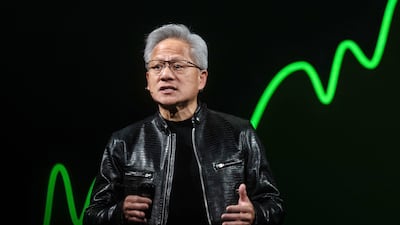

The Jensen Huang saga took another turn this week, with Nvidia's board surprisingly reinstating its chief executive. That ended an 11-day whirlwind that triggered national security fears and a stock market rout.
One issue the drama magnified was the artificial intelligence company's lack of a succession plan. Chief financial officer Colette Kress was named interim chief, but that was more of a stopgap and, as the title implied, temporary.
That exposed a weak link in Nvidia's leadership chain, in contrast to some of its peers, which at least have a plan, follow tradition or are experimenting with how they are run.

Oracle
After 37 years as chief executive, Oracle founder Larry Ellison stepped down in 2014 and the company adopted a co-chief executive model. Mark Hurd and Safra Catz shared the role until Mr Hurd's death in 2019, which left Ms Catz running the company alone until 2025. Clay Magouyrk and Mike Sicilia now lead it.
Mr Ellison remains Oracle's chairman and chief technology officer, while Ms Catz has become executive vice chair of the board. The unusual structure, an "experiment", creates ambiguity over who is truly in charge, Fortune noted in 2025.
Alphabet
Sundar Pichai became chief executive of Google in 2015 and of its parent Alphabet in 2019, succeeding co-founder Larry Page both times. Mr Pichai was reportedly chosen for his leadership and product savvy. Those qualities also drew interest from Microsoft in 2014, before it picked Satya Nadella, and from what was then Twitter, albeit for a less senior role.
Alphabet has no public succession plan. Names that stand out include president and chief investment officer Ruth Porat and Google Cloud chief Thomas Kurian. Given AI's influence today, Google DeepMind leaders Demis Hassabis and Koray Kavukcuoglu could also be in the running.
Meta Platforms
The Facebook parent has no public succession plan. Founder Mark Zuckerberg, who is also chief executive and chairman, has given no sign of when he might retire or who might succeed him. He is only 42 and the youngest person in the top 20 of the Bloomberg Billionaires Index.
His top team includes president Dina Powell McCormick and senior executives Joel Kaplan, Susan Li, Javier Olivan, Chris Cox and Andrew Bosworth. Meanwhile, the stock of chief AI officer Alexandr Wang, 29, has risen. Mr Zuckerberg reportedly trusts him to lead the company's AI ambitions and turnaround.
Meta may not have a succession plan for Mr Zuckerberg, but Mr Wang could be an example of the company "already creating the conditions for people to speculate about one", said Inna Kuts, founder of Dublin-based executive branding advisory IKCCG.
"Mr Wang has capital, organisational authority, direct access to Mr Zuckerberg and responsibility for one of Meta’s most consequential strategic priorities. That is how potential successors often become visible long before anyone uses the word 'succession'."
Samsung
In South Korea, chaebols are the norm. These are sprawling family-controlled conglomerates, and the word literally means "wealth clan". The Lee family has controlled Samsung Group for 88 years. Its current chairman, Lee Jae-yong, is the son and successor of Lee Kun-hee, who in turn took over from his father, Samsung founder Lee Byung-chul.
In 2016, however, Lee Jae-yong was implicated in a corruption, bribery and embezzlement scandal. His father had been incapacitated by a heart attack in 2014, and the case cast serious doubt on the son's expected rise to the top. (His father had legal troubles of his own, which led him to leave the company and later return.)
In 2017, Mr Lee was convicted and jailed for his role in the scandal, which also led to the impeachment and conviction of then-president Park Geun-hye. He was paroled in 2021, pardoned in 2022 and named executive chairman that October.
Even so, Mr Lee said in 2020 that he did not plan to hand control of the company to his children. It is unclear whether that was down to recent history, political pressure or a genuine attempt to break with chaebol tradition. Separately, Samsung was reported last month to have expanded an affiliate system that draws up shortlists of candidates for chief executive roles across its business units.
Apple
Apple is arguably the most straightforward case on this list. Since co-founder Steve Jobs returned in 1997, it has changed leaders twice: when Mr Jobs resigned shortly before his death in 2011, and when Tim Cook stepped down this September.
Both times, the iPhone maker picked a chief executive who could steer it through a transformational phase in step with the industry. Mr Cook, then Apple's operations chief, had built one of technology's most robust supply chains. Hardware maven John Ternus is expected to strike the right balance in the age of AI.
Apple had a strong list of contenders, including Craig Federighi, Greg Joswiak, Eddy Cue and Deirdre O'Brien, and its choice of the low-profile Mr Ternus shows how deep its bench is.
Lesson for Nvidia
Not having a succession plan at the biggest and most influential companies could prove costly. Having one in place reassures investors and supports business continuity.
Nvidia may have learnt this the hard way, especially as Mr Huang's departure was bigger than a succession story, said Mazen Hayek, a Dubai-based media consultant.
"It is a stress test of corporate governance, US national security policy, global semiconductor supply chains and the balance of power in the AI race," he told The National.
Investors would welcome clearer information about succession plans. Now that Nvidia has seen the risk up close, it should be able to prepare for Mr Huang stepping down again, for whatever reason.
"The board’s real test is succession. Those are governance questions because the answers determine what the board can do when it has to make a difficult decision," said Mohammad Fheili, a risk strategist and executive in residence at the American University of Beirut.
"Directors who have prepared for a handover can judge a chief executive's conduct on its merits and act on that judgment."