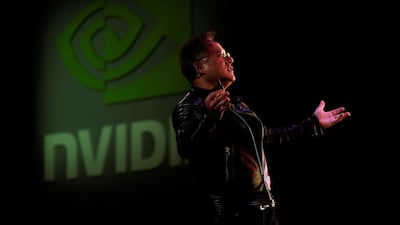

Jensen Huang was considered the world's hottest AI and chip diplomat. His absence from the proverbial negotiating table might result in the technology's expansion cooling off.
Mr Huang – forced to step down as Nvidia boss after an extramarital affair with Megaspeed executive and alleged Chinese spy Alice Huang – has been instrumental in building personal relationships with governments and corporates that have shaped AI investments and programmes, and data centres.
With artificial intelligence's biggest champion no longer at the helm, analysts expect the dynamics to shift. They anticipate an incoming Nvidia chief who may be largely untested, uncertainty over the company’s strategic direction, and a potential opening for China to pounce on the opportunity during this transition.

“Jensen Huang spent years … often helping negotiate deals that went far beyond chip sales,” Irina Tsukerman, a geopolitical analyst in New York, tells The National.
“Governments that negotiated directly with him will now have to establish relationships with new leadership, potentially delaying projects and reopening agreements that appeared settled.”
Gulf's conundrum
In regions where Mr Huang was particularly hands-on, the AI engine hummed and chugged along. Billions of dollars worth of chips, the power behind the AI boom, have been involved, especially with the UAE and Saudi Arabia.
Ms Tsukerman says that the Emirates and Saudi Arabia face more immediate commercial concerns because the Arab world's two biggest economies are spending heavily to develop AI industries.
“Mr Huang's personal involvement helped advance relationships with Gulf investors and technology companies. A leadership change could delay negotiations over new computing facilities and complicate discussions with Washington about access to advanced processors,” she said.
“Gulf investors may also reconsider the terms of their commitments if Nvidia's new management changes its international priorities.”
For Europe and the Gulf, this could mean a more transactional and compliance-driven relationship, particularly around access to advanced chips, technology partnerships and AI infrastructure, says Mazen Hayek, a Dubai-based media consultant.
The Nvidia board named Colette Kress as interim chief executive. Analysts have argued that she could be a logical choice.
Ms Kress delivered “what investors needed most: reassurance that the business can continue executing without Huang”, says Charu Chanana, chief investment strategist at Denmark's Saxo Bank.
The “emphasis on her long-standing role in executing Nvidia's strategy was important in challenging the perception that the company's competitive advantage rests entirely on one individual”, she adds.
But that doesn't paint a clear picture of how she would steer the world's second-most valuable listed company. A more cautious approach from Ms Kress, or whoever takes over on a permanent basis, might mean more delays for AI build-outs.
“Nvidia will survive, but a Jensen-less Nvidia would almost certainly be a different proposition: potentially more institutionalised, more cautious and subject to greater governance, regulatory and geopolitical scrutiny,” Mr Hayek tells The National.
In its global investment outlook for 2027 released this week, JPMorgan notes that regulations would be a determining factor for whether capital spending for AI build-outs, which is now running in the trillions, will continue to grow.
Linda Sui, founder and principal analyst of California-based Smart Analytics Global, says the Gulf and Europe may experience a slowdown in new AI infrastructure projects due to the uncertainty.
But Nvidia's “strong technology leadership”, the company's Cuda computing platform and established customer relationships, “will remain intact”.
“I do not expect major disruptions to existing partnerships, but Nvidia may lose some momentum in expanding its global influence,” she tells The National.
China momentum?
However, for China, the stakes are significantly higher.
The rivalry between the US and China, long cemented in economic and political realms, has spilt over into AI. The leadership vacuum at Nvidia might be what Beijing needs to close the gap with America.
China is, arguably, the biggest strategic beneficiary of any prolonged uncertainty at Nvidia. While opinions differ on whether China is leading the AI race or remains second to the US, there is little doubt that Beijing has the ambition, talent, industrial capacity and resources to challenge American dominance.
Developing the best AI model aside, “it is who controls the underlying infrastructure – advanced semiconductors, computing capacity, data, talent and the ecosystems – that turn innovation into geopolitical and economic power”, Mr Hayek says.
Noteworthy, however, is that Mr Huang was a huge advocate for maintaining business ties with China, in particular, favouring selling non-high-end chips to the world's second-biggest economy.
Beijing could benefit from Nvidia's leadership uncertainty, particularly, if it leads to tighter US export restrictions or weaker co-operation between the US and other countries, Ms Sui says.
“Without Mr Huang, Chinese companies may accelerate their shift toward domestic AI chips, particularly Huawei's solutions. However, China still faces major challenges in advanced chip manufacturing and the AI software ecosystem,” she says.
“I expect China to gain some opportunities, but not a fundamental competitive advantage in the near term.”
Carlos Uraga, chief executive of Spain-based energy technology firm Nantek, circles back to Mr Huang's diplomat role.
He sees the Nvidia dilemma's direct effect on chips as close to zero, since the company holds virtually zero per cent of the Chinese market on US export controls, and Huawei is growing fast. China’s gain, therefore, is diplomatic.
“The West loses its main advocate against fully cutting China off, Beijing can frame the ouster as US paranoia and countries caught in between could shift towards Huawei if Washington tightens conditions on them,” he tells The National.
“The limit is that China’s bottleneck is manufacturing advanced chips, not who runs Nvidia and if a leak is proven [to China through Ms Huang], export controls will only get tougher.”
Back in the Gulf, Ms Tsukerman believes Beijing could encourage governments in the region to expand co-operation with Chinese cloud providers, especially on projects where US export restrictions complicate access to advanced processors.
The UAE and Saudi Arabia, she says, are particularly attractive markets because both have substantial investment resources and maintain extensive economic relationships with China, which can offer more favourable financing arrangements or greater local participation in infrastructure development.
“China also has an opportunity to influence international technology standards,” she says.
“If governments begin purchasing AI infrastructure from competing American and Chinese suppliers, Beijing could encourage adoption of Chinese software frameworks and technical standards.”
Shades of OpenAI
In Tuesday's earnings announcement, the first after Mr Huang's departure, California-based Nvidia forecast quarterly revenue above estimates. The company's board also stressed that it was not considering reinstating the disgraced former chief executive.
That's despite an online petition seeking his return, which has the support of even Elon Musk. US President Donald Trump has said he would welcome Mr Huang's return, while Treasury Secretary Scott Bessent says the next Nvidia boss should come from outside the company.
Nvidia's board reversing its position while its investigation remains unresolved could expose directors to criticism from shareholders and Congress. Nvidia is already facing scrutiny over its compliance with US export restrictions, particularly concerning Megaspeed's alleged dealings with Chinese customers.
The Nvidia saga brings back memories of Sam Altman's removal and reinstatement at OpenAI, almost exactly three years ago, when employee and investor pressure forced the board to reverse course. The only problem with Nvidia's case: its directors face questions involving national security, since an alleged spy was involved.
“This is not the Altman case … [and] the obstacles are clear … he would only return if he is cleared, the stock keeps suffering, key talent leaves and the White House signals approval,” says Mr Uraga, who also floated the idea of Mr Musk doing “whatever it takes” to get him into his companies, “so he would control rockets, cars, AI and now the chips infrastructure”.
Mr Huang's prospects would improve if there is no evidence that he compromised sensitive information, and if Nvidia's interim leadership struggles to maintain investor confidence, or major customers begin reconsidering their commitments.
“The board would have to explain why reinstatement serves shareholders' interests while addressing concerns about Mr Huang's conduct,” Ms Tsukerman says.
That in turn, would mean Mr Huang himself could resume personal negotiations with Gulf investors.
“Saudi Arabia and the UAE would have particular reasons to welcome continuity because their AI ambitions depend on major infrastructure projects involving Nvidia technology,” she adds.
“His return could help revive delayed discussions and reassure partners concerned about changes in Nvidia's commercial strategy.”

