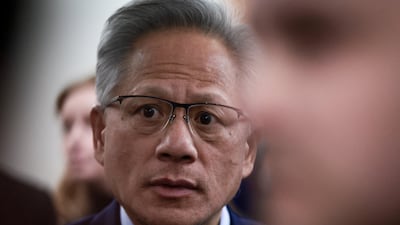
Nvidia chief executive Jensen Huang has never anointed a successor, but many analysts and investors see two people as particularly likely candidates, at least for the short term: engineer Ian Buck and chief financial officer Colette Kress.
Nvidia's board is meeting on Wednesday to decide whether to oust Mr Huang, a source said, as the world's dominant supplier of AI processors deals with reports of two extramarital affairs involving its longtime leader. Nvidia did not immediately respond to a request for comment on the board meeting.
Mr Huang is not the usual chief executive. He is a charismatic, leather-jacket-wearing apostle of Nvidia chips who built the company on processors for video games, transformed it into an artificial intelligence machine, and, in turn, created the most valuable company in the world.

“Jensen Huang is a rock star in the industry. He’s outspoken and synonymous with the Nvidia brand, and a leader like that is very hard to replace,” said Anna Wu, founder of Floodlines Research in Sydney.
That fear has contributed to a $600 billion sell-off of Nvidia's shares this week, now making it the world's second-most valuable company.
On Wednesday, speculation on who might be tapped if Mr Huang is removed ranged from a leader of a rival chip giant, such as Arm chief Rene Haas, and 32-year Nvidia veteran Jeff Fisher, to one of Mr Huang's two children, both of whom are executives at the company.
Colette Kress
One of the simplest ways to fill the void, some analysts said, would be to turn to the person who has joined Huang on quarterly results calls: Ms Kress.
The 59-year-old joined Nvidia in 2013 after a long career at other tech industry giants including Microsoft, Cisco and chip maker Texas Instruments. Some members of Nvidia’s board favour appointing her interim chief executive, Semafor reported, quoting sources.
“Colette Kress is the obvious choice to steady the ship. She has been CFO for 13 years and fronts every earnings call alongside him, so she’s a familiar and trusted voice for the market at a time when it badly needs one,” said Josh Gilbert, lead analyst at trading platform eToro.
“The permanent job is a different story, though, because Nvidia’s edge comes from its technology, and the board would likely want an engineer in the chair. Someone like Ian Buck, who led the software platform that keeps developers tied to Nvidia’s chips, is the sort of internal name you’d expect to come up.”
Ian Buck
Engineer Mr Buck, who joined in 2004, helped launch AI on Nvidia chips and was a leader in developing the Cuda software system. His prowess at solving “wickedly hard” technical problems could be crucial to guiding Nvidia's development, no matter who is chief executive
Mr Buck manages Nvidia's AI hardware and software products as head of product for hyperscale AI. He has a PhD from Stanford for work that led to his AI-focused software at the California chip designer.
Odds on prediction-market website Polymarket showed an 83 per cent chance that Mr Huang would resign or be removed by the end of the year. Odds for his successor favoured Mr Buck, with Ms Kress second, however volume on that market is small.
“My bigger concern is next decade, because Jensen isn't simply Nvidia's CEO but he's the person who has consistently identified where computing is going,” said Shay Boloor, chief market strategist of Futurum Equities. “If a transition becomes necessary then Ian Buck is the strongest long-term internal candidate given his role in creating Cuda and leading Nvidia’s hyperscale business.”
Rene Haas
Mr Boloor said Arm chief executive and former Nvidia executive Mr Haas could be an external candidate worth considering. A banker working on chips deals said that Mr Haas made the most “logical sense” because he was high profile and also understood the semiconductor industry.
There was no immediate responses to emails to the companies requesting comment from Ms Kress, Mr Buck and Mr Haas.
Mr Buck himself can be modest about his abilities.
“One of the most challenging parts of my job often is to try to predict the future, but AI is always surprising us,” Mr Buck said at a Bank of America conference last year.
“Inference is hard. It’s wickedly hard,” he said earlier this year, referring to the process in which AI answers user questions.
An author page on Nvidia's website holds a small trove of articles that show off Mr Buck's tech chops, delving into how to “advance agentic and physical AI”, AI and cyber security, and deals with companies including Microsoft and Oracle.
Armina Rosenberg
Armina Rosenberg, portfolio manager and co-founder at Minotaur Capital in Sydney, which owns Nvidia shares, wondered if the board would choose the best of both worlds, since finding a permanent replacement would not be quick.
“The more realistic route is an interim leader from the long-serving inner circle, possibly as a co-CEO structure: one leader to steady the business and the finances, such as Colette Kress, alongside a product and technology leader, such as Ian Buck,” she said.

