
Fewer people are willing to fly when the Covid-19 pandemic subsides than there were at the height of movement restrictions in April, according to an International Air Transport Association survey.
More than eight in 10 people said they were concerned about catching the virus while travelling, the poll conducted by consultancy Rockland Dutton Research on behalf of Iata showed. The survey said 45 per cent expected to travel within two months, compared to 61 per cent in April.
“People are basically saying, at least in this survey, that they are going to wait a little longer,” David Dutton, an analyst at the consultancy, said on Tuesday.
“I would venture that as this pandemic plays out, the longer it lasts, the more people are concerned about when they might return to travel because it may have nothing to do with travel as much as their own habits have changed.”
The survey of 4,700 leisure and business travellers in 11 countries, including the UAE, was conducted in February, April and June.
-
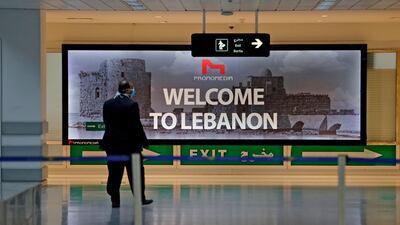
The arrivals' terminal at Beirut international airport is pictured as it re-opens. AFP -
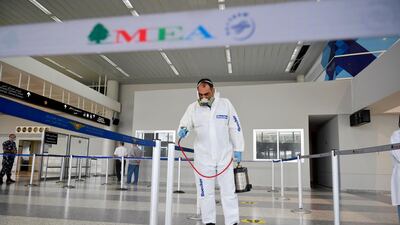
An airport worker wearing a protective suit sprays disinfectant as a precaution against the spread of the Covid-19. EPA -
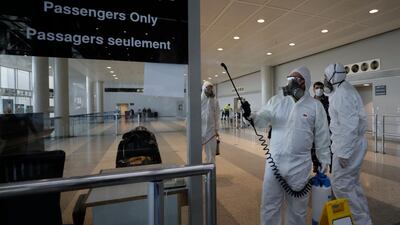
Beirut's airport is partially reopening after a three-month shutdown and Lebanon's cash-strapped government hopes thousands of Lebanese expatriates will return for the summer, injecting badly needed dollars into the sinking economy. AP -

Social distancing markings have been established in the arrival hall of the Rafik Hariri international airport during its re-opening in Beirut. EPA -

Social distancing markers line the floors to the passport control area in the departures hall at Rafik Hariri International Airport in Beirut. Bloomberg -
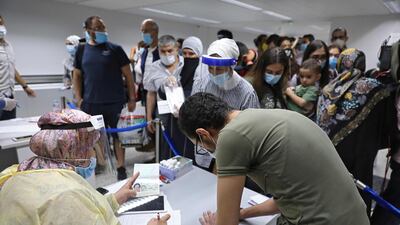
People arriving at Beirut international airport stop at a counter manned by health workers as the airport re-opens in the Lebanese capital. AFP -
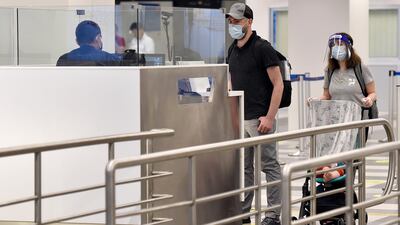
A member of a Lebanese General Security checks the passports of passengers upon her arrival at Rafik Hariri international airport during its re-opening in Beirut. EPA -
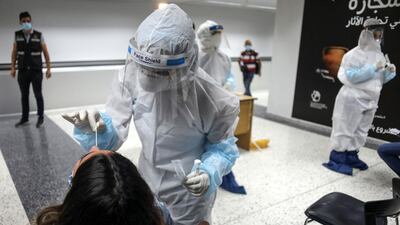
Medical workers wearing personal protective equipment collect Covid-19 swab samples as they test travellers inside the arrivals hall at Rafik Hariri International Airport in Beirut. Bloomberg -

A passenger arrives at the Rafik Hariri international airport during its re-opening in Beirut, Lebanon. EPA -
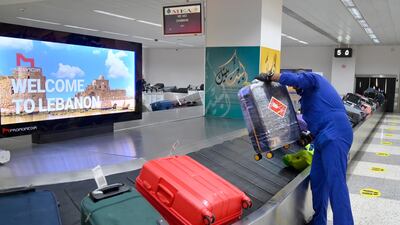
A worker carries luggage at Rafik Hariri international airport during its re-opening in Beirut at 10 per cent capacity, which is expected to bring in around 2,000 travellers per day. EPA -
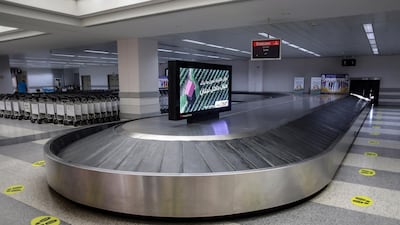
Social distancing markers sit on the floor around the baggage reclaim carousel in the arrivals hall at Rafik Hariri International Airport in Beirut. Bloomberg -
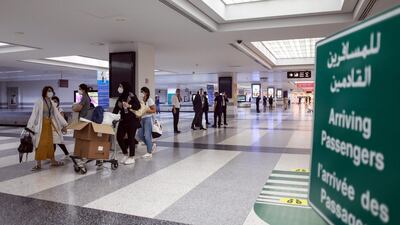
Passengers wearing protective face masks walk through the baggage reclaim area inside the arrivals hall at Rafik Hariri International Airport in Beirut. Bloomberg -
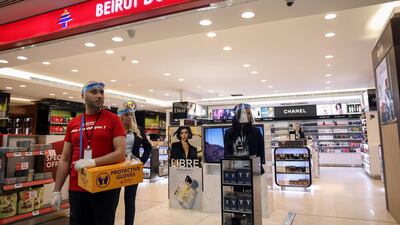
With many governments loosening travel restrictions to restart economies, airlines have begun restoring flights that were put on hold as the coronavirus pandemic spread. Bloomberg -

Lebanon was faster than most other countries to decide on a lockdown to avoid the spread of the Covid-19 coronavirus. By the end of February, schools were closed, and the airport and most bars and restaurants soon follow suit. AFP -
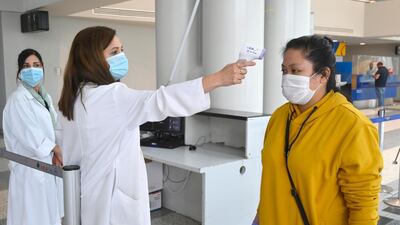
Health workers checks the temperature of a passenger at the departure terminal of the Rafik Hariri International Airport during its re-opening in Beirut. EPA -
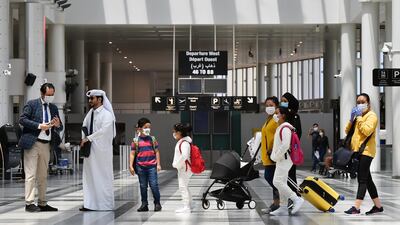
People wearing protective face masks against Covid-19 are pictured at the departure terminal of the Rafik Hariri international airport during its re-opening. EPA -

Passengers and officials wearing protective face masks against Covid-19 are pictured at Beirut international airport as it re-opens. AFP -
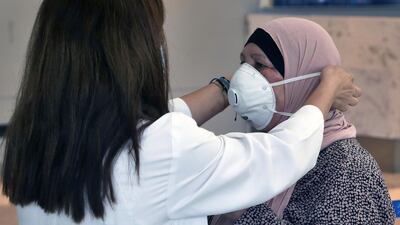
A healthcare worker adjusts the mask of a passenger who is departing the Rafik Hariri International Airport in Beirut, Lebanon, Wednesday, July 1, 2020. AP -
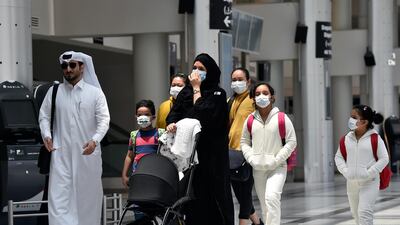
People wearing protective face masks against Covid-19 are pictured at the departure terminal of the Rafik Hariri international airport during its re-opening in Beirut. EPA -
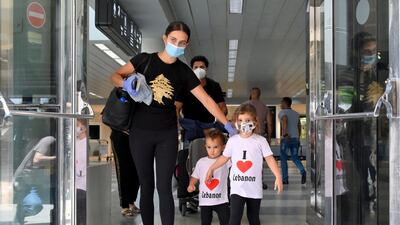
People wearing protective face masks against Covid-19 are pictured upon their arrival at the terminal of the Rafik Hariri International Airport during its re-opening in Beirut. EPA -
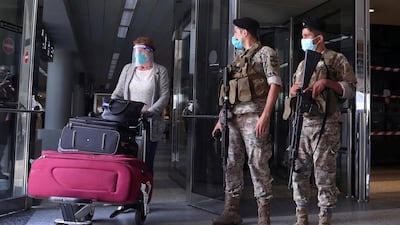
Lebanese soldiers stand guard as a woman leaves the Rafik Hariri International Airport in Beirut. AP -
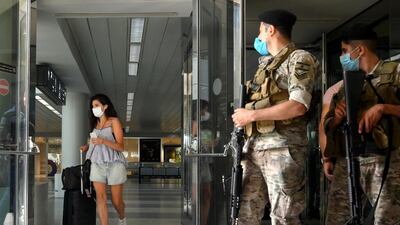
Lebanese soldiers stand guard as a woman leaves Rafik Hariri international airport during its re-opening in Beirut. EPA -
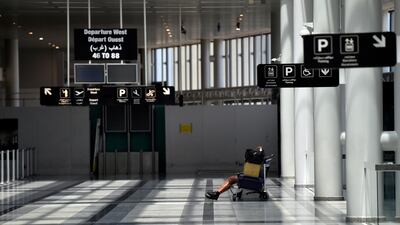
A passenger waits in the departure hall of the Rafik Hariri international airport during its re-opening in Beirut. EPA -
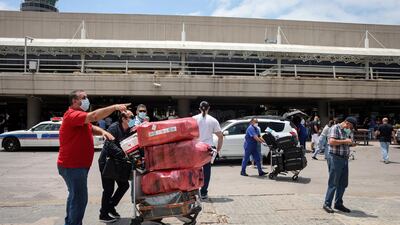
Passengers wearing protective face masks push luggage carts outside the terminal at Rafik Hariri International Airport in Beirut. Bloomberg


About two thirds of respondents said they expected to travel less for business or for leisure once the pandemic subsided, while 64 per cent said they would postpone travel until their personal finances and the broader economy improved.
However, people had not entirely lost their appetite to fly, with 57 per cent saying they were willing board a plane to see family and friends once the pandemic ends.
Another 56 per cent said they were willing to go on vacation while 55 per cent were willing take to the skies on business trips.
“You have a combination of ‘I don’t think I’ll travel as much’ but on the flip side ‘I’m going to travel soon’. One could almost conjecture that there is some pent-up demand there,” Mr Dutton said, pointing to the divergence in results.
People in France and Germany were more inclined to begin travelling once the pandemic ends while those in Singapore and Japan showed the least interest, Mr Dutton said.
Respondents were mainly concerned about being in crowded buses or trains, standing in check-in or border control queues and using airport toilets.
The biggest worries travellers had about flying were sitting next to someone with Covid-19, using aircraft toilets or breathing the air in the plane.
While 84 per cent said they feared catching the virus while travelling, they were also worried about being quarantined abroad or when they returned home.
Asked about the top three measures that would make them feel safer, 37 per cent cited Covid-19 screening at departure airports, while 34 per cent backed the mandatory wearing of face masks and 33 per cent mentioned social distancing measures on aircraft.
Respondents said they were willing to have their temperature checked and to wear face masks during the flight. They also said they preferred online check-ins to reduce the risk of having contact with others at airports.
Still, 17 per cent were unwilling to undergo a 14-day self-isolation period. Iata called for alternative measures to quarantines, which it called a "demand killer".
-
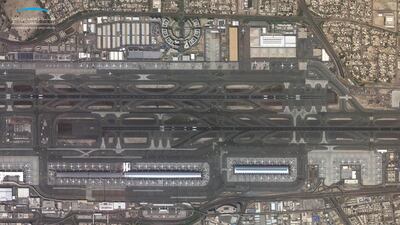
Dubai International Airport. Courtesy MBRSC -
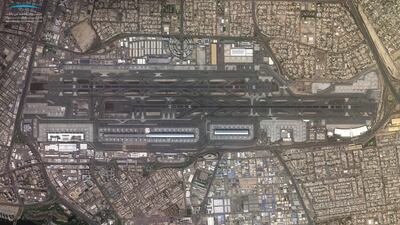
Another view of Dubai Airport. Courtesy MBRSC -

Los Angeles International Airport taken during the coronavirus pandemic. Courtesy MBRSC -
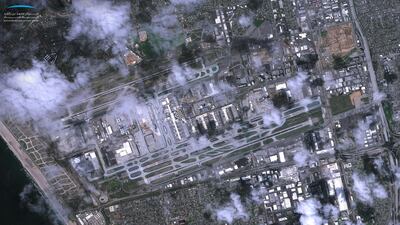
Los Angeles International. Courtesy MBRSC -
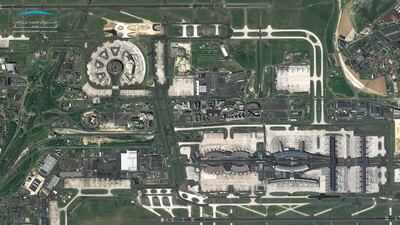
Paris's Charles de Gaulle Airport. Courtesy MBRSC -
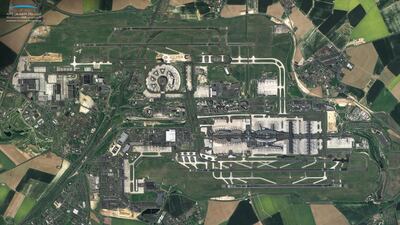
Paris Charles de Gaulle. Courtesy MBRSC -
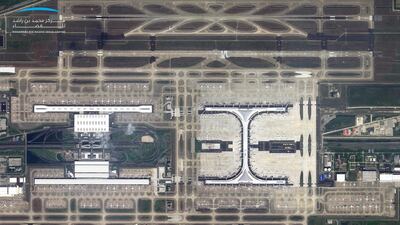
Shanghai's Pudong International Airport taken during the coronavirus pandemic. Courtesy MBRSC -
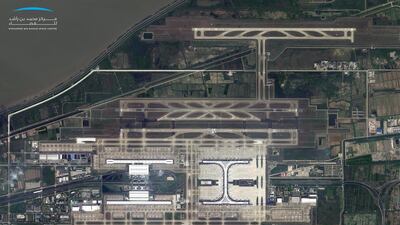
Shanghai International. Courtesy MBRSC -
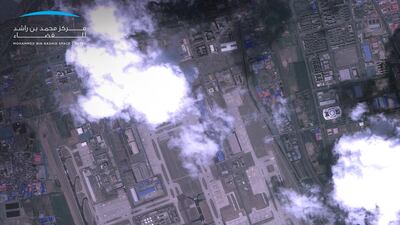
Beijing Central. Courtesy MBRSC -
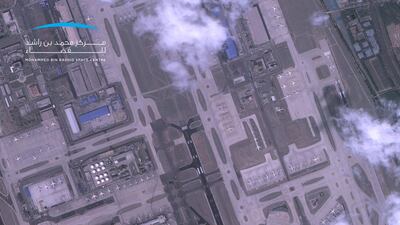
Beijing Capital International Airport. Courtesy MBRSC


Asked about products or incentives that would encourage them to fly again, two in five respondents cited insurance to cover virus-related disruptions and a cheaper or easier process to obtain visas for foreign travel.
Typically, when airlines emerge from a recession, they offer low fares to stimulate demand but in the case of the pandemic, it is a matter of restoring passenger confidence, Brian Pearce, Iata’s chief economist, said.
Alexandre de Juniac, Iata’s director general, said he was disappointed by the concerns highlighted in the survey because the industry had introduced layers of protective safety measures.
“This crisis could have a very long shadow,” Mr de Juniac said. “Passengers are telling us that it will take time before they return to their old travel habits.”
Airlines said they did not expect travel demand to return to pre-pandemic levels until 2023 or 2024 as Covid-19 takes its toll on the world economy, consumer spending and passenger confidence.
Continued government financial relief measures will therefore be critical "for some time to come," Mr de Juniac said.

