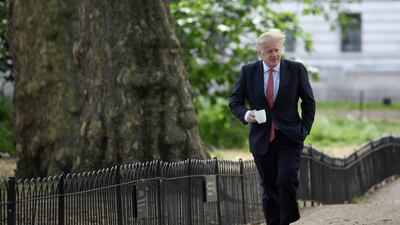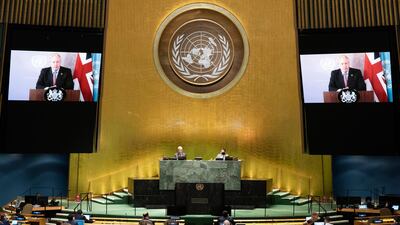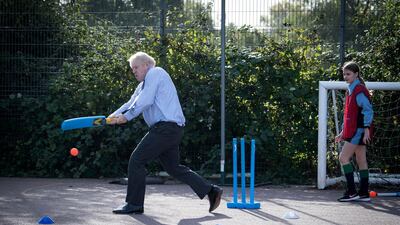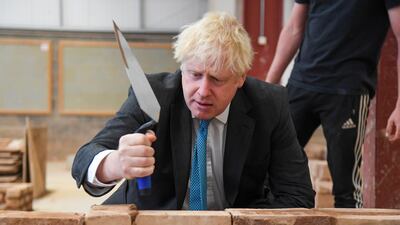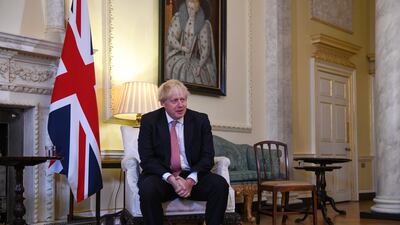
The British Prime Minister Boris Johnson took a second class degree in Classics at Oxford and will be familiar with the Latin phrase “annus mirabilis”, or “wonderful year”.
In his “annus mirabilis”, 2019, Mr Johnson achieved his heart’s desire – becoming prime minister. In last December’s General Election, he annihilated his opponents and destroyed rebels in his own party by winning an 80 seat majority. He triumphed because he promised to “Get Brexit Done.” He then threatened the EU that he would walk away with “No Deal” unless they offered him “fantastic” terms, which meant the UK could “have our cake and eat it”.
Mr Johnson had enthusiastic support from the US President, which meant he could perhaps secure a rapid US-UK post-Brexit trade deal and reinvigorate the “special relationship”. Donald Trump praised Johnson publicly in terms even more glowing than he had used to describe North Korea’s leader Kim Jong-un.
Mr Trump said: “We have a really good man who’s going to be the prime minister of the UK now. He’s tough and he’s smart. They’re saying, ‘Britain Trump’. They call him ‘Britain Trump’ and people are saying that’s a good thing.”
If 2019 was Mr Johnson's “annus mirabilis” – he even managed to get divorced and father a new child – 2020 is Mr Johnson’s “annus horribilis”, a terrible year in which the wheels have come off the Johnson bandwagon. Brexit isn’t done. Mr Johnson set another self-invented deadline for finalising negotiations by mid-October.
Maybe something extraordinary this week will produce a rapid deal, or maybe not. Then the coronavirus pandemic exposed his personal as well as policy failures. He doesn’t do details, often doesn’t listen to expert advice, and has no clearly defined ideology or plan.
Instead Boris Johnson has a style, bragging like Donald Trump about his “world-beating” successes, which never quite exist in real life. He claimed UK coronavirus testing in 2020 would be “world-beating”. It isn’t. It is expensive and incompetent.
He himself caught the virus. The UK death rate is high. The arrival of a second wave has resulted in open rebellion from mayors in some of England’s great cities who say they are fed up with Mr Johnson’s chaotic “leadership”.
Mr Johnson’s cronies have been appointed to top positions. Companies with no experience in dealing with a viral epidemic have been awarded lucrative government contracts. TV comedians poke fun at him for mixed messages and an antiquated style of speaking.
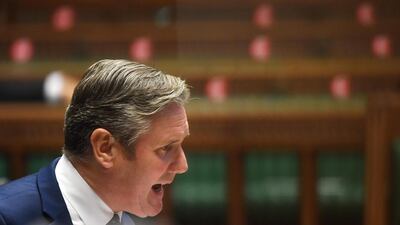
Opinion polls now show the British Prime Minister is less popular than Labour's leader Kier Starmer. Conservative Members of Parliament are privately very uneasy that Mr Johnson is adrift in his high office.
Boris Johnson triumphed because he promised to 'get Brexit done', then threatened to walk away
It is bad but all the signs are that the “annus horribilis” could get even worse. Mr Johnson has shown no coherent plan for bearing down on coronavirus while the British economy is set to weaken still further.
On top of the pandemic, the self-inflicted wound of Brexit means that after four and a half years of blathering, the UK could face severe trade dislocation, confusion at British ports, a weakening of the currency and inevitably more job losses.
It appears that the Prime Minister has three options. The first is that Britain seeks yet another extension for more talks, but Brexit supporters will be furious at any further delay.
Option two is that to get a last minute deal Mr Johnson will – as he has done before – concede whatever the EU demands yet present it as a "fantastic success". Staunch Brexit campaigners like Nigel Farage will be even more furious and call it a "sell-out".
The third possibility is that there will be no deal, which will do massive self-inflicted damage to the UK economy. While Brexit hardliners may rejoice at No Deal, Mr Johnson will be faced with leading a government through years of economic turmoil, while financing the cost of existing economic damage from coronavirus. That presumably means unpopular tax rises.
As the former prime minister Tony Blair once put it to me, Mr Johnson ultimately must choose between “a pointless Brexit or a painful Brexit”, a deal which does profound damage to the British economy, or one which aligns Britain with Europe, does less damage but does indeed seem pointless.
If 2020 was bad, next year could be even worse. Polls suggest that in January 2021, it will be Joe Biden who is inaugurated President of the US. “Britain Trump” is already desperately trying to cosy up to “America Biden”, but given the way Mr Johnson derided the Obama presidency when Joe Biden was vice president, a warm Johnson-Biden relationship seems unlikely.
And so, out of the EU, probably out of favour with the White House, Mr Johnson might find British voters, after a terrible year, come to learn another Latin phrase in 2021 – “annus exitiabilis” or a “catastrophic year”.
Gavin Esler is a UK columnist for The National

Mercer, the investment consulting arm of US services company Marsh & McLennan, expects its wealth division to at least double its assets under management (AUM) in the Middle East as wealth in the region continues to grow despite economic headwinds, a company official said.
Mercer Wealth, which globally has $160 billion in AUM, plans to boost its AUM in the region to $2-$3bn in the next 2-3 years from the present $1bn, said Yasir AbuShaban, a Dubai-based principal with Mercer Wealth.
“Within the next two to three years, we are looking at reaching $2 to $3 billion as a conservative estimate and we do see an opportunity to do so,” said Mr AbuShaban.
Mercer does not directly make investments, but allocates clients’ money they have discretion to, to professional asset managers. They also provide advice to clients.
“We have buying power. We can negotiate on their (client’s) behalf with asset managers to provide them lower fees than they otherwise would have to get on their own,” he added.
Mercer Wealth’s clients include sovereign wealth funds, family offices, and insurance companies among others.
From its office in Dubai, Mercer also looks after Africa, India and Turkey, where they also see opportunity for growth.
Wealth creation in Middle East and Africa (MEA) grew 8.5 per cent to $8.1 trillion last year from $7.5tn in 2015, higher than last year’s global average of 6 per cent and the second-highest growth in a region after Asia-Pacific which grew 9.9 per cent, according to consultancy Boston Consulting Group (BCG). In the region, where wealth grew just 1.9 per cent in 2015 compared with 2014, a pickup in oil prices has helped in wealth generation.
BCG is forecasting MEA wealth will rise to $12tn by 2021, growing at an annual average of 8 per cent.
Drivers of wealth generation in the region will be split evenly between new wealth creation and growth of performance of existing assets, according to BCG.
Another general trend in the region is clients’ looking for a comprehensive approach to investing, according to Mr AbuShaban.
“Institutional investors or some of the families are seeing a slowdown in the available capital they have to invest and in that sense they are looking at optimizing the way they manage their portfolios and making sure they are not investing haphazardly and different parts of their investment are working together,” said Mr AbuShaban.
Some clients also have a higher appetite for risk, given the low interest-rate environment that does not provide enough yield for some institutional investors. These clients are keen to invest in illiquid assets, such as private equity and infrastructure.
“What we have seen is a desire for higher returns in what has been a low-return environment specifically in various fixed income or bonds,” he said.
“In this environment, we have seen a de facto increase in the risk that clients are taking in things like illiquid investments, private equity investments, infrastructure and private debt, those kind of investments were higher illiquidity results in incrementally higher returns.”
The Abu Dhabi Investment Authority, one of the largest sovereign wealth funds, said in its 2016 report that has gradually increased its exposure in direct private equity and private credit transactions, mainly in Asian markets and especially in China and India. The authority’s private equity department focused on structured equities owing to “their defensive characteristics.”
Fireball
Moscow claimed it hit the largest military fuel storage facility in Ukraine, triggering a huge fireball at the site.
A plume of black smoke rose from a fuel storage facility in the village of Kalynivka outside Kyiv on Friday after Russia said it had destroyed the military site with Kalibr cruise missiles.
"On the evening of March 24, Kalibr high-precision sea-based cruise missiles attacked a fuel base in the village of Kalynivka near Kyiv," the Russian defence ministry said in a statement.
Ukraine confirmed the strike, saying the village some 40 kilometres south-west of Kyiv was targeted.
If you go
The flights
Etihad (etihad.com) flies from Abu Dhabi to Luang Prabang via Bangkok, with a return flight from Chiang Rai via Bangkok for about Dh3,000, including taxes. Emirates and Thai Airways cover the same route, also via Bangkok in both directions, from about Dh2,700.
The cruise
The Gypsy by Mekong Kingdoms has two cruising options: a three-night, four-day trip upstream cruise or a two-night, three-day downstream journey, from US$5,940 (Dh21,814), including meals, selected drinks, excursions and transfers.
The hotels
Accommodation is available in Luang Prabang at the Avani, from $290 (Dh1,065) per night, and at Anantara Golden Triangle Elephant Camp and Resort from $1,080 (Dh3,967) per night, including meals, an activity and transfers.
COMPANY PROFILE
Name: Kumulus Water
Started: 2021
Founders: Iheb Triki and Mohamed Ali Abid
Based: Tunisia
Sector: Water technology
Number of staff: 22
Investment raised: $4 million
UAE currency: the story behind the money in your pockets
First Person
Richard Flanagan
Chatto & Windus
Dubai Bling season three
Cast: Loujain Adada, Zeina Khoury, Farhana Bodi, Ebraheem Al Samadi, Mona Kattan, and couples Safa & Fahad Siddiqui and DJ Bliss & Danya Mohammed
Rating: 1/5
UNSC Elections 2022-23
Seats open:
- Two for Africa Group
- One for Asia-Pacific Group (traditionally Arab state or Tunisia)
- One for Latin America and Caribbean Group
- One for Eastern Europe Group
Countries so far running:
Ten tax points to be aware of in 2026
1. Domestic VAT refund amendments: request your refund within five years
If a business does not apply for the refund on time, they lose their credit.
2. E-invoicing in the UAE
Businesses should continue preparing for the implementation of e-invoicing in the UAE, with 2026 a preparation and transition period ahead of phased mandatory adoption.
3. More tax audits
Tax authorities are increasingly using data already available across multiple filings to identify audit risks.
4. More beneficial VAT and excise tax penalty regime
Tax disputes are expected to become more frequent and more structured, with clearer administrative objection and appeal processes. The UAE has adopted a new penalty regime for VAT and excise disputes, which now mirrors the penalty regime for corporate tax.
5. Greater emphasis on statutory audit
There is a greater need for the accuracy of financial statements. The International Financial Reporting Standards standards need to be strictly adhered to and, as a result, the quality of the audits will need to increase.
6. Further transfer pricing enforcement
Transfer pricing enforcement, which refers to the practice of establishing prices for internal transactions between related entities, is expected to broaden in scope. The UAE will shortly open the possibility to negotiate advance pricing agreements, or essentially rulings for transfer pricing purposes.
7. Limited time periods for audits
Recent amendments also introduce a default five-year limitation period for tax audits and assessments, subject to specific statutory exceptions. While the standard audit and assessment period is five years, this may be extended to up to 15 years in cases involving fraud or tax evasion.
8. Pillar 2 implementation
Many multinational groups will begin to feel the practical effect of the Domestic Minimum Top-Up Tax (DMTT), the UAE's implementation of the OECD’s global minimum tax under Pillar 2. While the rules apply for financial years starting on or after January 1, 2025, it is 2026 that marks the transition to an operational phase.
9. Reduced compliance obligations for imported goods and services
Businesses that apply the reverse-charge mechanism for VAT purposes in the UAE may benefit from reduced compliance obligations.
10. Substance and CbC reporting focus
Tax authorities are expected to continue strengthening the enforcement of economic substance and Country-by-Country (CbC) reporting frameworks. In the UAE, these regimes are increasingly being used as risk-assessment tools, providing tax authorities with a comprehensive view of multinational groups’ global footprints and enabling them to assess whether profits are aligned with real economic activity.
Contributed by Thomas Vanhee and Hend Rashwan, Aurifer
Red flags
- Promises of high, fixed or 'guaranteed' returns.
- Unregulated structured products or complex investments often used to bypass traditional safeguards.
- Lack of clear information, vague language, no access to audited financials.
- Overseas companies targeting investors in other jurisdictions - this can make legal recovery difficult.
- Hard-selling tactics - creating urgency, offering 'exclusive' deals.
Courtesy: Carol Glynn, founder of Conscious Finance Coaching
The specs: 2018 Audi R8 V10 RWS
Price: base / as tested: From Dh632,225
Engine: 5.2-litre V10
Gearbox: Seven-speed automatic
Power: 540hp @ 8,250rpm
Torque: 540Nm @ 6,500rpm
Fuel economy, combined: 12.4L / 100km