Tourists watching the water fountain display near the Burj Khalifa in Dubai. Bloomberg

Dubai's international visitors up more than threefold in first five months of 2022


Alvin R Cabral
  • English
  • Arabic

Dubai welcomed about 6.17 million international visitors from January to May 2022, three times more than the approximately two million recorded in the same period last year, according to the emirate's Department of Economy and Tourism.

The surge in visitor numbers was a result of government initiatives that helped the tourism sector bounce back quickly from the Covid-19 pandemic and the momentum generated by Expo 2020 Dubai, the DET said in its first City Briefing for 2022 on Thursday.

The figure is also up about 20 per cent from the 5.1 million visitors recorded in the first four months of 2022.

"As we look ahead to the remainder of 2022 and beyond, we will harness the key elements that have ensured the industry’s steady growth year after year since we reopened to international visitors in 2020 — providing an unparalleled diverse destination offering [with] unique value and memorable experiences for our guests," Helal Almarri, director general of DET, said in a statement provided by the Dubai Media Office.

Tourism is one of the key pillars of Dubai's economy, but as with the global industry, it ground to a halt because of the pandemic.

The UAE, however, implemented rigid safety measures and rolled out an extensive vaccination programme to stem the spread of Covid-19. As a result, it became one of the first economies to reopen and welcome back visitors.

The travel and tourism sector plays a key role in Dubai's non-oil private sector economy, which posted “robust improvement” in May as it surged to its strongest level in 35 months, the headline S&P Global Dubai Purchasing Managers' Index showed earlier this month.

Outbound travel is also expected to continue its upward trajectory. Dubai Airports on Thursday advised travellers to brace for a busy period starting this weekend, with daily passenger traffic at Dubai International Airport expected to average 214,000 owing to the school summer break and the upcoming Eid Al Adha holidays.

There are also several megaprojects in the UAE, either under way or already open, that will help attract more visitors, including the Sharjah forest community, Falcon Island in Ras Al Khaimah, National History Museum Abu Dhabi and the recently opened Mohammed bin Rashid Library in Dubai.

Meanwhile, the site of Expo 2020, which concluded in March, will be transformed into Expo City Dubai and will soon welcome thousands of new residents and businesses.

DET figures revealed that Dubai's hotels had an occupancy level of 76 per cent from January to May, maintaining their performance through the end of April, and up from 62 per cent in the same period last year.

That places the emirate first globally in that metric, ahead of other international destinations including New York, London and Paris, according to hospitality analytics provider STR.

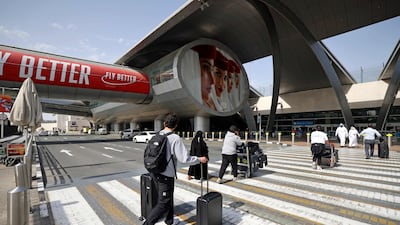
  • Dubai's post-pandemic boom has made it one of the most visited places in the world today. Further to that, the city has seen tens of thousands of new residents arrive to settle down. Reuters
    Dubai's post-pandemic boom has made it one of the most visited places in the world today. Further to that, the city has seen tens of thousands of new residents arrive to settle down. Reuters
  • Between late 2020 and spring 2022, the city's population grew by close to 100,000 people. Karim Sahib / AFP
    Between late 2020 and spring 2022, the city's population grew by close to 100,000 people. Karim Sahib / AFP
  • Lifestyle and a growing jobs market has attracted many residents to flashy communities such as Jumeirah Beach Residence. Reuters
    Lifestyle and a growing jobs market has attracted many residents to flashy communities such as Jumeirah Beach Residence. Reuters
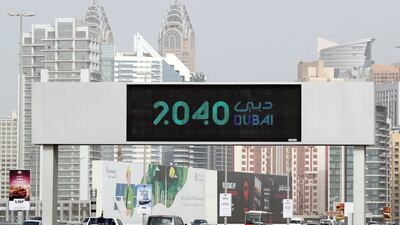
  • Population growth is a major part of Dubai's 2040 Urban Plan, which seeks to boost the population to 5.8 million. Chris Whiteoak / The National
    Population growth is a major part of Dubai's 2040 Urban Plan, which seeks to boost the population to 5.8 million. Chris Whiteoak / The National
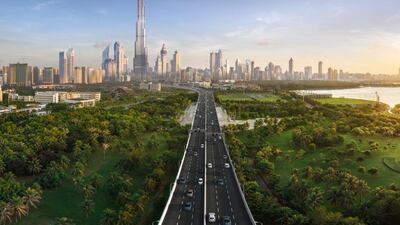
  • There are plans to physically expand Dubai, creating new beaches and parks for the larger population. The government wants 60 per cent of the city to be green parks and reserves. Photo: Dubai Media Office
    There are plans to physically expand Dubai, creating new beaches and parks for the larger population. The government wants 60 per cent of the city to be green parks and reserves. Photo: Dubai Media Office
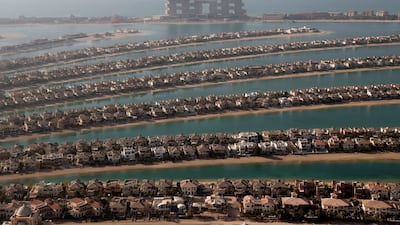
  • The past two years have \seen a rush of foreign investors looking to buy new property in places such as Palm Jumeirah, where prices have risen significantly. AP Photo / Kamran Jebreili
    The past two years have \seen a rush of foreign investors looking to buy new property in places such as Palm Jumeirah, where prices have risen significantly. AP Photo / Kamran Jebreili
  • Landmarks such as Bluewaters Island and Ain Dubai, the world’s largest observation wheel, have put Dubai on the map as a global lifestyle destination. Reuters
    Landmarks such as Bluewaters Island and Ain Dubai, the world’s largest observation wheel, have put Dubai on the map as a global lifestyle destination. Reuters

All these figures reflect the emirate's resilience and the successful implementation of the recovery strategy for the tourism sector, said Issam Kazim, chief executive of Dubai Corporation for Tourism and Commerce Marketing.

“Our constant dialogue with partners is crucial in ensuring that we are all aligned with the collective efforts being made under the guidance of our visionary leadership to ensure the city stays at the forefront of the world’s leading travel destinations," he said.

The summer season will bring back notable events on Dubai's tourism and retail calendar, including Dubai Summer Surprises, the region’s biggest festival for the season that is marking its 25th edition, Eid Al Adha and the Dubai Fitness Challenge, which kicks off in October.

“With our unbeatable summer proposition, Dubai offers more value than any comparable destination with its world-class infrastructure, the vast scope of its events and entertainment centres and hassle-free entry process, making it the summer destination of choice for families," said Ahmed Al Khaja, chief executive of the Dubai Festivals and Retail Establishment.

"Our continuous collaboration with partners has paved the way for Dubai to offer a unique holiday package, allowing families, residents and visitors to avail themselves of innovative promotions, incentives and diverse deals this summer in Dubai."


Dubai's Department of Economy and Tourism held its first City Briefing for 2022 on Thursday. Photo: DET
Mental%20health%20support%20in%20the%20UAE
%3Cp%3E%E2%97%8F%20Estijaba%20helpline%3A%208001717%3Cbr%3E%E2%97%8F%20UAE%20Ministry%20of%20Health%20and%20Prevention%20hotline%3A%20045192519%3Cbr%3E%E2%97%8F%20UAE%20Mental%20health%20support%20line%3A%20800%204673%20(Hope)%3Cbr%3EMore%20information%20at%20hope.hw.gov.ae%3C%2Fp%3E%0A

Mercer, the investment consulting arm of US services company Marsh & McLennan, expects its wealth division to at least double its assets under management (AUM) in the Middle East as wealth in the region continues to grow despite economic headwinds, a company official said.

Mercer Wealth, which globally has $160 billion in AUM, plans to boost its AUM in the region to $2-$3bn in the next 2-3 years from the present $1bn, said Yasir AbuShaban, a Dubai-based principal with Mercer Wealth.

Within the next two to three years, we are looking at reaching $2 to $3 billion as a conservative estimate and we do see an opportunity to do so,” said Mr AbuShaban.

Mercer does not directly make investments, but allocates clients’ money they have discretion to, to professional asset managers. They also provide advice to clients.

“We have buying power. We can negotiate on their (client’s) behalf with asset managers to provide them lower fees than they otherwise would have to get on their own,” he added.

Mercer Wealth’s clients include sovereign wealth funds, family offices, and insurance companies among others.

From its office in Dubai, Mercer also looks after Africa, India and Turkey, where they also see opportunity for growth.

Wealth creation in Middle East and Africa (MEA) grew 8.5 per cent to $8.1 trillion last year from $7.5tn in 2015, higher than last year’s global average of 6 per cent and the second-highest growth in a region after Asia-Pacific which grew 9.9 per cent, according to consultancy Boston Consulting Group (BCG). In the region, where wealth grew just 1.9 per cent in 2015 compared with 2014, a pickup in oil prices has helped in wealth generation.

BCG is forecasting MEA wealth will rise to $12tn by 2021, growing at an annual average of 8 per cent.

Drivers of wealth generation in the region will be split evenly between new wealth creation and growth of performance of existing assets, according to BCG.

Another general trend in the region is clients’ looking for a comprehensive approach to investing, according to Mr AbuShaban.

“Institutional investors or some of the families are seeing a slowdown in the available capital they have to invest and in that sense they are looking at optimizing the way they manage their portfolios and making sure they are not investing haphazardly and different parts of their investment are working together,” said Mr AbuShaban.

Some clients also have a higher appetite for risk, given the low interest-rate environment that does not provide enough yield for some institutional investors. These clients are keen to invest in illiquid assets, such as private equity and infrastructure.

“What we have seen is a desire for higher returns in what has been a low-return environment specifically in various fixed income or bonds,” he said.

“In this environment, we have seen a de facto increase in the risk that clients are taking in things like illiquid investments, private equity investments, infrastructure and private debt, those kind of investments were higher illiquidity results in incrementally higher returns.”

The Abu Dhabi Investment Authority, one of the largest sovereign wealth funds, said in its 2016 report that has gradually increased its exposure in direct private equity and private credit transactions, mainly in Asian markets and especially in China and India. The authority’s private equity department focused on structured equities owing to “their defensive characteristics.”

Updated: June 23, 2022, 4:50 PM