


Sheikh Khalifa bin Zayed, who died on Friday at the age of 73, presided over the UAE’s transformation into a progressive economy.
Diversifying the UAE economy to boost non-oil revenue, developing it into a regional and global financial and tourism hub with best-in-class infrastructure and transportation networks and promoting the growth of a business-friendly environment were among the many milestones achieved by Sheikh Khalifa.
The Emirates opened up property sales to foreign investors and built an attractive ecosystem for small and medium-sized enterprises under his watch.
After succeeding the UAE Founding Father, the late Sheikh Zayed bin Sultan Al Nahyan, as President in November 2004, Sheikh Khalifa brought his long experience at senior levels of leadership to bear in charting the modernisation of the seven-emirate federation and ensuring its continued economic relevance both within the region and beyond.
“Sheikh Khalifa is recognised for bringing the UAE, a modest desert sheikhdom of seven emirates, to international fame and guiding the country through challenging times,” said Vijay Valecha, chief investment officer of Dubai-based Century Financial.
“Under his leadership, the UAE has seen rapid growth, offering a fair standard of living for the people calling this country home. Furthermore, he spearheaded the expansion of healthcare, education and technology sectors on regional and global scales as well as secondary sectors, which have effectively promoted the country’s economic diversity.”
He was responsible for steering the development of the oil and gas sector that has contributed to the country’s economic diversification. He also placed a heavy emphasis on renewable energies and redirected the UAE’s growth trajectory towards a future where hydrocarbons will no longer be the mainstay of the economy.
"Under his leadership, the UAE has become the most diversified economy in the GCC, transforming into a key logistical and tourist hub in the region," said M R Raghu, chief executive of research company Marmore Mena Intelligence.
"The UAE has the highest contribution of non-oil revenue as a percentage of total government revenue compared with other major oil-exporting countries in the region."
Opec’s third-largest producer, the UAE is turning to renewables as an alternative energy source and growing into a world leader in developing hydrogen.
Under Sheikh Khalifa’s leadership, the UAE also achieved success internationally, one highlight being the decision in 2009 to host the headquarters of the International Renewable Energy Agency in Abu Dhabi.
Sheikh Khalifa’s decree in December 2009 establishing the Emirates Nuclear Energy Corporation as the entity in charge of carrying out the UAE’s nuclear programme represents another milestone for the country. In 2021, commercial operations began at Barakah Nuclear Energy Plant.
The establishment of the renewable energy company, Masdar, in Abu Dhabi in 2006, paved the way for the building of solar power plants, further diversifying the energy mix. And last year, the UAE became the first Middle Eastern country to announce a net-zero by 2050 strategy as the country committed to supporting international efforts on global warming.
Under Sheikh Khalifa's leadership, a clear vision for the future helped to drive forward the Abu Dhabi Investment Authority, one of the nation's sovereign wealth funds.
Adaptable policy frameworks, regulatory changes and a flexible business and corporate environment have underpinned the country’s progress and propelled it to become the Arab world’s second-largest economy.
As part of Sheikh Khalifa's vision to attract business, the UAE introduced its first free zone in the 1980s, offering investors 100 per cent ownership of their organisations and favourable tax conditions. Today, there are more than 50 free zones across the Emirates.
The UAE is also home to world-leading financial and commodities hubs. Today, the Dubai International Financial Centre and Abu Dhabi Global Market are home to some of the world’s largest banks, investment houses, insurers, asset managers, cryptocurrency exchanges and a host of technology-focused start-ups, disrupting sectors from financial services to health and education. Dubai Multi Commodities Centre, one of the world’s fastest-growing commodities hubs, hosts companies that deal in everything from tea and coffee to rough diamonds and currency futures.
-
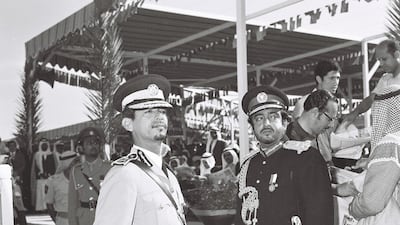
Sheikh Khalifa, right, and dignitaries watch a parade on Abu Dhabi Corniche to celebrate Accession Day, on November 28 1971. Photo: Al Ittihad -
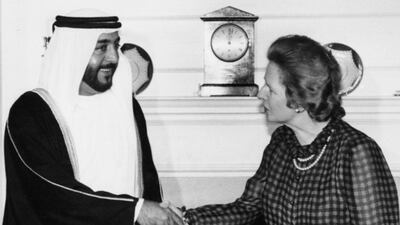
British Prime Minister Margaret Thatcher greets Sheikh Khalifa, Crown Prince of Abu Dhabi, at 10 Downing Street in London, on July 18, 1984. Keystone / Hulton Archive -
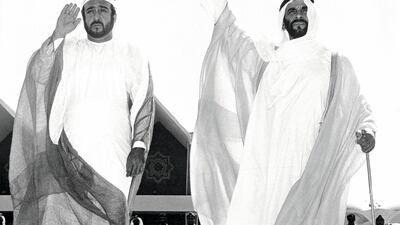
UAE Founding Father, the late Sheikh Zayed bin Sultan Al Nahyan, and Sheikh Khalifa. Photo: Al Ittihad -
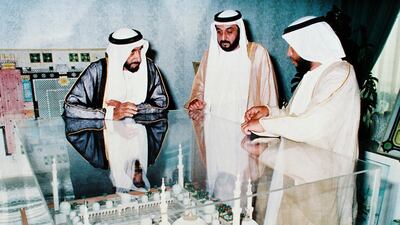
Sheikh Zayed inspects plans for the Sheikh Zayed Grand Mosque in Abu Dhabi, with his sons Sheikh Khalifa and Sheikh Sultan. Photo: Al Ittihad -
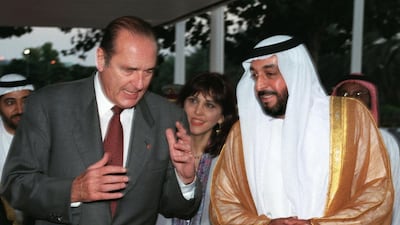
French President Jacques Chirac speaks to Sheikh Khalifa, Crown Prince of Abu Dhabi, at the end of his visit to the UAE on December 16, 1997. Reuters -
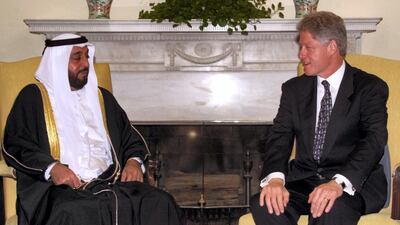
US President Bill Clinton meets Sheikh Khalifa, Crown Prince of Abu Dhabi, in the Oval Office of the White House on May 12, 1998. Reuters -
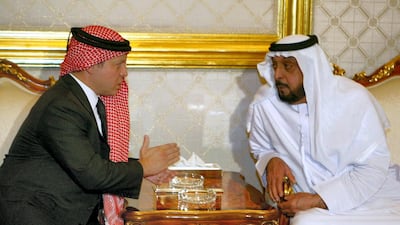
Jordan's King Abdullah II speaks to President Sheikh Khalifa, on the sidelines Sheikh Zayed's funeral in Abu Dhabi on November 3, 2004. AFP -

President Sheikh Khalifa stands for a photo with the UAE national football team at the Presidential Palace in Abu Dhabi on January 31, 2007, after the team beat Oman to win the Gulf Cup for the first time. AFP -
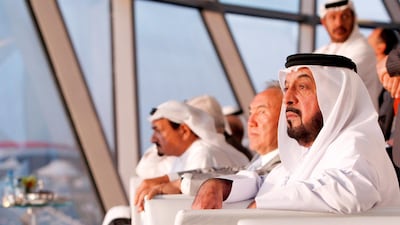
President Sheikh Khalifa watches the first Abu Dhabi Grand Prix at Yas Marina Circuit on November 1, 2009, with Nursultan Nazarbayev, President of Kazakstan, and Sheikh Humaid bin Rashid Al Nuaimi, Ruler of Ajman. Ryan Carter / The National -
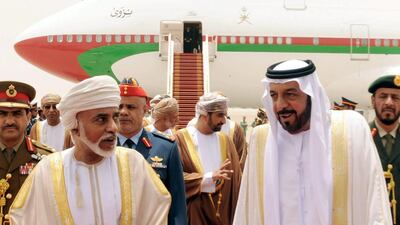
President Sheikh Khalifa greets Oman's leader, Sultan Qaboos, at Al Ain airport on July 11, 2011. Wam -
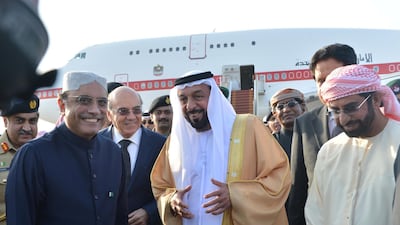
President Sheikh Khalifa leaves Al Ain on December 30, 2012, for a private visit to Pakistan. Wam -
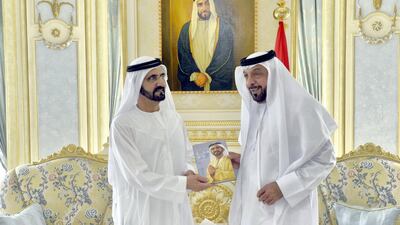
Sheikh Mohammed bin Rashid, Vice President and Ruler of Dubai, presents the first copy of his new book 'Flashes of Thought' to President Sheikh Khalifa in 2013. Wam -
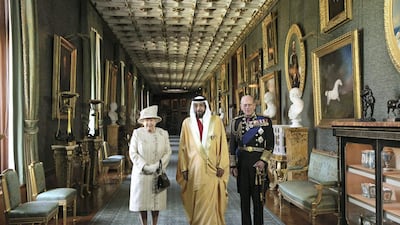
Britain's Queen Elizabeth II and Prince Philip with President Sheikh Khalifa at Windsor Castle in southern England on April 30, 2013. Reuters -
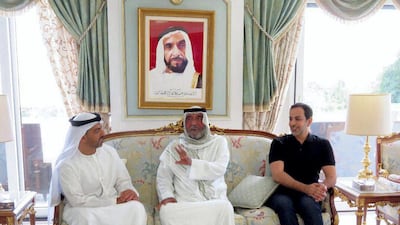
President Sheikh Khalifa meets family members at his home in Evian, France, in 2014. Wam -
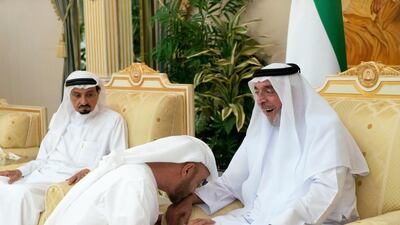
President Sheikh Khalifa receives Sheikh Mohamed bin Zayed, Crown Prince of Abu Dhabi and Deputy Supreme Commander of the UAE Armed Forces, at the Presidential Palace in Al Bateen, Abu Dhabi, on May 8, 2019. Also present is Sheikh Humaid bin Rashid Al Nuaimi, Ruler of Ajman. Ministry of Presidential Affairs -
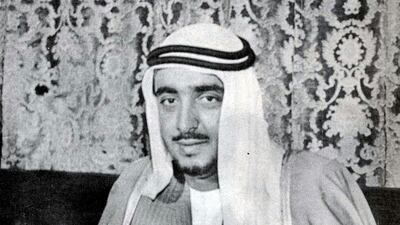
Sheikh Khalifa. Wam -

President Sheikh Khalifa. Wam -
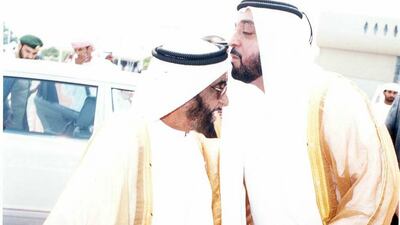
Sheikh Zayed and Sheikh Khalifa. Wam -
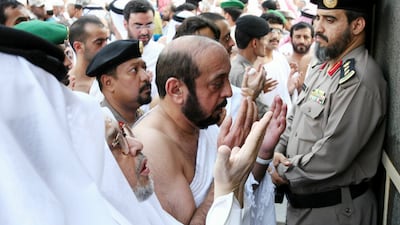
Sheikh Khalifa performing Umrah. Wam -
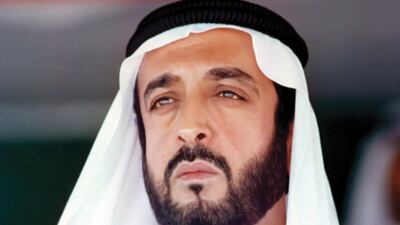
Sheikh Khalifa. Wam -

President Sheikh Khalifa receives Sheikh Dr Sultan bin Muhammad Al Qasimi, Ruler of Sharjah; Sheikh Humaid bin Rashid Al Nuaimi, Ruler of Ajman; Sheikh Hamad bin Mohammed Al Sharqi, Ruler of Fujairah; Sheikh Saud bin Rashid Al Mualla, Ruler of Umm Al Quwain; and Sheikh Saud bin Saqr Al Qasimi, Ruler of Ras Al Khaimah. Wam


These free zones have put the UAE on the global map and helped boost foreign direct investment (FDI) flows to the country.
“The UAE is almost unrecognisable from 20 years ago and has developed into a vibrant and dynamic place where individuals and businesses can flourish,” said Scott Livermore, chief economist at Oxford Economics Middle East.
“An important legacy from an economic perspective is the optimism and positivity around growth prospects for the coming years and the opportunities available to investors and talent attracted to the UAE.”
The local aviation industry’s development over the decades has transformed the nation from a fishing and pearl-diving spot into a global centre for air transport. It has developed into a global powerhouse for air connectivity and created best-in-class airlines such as Emirates, Etihad, Flydubai and Air Arabia that connect far-flung parts of the globe.
Under Sheikh Khalifa's leadership, the UAE aviation industry grew into a key pillar of the economy and a driver of business activity, contributing about 13 per cent of national gross domestic product. It is now home to six national airlines ranging from low-cost to full-service operators.
Open skies policies, large investments in infrastructure and a foreign investor-friendly business environment have spurred the development of the aviation industry under his leadership.
The UAE has also become part of the aerospace supply chain, rather than only a customer of billion-dollar aircraft orders placed with the world’s biggest plane makers. Strata, Mubadala Investment Company’s aerospace manufacturing unit, became the Arabian Gulf’s first producer of composite aircraft parts and is a key part of the UAE’s economic diversification and local industrialisation plan.
Etihad Rail, which aims to connect the UAE with the rest of the GCC, is another key infrastructure project under development. Stage one is complete and operating along a 264-kilometre route from Shah and Habshan to Ruwais, transporting sulphur.
The Emirates is also a world-leading tourist destination, with many projects introduced to attract both business and leisure visitors, including Louvre Abu Dhabi, Dubai’s Museum of the Future and the world's tallest building, Burj Khalifa.
The industry is a leading contributor to the country’s gross domestic product and also acts as a catalyst for the growth of the retail sector.
The UAE’s entertainment and hotel offerings are second to none in the region and its Mice (meetings, incentives, conferences, and events) industry enables it to host international business conferences and exhibitions throughout the year. Most recently, the country successfully organised Expo 2020 Dubai. It is set to host the 28th UN global climate change talks in 2023.
In the UAE, the decision in 2005 to permit the sale of freehold properties and 99-year leases in certain areas was also a game-changer. The sector is now one of the leading contributors to the UAE's non-oil economy and attracts significant global investment.
-
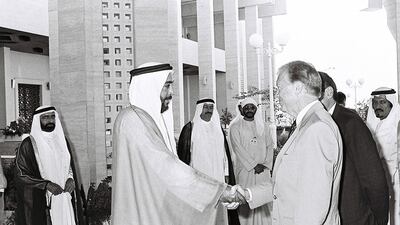
The UAE's President, Sheikh Khalifa, meets former US president Jimmy Carter at the Carter Centre in Atlanta, Georgia, in 1986. Photo: Al Ittihad -
President Sheikh Khalifa is welcomed to the Oval Office of the White House in Washington by then-US president Bill Clinton in May 1998. Reuters -
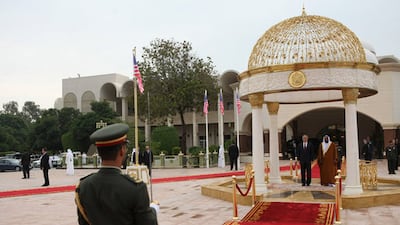
President Sheikh Khalifa and then-US president George W Bush stand for their national anthems in the courtyard of Al Mushrif Palace in Abu Dhabi. Photo: National Archives -
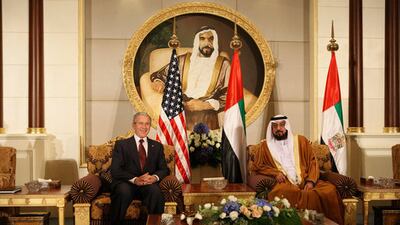
President Sheikh Khalifa and then-US president George W Bush at Al Mushrif Palace in Abu Dhabi. Photo: National Archives -

President Sheikh Khalifa welcomes then-US president George W Bush to the UAE at Abu Dhabi International Airport. Photo: National Archives -
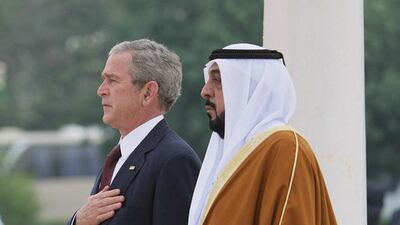
President Sheikh Khalifa and then-US president George W Bush at Al Mushref Palace in Abu Dhabi. Photo: National Archives


“Sheikh Khalifa was a visionary and embraced sustainable development as a guiding methodology to build a modern nation. He oversaw much of the country’s economic growth,” said Rizwan Sajan, founder and chairman of Danube Group.
Despite the pandemic shock in 2020 that sent the world into its deepest recession since the 1930s, the UAE economy bounced back strongly and is forecast by the Central Bank of the UAE to grow 4.2 per cent in 2022.
After expanding the size of its economy to about Dh1.5 trillion from Dh11 billion ($3bn) in 1973, the country now plans to double its economic output over the coming decade to Dh3tn.
In March, the UAE announced plans to increase the manufacturing sector’s contribution to GDP to Dh300bn over the next decade as it embarks on a national programme to boost output.
The “Operation 300bn” strategy is focused on expanding the UAE’s advanced manufacturing base in sectors including energy, petrochemicals, plastics, metals and green fuels. Building partnerships with global industrial champions and boosting FDI is part of the broader industrial growth plan.
Rules allowing full foreign ownership of onshore companies came into effect in June last year. Changes to the commercial company ownership laws, which were first announced in November 2020, removed the requirement for onshore companies to have a major UAE shareholder.
In November, the Central Bank of the UAE, the Ministry of Economy and the Ministry of Justice also enacted amendments to the Commercial Transactions Law regarding the decriminalisation of bounced cheques.
The UAE also launched Golden Visas and a path to citizenship for talented individuals who have made outstanding contributions to the country, as well as those who have highly-prized skills or work in key industries that are crucial to economic growth. This is aimed at encouraging more people to put down long-term roots in the country and to attract global talent to the UAE.
"The period of phenomenal growth had a need for legal reforms in the country," said Devanand Mahadeva, director of Bestwins Law Corporation.
"The most important legal developments have revolved around making the UAE more tolerant, such as with the reforms on personal status laws, labour laws, foreign business ownership, tax laws and cyber laws to meet the demands of the modern world."
Earlier this week, an unemployment insurance programme for Emirati and foreign workers was announced for both the private and public sectors.
The UAE also launched the Virtual Assets Regulatory Authority in March that aims to create an advanced legal framework to protect investors and provide international standards for virtual asset industry governance to enable responsible business growth.
-
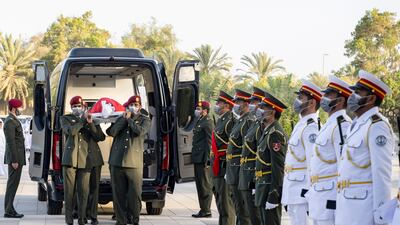
Pallbearers carry the body of President Sheikh Khalifa to be laid to rest. All photos: Ministry of Presidential Affairs -
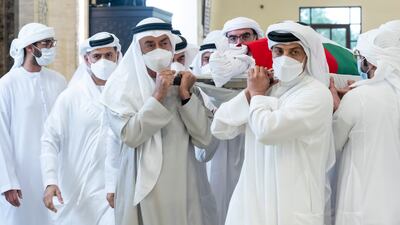
Sheikh Mohamed bin Zayed, Ruler of Abu Dhabi, and Sheikh Mansour bin Zayed, Deputy Prime Minister and Minister of Presidential Affairs, carry the body of Sheikh Khalifa. Hamad Al Kaabi / Ministry of Presidential Affairs -
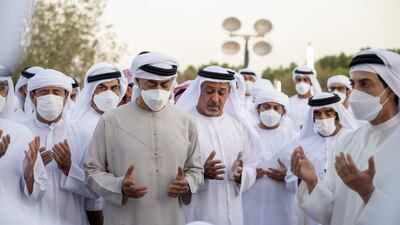
Sheikh Mohamed bin Zayed leads prayers for the late President Khalifa. Hamad Al Kaabi / Ministry of Presidential Affairs -
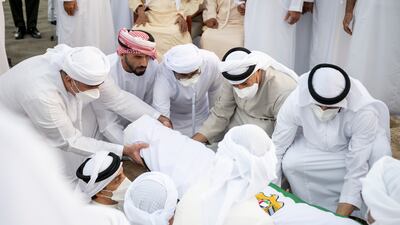
Sheikh Mohamed bin Zayed attends the burial of Sheikh Khalifa bin Zayed at Al Bateen cemetery. -
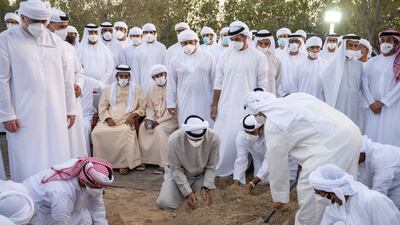
Sheikh Khalifa is laid to rest -

Sheikh Mansour prays at Al Bateen cemetery -
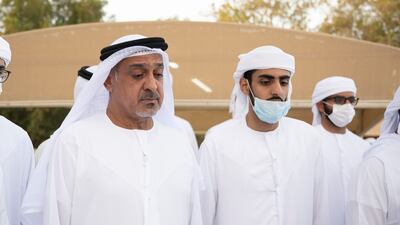
Sheikh Dr Sultan bin Khalifa Al Nahyan, left, adviser to the UAE President, attends the burial of Sheikh Khalifa bin Zayed at Al Bateen cemetery. -
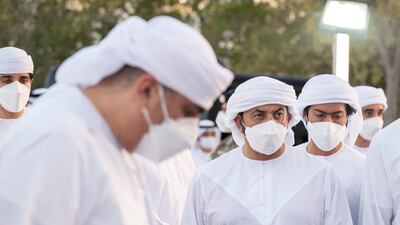
Sheikh Khalifa bin Tahnoon, right, and Sheikh Hamdan bin Zayed at the burial. -
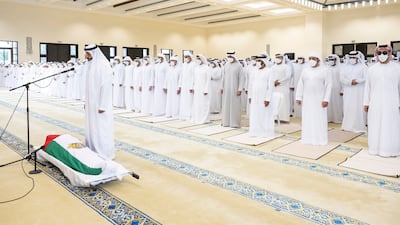
Ruling family members and senior officials attend funeral prayers -
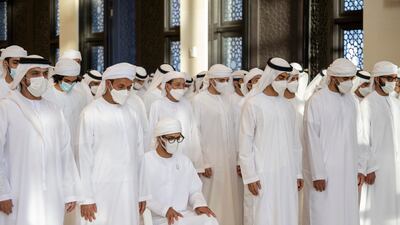
Sheikh Zayed bin Hamdan bin Zayed, third left; Sheikh Hamdan bin Mohamed bin Zayed, fourth left; and Sheikh Zayed bin Mohamed attend funeral prayers for Sheikh Khalifa at Sheikh Sultan bin Zayed The First mosque. -
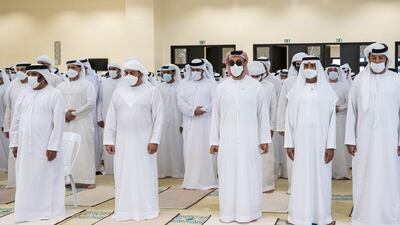
From right: Sheikh Saeed bin Saif, Sheikh Nahyan bin Mubarak, Sheikh Tahnoon bin Zayed, Sheikh Hamdan bin Zayed and Sheikh Saif bin Mohamed attend funeral prayers for Sheikh Khalifa bin Zayed at Sheikh Sultan bin Zayed The First mosque.


The country has created various business incubators to nurture start-ups, offering funding and mentorship, as it seeks to spur innovation and attract skilled talent. These include Abu Dhabi’s technology start-up incubator Hub71, Dubai Internet City’s tech-focused in5 business incubator and Intelak Hub, among others.
"The support extended by the UAE government to develop the SME ecosystem has enabled the country to become the most-preferred destination for foreign companies and start-ups in the Middle East. Notably, the UAE has the highest SME contribution to GDP among all GCC countries," Mr Raghu said.
The UAE made it mandatory for all listed companies to have at least one female director on their boards last year as it seeks to boost female participation in the workforce. The Emirates already has the highest level of women participating in the workforce — at 57.5 per cent in 2020 — of any country in the Mena region, the World Bank said last year.
Sheikh Khalifa also focused on developing a knowledge-based digital economy, driven by data analytics and artificial intelligence (AI). The UAE is developing a super computer and aims to train 100,000 coders as part of efforts to boost its knowledge-based economy.
The UAE’s road map for the next 50 years of development and economic growth focuses on new technologies, the Fourth Industrial Revolution and artificial intelligence. More importantly, the road map also looks to develop renewable and clean energy; oil, petrochemical and mining industries; and land and sea transport and storage sectors.

