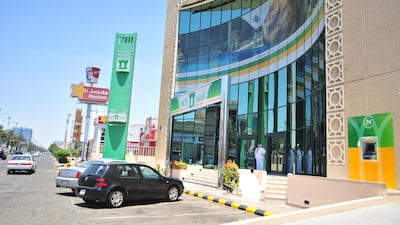
A new wave of mergers and acquisitions could take place within the GCC's banking sector as profit margins are pressured due to pandemic-induced headwinds, according to S&P Global Ratings.
The need for recapitalisation as provisions for bad loans rise and the asset quality deteriorates also supports the case for the consolidation of financial institutions in the region, Mohamed Damak, senior director for financial institutions ratings, said.
“Ultimately, lower profitability could start a new wave of M&A, and we think this wave, if it starts, will be different from what we have been observing so far,” Mr Damak told a webinar on Wednesday.
“It might involve consolidation across different GCC countries, or consolidation across different emirates here [in the UAE].”
Profits for most regional lenders, like their international peers, shrunk last year as they proactively allocated funds to cover potential loan losses. Loan book growth has also slowed and margins are under pressure amid historically low interest rates.
GCC banks have already experienced significant M&A activity after the three-year oil price slump that began in the middle of 2014. Shareholders who held stakes in more than one lender – typically regional governments and related entities – drove consolidation, creating stronger financial institutions with more robust balance sheets to better face tougher operating conditions.
The first wave led to the creation of some of the strongest financial institutions. First Abu Dhabi Bank, the UAE’s largest lender, was formed through the merger of National Bank of Abu Dhabi and First Gulf Bank in 2017.
Abu Dhabi Commercial Bank also completed a three-way merger with Union National Bank and Al Hilal Bank in 2019. Last year, Dubai Islamic Bank completed its acquisition of competitor Noor Bank to create an Islamic lender with total assets of more than Dh275bn ($75bn).
In Saudi Arabia, the kingdom’s largest lender National Commercial Bank, is edging closer to its takeover of smaller rival Samba Financial Group that will create a lender with a 31 per cent market share by assets.
Kuwait Finance House and Bahrain’s Ahli United Bank have also been in cross-border merger talks, but these were postponed in April last year.
A new wave of mergers will be more opportunistic and spurred by economic rationale, Mr Damak said.
“It would definitely require a more aggressive stance by managements to clear hurdles … convincing for example boards or shareholders … to accept to be diluted,” he said. “That exercise might be easier if they have to recapitalise their banks anyway.”
Moody’s Investors Services in October said the need for consolidation is more intense among smaller banks who face being “crowded out” by larger competitors.
S&P said that given the tough operating environment faced by the region's corporate sector, banks face a “lower-for-longer profitability” trend.
“The higher cost of risk and the decline in margins will drive profitability down,” Mr Damak said.
He expects an increase in non-performing loans in the region from 3.6 per cent on average last year to about 5-6 per cent in the next 12-24 months, as regulators gradually withdraw forbearance measures.
Sectors including real estate, construction, hospitality and consumer-related business are likely to put pressure on banks’ asset quality going forward.
“It remains to be seen whether we are going to see any additional intervention from the governments to reduce the risk of banks’ balance sheets,” he said.
In the UAE, the economy has been underpinned by more than Dh388bn worth of local and federal support measures to help cushion the impact of Covid-19 on the economy. However, liquidity within the banking system is already back to pre-pandemic levels, the Central Bank of the UAE said earlier this week.

Other workplace saving schemes
- The UAE government announced a retirement savings plan for private and free zone sector employees in 2023.
- Dubai’s savings retirement scheme for foreign employees working in the emirate’s government and public sector came into effect in 2022.
- National Bonds unveiled a Golden Pension Scheme in 2022 to help private-sector foreign employees with their financial planning.
- In April 2021, Hayah Insurance unveiled a workplace savings plan to help UAE employees save for their retirement.
- Lunate, an Abu Dhabi-based investment manager, has launched a fund that will allow UAE private companies to offer employees investment returns on end-of-service benefits.
Hurricanes 31-31 Lions
Wellington Hurricanes:
Tries: Gibbins, Laumape, Goosen, Fifita tries, Barrett
Conversions: Barrett (4)
Penalties: Barrett
British & Irish Lions:
Tries: Seymour (2), North
Conversions: Biggar (2)
Penalties: Biggar (4)
Benefits of first-time home buyers' scheme
- Priority access to new homes from participating developers
- Discounts on sales price of off-plan units
- Flexible payment plans from developers
- Mortgages with better interest rates, faster approval times and reduced fees
- DLD registration fee can be paid through banks or credit cards at zero interest rates
Frida%20
%3Cp%3E%3Cstrong%3EDirector%3A%20%3C%2Fstrong%3ECarla%20Gutierrez%3C%2Fp%3E%0A%3Cp%3E%3Cstrong%3EStarring%3A%3C%2Fstrong%3E%20Frida%20Kahlo%3C%2Fp%3E%0A%3Cp%3E%3Cstrong%3ERating%3A%3C%2Fstrong%3E%204%2F5%3C%2Fp%3E%0A
UAE currency: the story behind the money in your pockets
More from Rashmee Roshan Lall
MATCH INFO
Uefa Champions League semi-finals, first leg
Liverpool v Roma
When: April 24, 10.45pm kick-off (UAE)
Where: Anfield, Liverpool
Live: BeIN Sports HD
Second leg: May 2, Stadio Olimpico, Rome
What vitamins do we know are beneficial for living in the UAE
Vitamin D: Highly relevant in the UAE due to limited sun exposure; supports bone health, immunity and mood.
Vitamin B12: Important for nerve health and energy production, especially for vegetarians, vegans and individuals with absorption issues.
Iron: Useful only when deficiency or anaemia is confirmed; helps reduce fatigue and support immunity.
Omega-3 (EPA/DHA): Supports heart health and reduces inflammation, especially for those who consume little fish.
Countries recognising Palestine
France, UK, Canada, Australia, Portugal, Belgium, Malta, Luxembourg, San Marino and Andorra
Who's who in Yemen conflict
Houthis: Iran-backed rebels who occupy Sanaa and run unrecognised government
Yemeni government: Exiled government in Aden led by eight-member Presidential Leadership Council
Southern Transitional Council: Faction in Yemeni government that seeks autonomy for the south
Habrish 'rebels': Tribal-backed forces feuding with STC over control of oil in government territory
GAC GS8 Specs
Engine: 2.0-litre 4cyl turbo
Power: 248hp at 5,200rpm
Torque: 400Nm at 1,750-4,000rpm
Transmission: 8-speed auto
Fuel consumption: 9.1L/100km
On sale: Now
Price: From Dh149,900
BMW M5 specs
Engine: 4.4-litre twin-turbo V-8 petrol enging with additional electric motor
Power: 727hp
Torque: 1,000Nm
Transmission: 8-speed auto
Fuel consumption: 10.6L/100km
On sale: Now
Price: From Dh650,000
Timeline
2012-2015
The company offers payments/bribes to win key contracts in the Middle East
May 2017
The UK SFO officially opens investigation into Petrofac’s use of agents, corruption, and potential bribery to secure contracts
September 2021
Petrofac pleads guilty to seven counts of failing to prevent bribery under the UK Bribery Act
October 2021
Court fines Petrofac £77 million for bribery. Former executive receives a two-year suspended sentence
December 2024
Petrofac enters into comprehensive restructuring to strengthen the financial position of the group
May 2025
The High Court of England and Wales approves the company’s restructuring plan
July 2025
The Court of Appeal issues a judgment challenging parts of the restructuring plan
August 2025
Petrofac issues a business update to execute the restructuring and confirms it will appeal the Court of Appeal decision
October 2025
Petrofac loses a major TenneT offshore wind contract worth €13 billion. Holding company files for administration in the UK. Petrofac delisted from the London Stock Exchange
November 2025
180 Petrofac employees laid off in the UAE
Mercer, the investment consulting arm of US services company Marsh & McLennan, expects its wealth division to at least double its assets under management (AUM) in the Middle East as wealth in the region continues to grow despite economic headwinds, a company official said.
Mercer Wealth, which globally has $160 billion in AUM, plans to boost its AUM in the region to $2-$3bn in the next 2-3 years from the present $1bn, said Yasir AbuShaban, a Dubai-based principal with Mercer Wealth.
“Within the next two to three years, we are looking at reaching $2 to $3 billion as a conservative estimate and we do see an opportunity to do so,” said Mr AbuShaban.
Mercer does not directly make investments, but allocates clients’ money they have discretion to, to professional asset managers. They also provide advice to clients.
“We have buying power. We can negotiate on their (client’s) behalf with asset managers to provide them lower fees than they otherwise would have to get on their own,” he added.
Mercer Wealth’s clients include sovereign wealth funds, family offices, and insurance companies among others.
From its office in Dubai, Mercer also looks after Africa, India and Turkey, where they also see opportunity for growth.
Wealth creation in Middle East and Africa (MEA) grew 8.5 per cent to $8.1 trillion last year from $7.5tn in 2015, higher than last year’s global average of 6 per cent and the second-highest growth in a region after Asia-Pacific which grew 9.9 per cent, according to consultancy Boston Consulting Group (BCG). In the region, where wealth grew just 1.9 per cent in 2015 compared with 2014, a pickup in oil prices has helped in wealth generation.
BCG is forecasting MEA wealth will rise to $12tn by 2021, growing at an annual average of 8 per cent.
Drivers of wealth generation in the region will be split evenly between new wealth creation and growth of performance of existing assets, according to BCG.
Another general trend in the region is clients’ looking for a comprehensive approach to investing, according to Mr AbuShaban.
“Institutional investors or some of the families are seeing a slowdown in the available capital they have to invest and in that sense they are looking at optimizing the way they manage their portfolios and making sure they are not investing haphazardly and different parts of their investment are working together,” said Mr AbuShaban.
Some clients also have a higher appetite for risk, given the low interest-rate environment that does not provide enough yield for some institutional investors. These clients are keen to invest in illiquid assets, such as private equity and infrastructure.
“What we have seen is a desire for higher returns in what has been a low-return environment specifically in various fixed income or bonds,” he said.
“In this environment, we have seen a de facto increase in the risk that clients are taking in things like illiquid investments, private equity investments, infrastructure and private debt, those kind of investments were higher illiquidity results in incrementally higher returns.”
The Abu Dhabi Investment Authority, one of the largest sovereign wealth funds, said in its 2016 report that has gradually increased its exposure in direct private equity and private credit transactions, mainly in Asian markets and especially in China and India. The authority’s private equity department focused on structured equities owing to “their defensive characteristics.”
Opening day UAE Premiership fixtures, Friday, September 22:
- Dubai Sports City Eagles v Dubai Exiles
- Dubai Hurricanes v Abu Dhabi Saracens
- Jebel Ali Dragons v Abu Dhabi Harlequins
