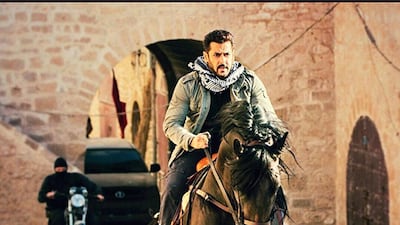
Salman Khan and Katrina Kaif in the song "Dil Diyan Gallan" for the movie Tiger Zinda Hai. Courtesy Yash Raj Films

Film review: Tiger Zinda Hai


Aarti Jhurani
  • English
  • Arabic

Starring: Salman Khan, Katrina Kaif

Director: Ali Abbas Zafar

4 stars

With 2017 being a year of flops, Tiger Zinda Hai was the big hit Bollywood needed to end the year on a high note.

After all, Bhai usually doesn’t disappoint, and this action-packed tale, based on real-life events has already got filmgoers rushing to theatres - this Thursday night showing was almost a full house.

Director Ali Abbas Zafar has taken the 2014 incident when 46 Indian nurses were held captive in Tikrit by suspected ISIL militants, to form the crux of the story. Despite the film being a sequel to 2012's Ek Tha Tiger, it stands on its own and quickly reestablishes the characters from the previous outing.

Tiger (Salman Khan) lives with his wife Zoya (Katrina Kaif) and their son in the Austrian Alps, far from the life he led as a RAW (India’s foreign intelligence agency) agent, and her job as a Pakistan ISI agent. But when New Delhi is given a week to save its trapped nurses from ISC (a terrorist group modeled on ISIL), Tiger is called on to do the job. Who needs an entire army to fight what is possibly the world’s largest terrorist organisation, when Bhai is on hand?

Everyone knows Khan will save the day, but the journey getting there is an exciting one, with many twists and turns. While the plot keeps Khan at the centre of the action, the ensemble cast has their moments and truly shine. Iranian actor Sajjad Delafrooz is fantastic in his stoic performance as the ISC chief Abu Usman. Senior actors Paresh Rawal and Kumud Mishra play interesting roles, and inject just the right kind of humour.

Kaif as Zoya is fearless and brave, but apart from a couple of action sequences ­– one of which involves her saving a store from being robbed with a pen – she doesn’t have a very large role to play. She does have fabulous chemistry with (her real-life ex) Khan, and the pair seem very comfortable on-screen.

Another unsung hero of the film is also the city of Abu Dhabi, which stands in for the war-torn Iraqi city of Ikrit.

A 20,000-square-metre plot in Khalifa Industrial Zone was set-up for the shooting, while the Arkan Cement Factory in Al Ain was used to shoot the oil refinery scenes in the film.

Khan is also briefly shown riding a quad bike in the Liwa desert, in a scene where he assembles the dream team for his mission.

Katrina Kaif and Salman Khan. AFP

Salman Khan, of course shines as Tiger – the RAW agent who goes above and beyond what he is asked to do. It may seem like a brave step, but to a logical viewer, it seems silly that he constantly attracts attention to himself (so much for being undercover!), and aims to wipe all the wrong doings of ISC in less than a week, and not just the job he was sent to do.

While logic is not a very important factor in Khan’s films, emotions certainly are, and the director made sure to hit all the soft spots – from patriotism to Indo-Pakistan bonding to a multitude of cheesy dialogues – which is a smart move, and sure to bring in both Indian and Pakistani audiences.

Certainly one of the better Salman Khan movies in the recent times - watch Tiger Zinda Hai for its action sequences, even though it does feature one too many slow-motion scenes, excellent background score and performances by the ensemble cast.


What can victims do?

Always use only regulated platforms

Stop all transactions and communication on suspicion

Save all evidence (screenshots, chat logs, transaction IDs)

Report to local authorities

Warn others to prevent further harm

Courtesy: Crystal Intelligence

Sole survivors
  • Cecelia Crocker was on board Northwest Airlines Flight 255 in 1987 when it crashed in Detroit, killing 154 people, including her parents and brother. The plane had hit a light pole on take off
  • George Lamson Jr, from Minnesota, was on a Galaxy Airlines flight that crashed in Reno in 1985, killing 68 people. His entire seat was launched out of the plane
  • Bahia Bakari, then 12, survived when a Yemenia Airways flight crashed near the Comoros in 2009, killing 152. She was found clinging to wreckage after floating in the ocean for 13 hours.
  • Jim Polehinke was the co-pilot and sole survivor of a 2006 Comair flight that crashed in Lexington, Kentucky, killing 49.
All you need to know about Formula E in Saudi Arabia

What The Saudia Ad Diriyah E-Prix

When Saturday

Where Diriyah in Saudi Arabia

What time Qualifying takes place from 11.50am UAE time through until the Super Pole session, which is due to end at 12.55pm. The race, which will last for 45 minutes, starts at 4.05pm.

Who is competing There are 22 drivers, from 11 teams, on the grid, with each vehicle run solely on electronic power.

The specs

Engine: 5.0-litre V8

Power: 480hp at 7,250rpm

Torque: 566Nm at 4,600rpm

Transmission: 10-speed auto

Fuel consumption: L/100km

Price: Dh306,495

On sale: now

Voy!%20Voy!%20Voy!
%3Cp%3E%3Cstrong%3EDirector%3A%3C%2Fstrong%3E%20Omar%20Hilal%3Cbr%3E%3Cstrong%3EStars%3A%3C%2Fstrong%3E%20Muhammad%20Farrag%2C%20Bayoumi%20Fouad%2C%20Nelly%20Karim%3Cbr%3E%3Cstrong%3ERating%3A%3C%2Fstrong%3E%204%2F5%3C%2Fp%3E%0A

THE SPECS

2020 Toyota Corolla Hybrid LE

Engine: 1.8 litre combined with 16-volt electric motors

Transmission: Automatic with manual shifting mode

Power: 121hp

Torque: 142Nm

Price: Dh95,900

10 tips for entry-level job seekers
  • Have an up-to-date, professional LinkedIn profile. If you don’t have a LinkedIn account, set one up today. Avoid poor-quality profile pictures with distracting backgrounds. Include a professional summary and begin to grow your network.
  • Keep track of the job trends in your sector through the news. Apply for job alerts at your dream organisations and the types of jobs you want – LinkedIn uses AI to share similar relevant jobs based on your selections.
  • Double check that you’ve highlighted relevant skills on your resume and LinkedIn profile.
  • For most entry-level jobs, your resume will first be filtered by an applicant tracking system for keywords. Look closely at the description of the job you are applying for and mirror the language as much as possible (while being honest and accurate about your skills and experience).
  • Keep your CV professional and in a simple format – make sure you tailor your cover letter and application to the company and role.
  • Go online and look for details on job specifications for your target position. Make a list of skills required and set yourself some learning goals to tick off all the necessary skills one by one.
  • Don’t be afraid to reach outside your immediate friends and family to other acquaintances and let them know you are looking for new opportunities.
  • Make sure you’ve set your LinkedIn profile to signal that you are “open to opportunities”. Also be sure to use LinkedIn to search for people who are still actively hiring by searching for those that have the headline “I’m hiring” or “We’re hiring” in their profile.
  • Prepare for online interviews using mock interview tools. Even before landing interviews, it can be useful to start practising.
  • Be professional and patient. Always be professional with whoever you are interacting with throughout your search process, this will be remembered. You need to be patient, dedicated and not give up on your search. Candidates need to make sure they are following up appropriately for roles they have applied.

Arda Atalay, head of Mena private sector at LinkedIn Talent Solutions, Rudy Bier, managing partner of Kinetic Business Solutions and Ben Kinerman Daltrey, co-founder of KinFitz

UAE currency: the story behind the money in your pockets
It's up to you to go green

Nils El Accad, chief executive and owner of Organic Foods and Café, says going green is about “lifestyle and attitude” rather than a “money change”; people need to plan ahead to fill water bottles in advance and take their own bags to the supermarket, he says.

“People always want someone else to do the work; it doesn’t work like that,” he adds. “The first step: you have to consciously make that decision and change.”

When he gets a takeaway, says Mr El Accad, he takes his own glass jars instead of accepting disposable aluminium containers, paper napkins and plastic tubs, cutlery and bags from restaurants.

He also plants his own crops and herbs at home and at the Sheikh Zayed store, from basil and rosemary to beans, squashes and papayas. “If you’re going to water anything, better it be tomatoes and cucumbers, something edible, than grass,” he says.

“All this throwaway plastic - cups, bottles, forks - has to go first,” says Mr El Accad, who has banned all disposable straws, whether plastic or even paper, from the café chain.

One of the latest changes he has implemented at his stores is to offer refills of liquid laundry detergent, to save plastic. The two brands Organic Foods stocks, Organic Larder and Sonnett, are both “triple-certified - you could eat the product”.  

The Organic Larder detergent will soon be delivered in 200-litre metal oil drums before being decanted into 20-litre containers in-store.

Customers can refill their bottles at least 30 times before they start to degrade, he says. Organic Larder costs Dh35.75 for one litre and Dh62 for 2.75 litres and refills will cost 15 to 20 per cent less, Mr El Accad says.

But while there are savings to be had, going green tends to come with upfront costs and extra work and planning. Are we ready to refill bottles rather than throw them away? “You have to change,” says Mr El Accad. “I can only make it available.”

White hydrogen: Naturally occurring hydrogenChromite: Hard, metallic mineral containing iron oxide and chromium oxideUltramafic rocks: Dark-coloured rocks rich in magnesium or iron with very low silica contentOphiolite: A section of the earth’s crust, which is oceanic in nature that has since been uplifted and exposed on landOlivine: A commonly occurring magnesium iron silicate mineral that derives its name for its olive-green yellow-green colour

From Zero

Artist: Linkin Park

Label: Warner Records

Number of tracks: 11

Rating: 4/5

Brief scores:

Day 1

Toss: South Africa, field first

Pakistan (1st innings) 177: Sarfraz 56, Masood 44; Olivier 4-48

South Africa (1st innings) 123-2: Markram 78; Masood 1-4

Abu%20Dhabi%E2%80%99s%20Racecard
%3Cp%3E%0D5pm%3A%20Al%20Bithnah%20%E2%80%93%20Maiden%20(PA)%20Dh80%2C000%20(Turf)%201%2C200m%0D%3Cbr%3E5.30pm%3A%20Al%20Khari%20%E2%80%93%20Hanidcap%20(PA)%20Dh80%2C000%20(T)%201%2C200m%0D%3Cbr%3E6pm%3A%20Al%20Qor%20%E2%80%93%20Handicap%20(PA)%20Dh80%2C000%20(T)%201%2C600m%0D%3Cbr%3E6.30pm%3A%20Wathba%20Stallions%20Cup%20%E2%80%93%20Handicap%20(PA)%20Dh70%2C000%20(T)%201%2C600m%0D%3Cbr%3E7pm%3A%20Al%20Badiyah%20%E2%80%93%20Handicap%20(PA)%20Dh80%2C000%20(T)%202%2C200m%0D%3Cbr%3E7.30pm%3A%20Al%20Hayl%20%E2%80%93%20Handicap%20(TB)%20Dh80%2C000%20(T)%202%2C200m%3C%2Fp%3E%0A
MATCH INFO

Who: UAE v USA
What: first T20 international
When: Friday, 2pm
Where: ICC Academy in Dubai

Mercer, the investment consulting arm of US services company Marsh & McLennan, expects its wealth division to at least double its assets under management (AUM) in the Middle East as wealth in the region continues to grow despite economic headwinds, a company official said.

Mercer Wealth, which globally has $160 billion in AUM, plans to boost its AUM in the region to $2-$3bn in the next 2-3 years from the present $1bn, said Yasir AbuShaban, a Dubai-based principal with Mercer Wealth.

Within the next two to three years, we are looking at reaching $2 to $3 billion as a conservative estimate and we do see an opportunity to do so,” said Mr AbuShaban.

Mercer does not directly make investments, but allocates clients’ money they have discretion to, to professional asset managers. They also provide advice to clients.

“We have buying power. We can negotiate on their (client’s) behalf with asset managers to provide them lower fees than they otherwise would have to get on their own,” he added.

Mercer Wealth’s clients include sovereign wealth funds, family offices, and insurance companies among others.

From its office in Dubai, Mercer also looks after Africa, India and Turkey, where they also see opportunity for growth.

Wealth creation in Middle East and Africa (MEA) grew 8.5 per cent to $8.1 trillion last year from $7.5tn in 2015, higher than last year’s global average of 6 per cent and the second-highest growth in a region after Asia-Pacific which grew 9.9 per cent, according to consultancy Boston Consulting Group (BCG). In the region, where wealth grew just 1.9 per cent in 2015 compared with 2014, a pickup in oil prices has helped in wealth generation.

BCG is forecasting MEA wealth will rise to $12tn by 2021, growing at an annual average of 8 per cent.

Drivers of wealth generation in the region will be split evenly between new wealth creation and growth of performance of existing assets, according to BCG.

Another general trend in the region is clients’ looking for a comprehensive approach to investing, according to Mr AbuShaban.

“Institutional investors or some of the families are seeing a slowdown in the available capital they have to invest and in that sense they are looking at optimizing the way they manage their portfolios and making sure they are not investing haphazardly and different parts of their investment are working together,” said Mr AbuShaban.

Some clients also have a higher appetite for risk, given the low interest-rate environment that does not provide enough yield for some institutional investors. These clients are keen to invest in illiquid assets, such as private equity and infrastructure.

“What we have seen is a desire for higher returns in what has been a low-return environment specifically in various fixed income or bonds,” he said.

“In this environment, we have seen a de facto increase in the risk that clients are taking in things like illiquid investments, private equity investments, infrastructure and private debt, those kind of investments were higher illiquidity results in incrementally higher returns.”

The Abu Dhabi Investment Authority, one of the largest sovereign wealth funds, said in its 2016 report that has gradually increased its exposure in direct private equity and private credit transactions, mainly in Asian markets and especially in China and India. The authority’s private equity department focused on structured equities owing to “their defensive characteristics.”