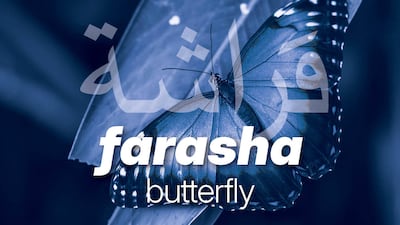

Few creatures have inspired as much symbolism in Arabic as the butterfly. Our Arabic word of the week, farasha, evokes not only colour and beauty, but also transformation, fragility and the pursuit of light. Across poetry, folklore and everyday speech, the butterfly has come to represent renewal, freedom and the fleeting nature of existence.
In modern Arabic, farasha is often used as a term of affection. A child may be described as a “little butterfly” because of their energy and constant movement. The phrase mithl al farasha (“like a butterfly”) can suggest grace, lightness or someone moving effortlessly through a space. The word also appears frequently in song lyrics and poetry, where butterflies are associated with love, longing and beauty.
Arabic literature has long drawn on the image of winged insects to explore the human condition. Like the moth drawn irresistibly towards a flame, a recurring image in classical poetry, the butterfly often represents purveyors of beauty despite the risk of being consumed by it. The symbolism rests on the tension between attraction and vulnerability, between the desire to seek light and the dangers that can accompany the quest.


The image appears in the work of modern Arab scribes as well. Egyptian poet Ibrahim Nagi evoked the butterfly in a meditation on mortality and human ambition, writing: “And despite a mind like a butterfly circling around a lamp that has been lit.” In the poem, the butterfly becomes a symbol of a restless intellect drawn towards illumination, whether in the form of knowledge, creativity or inspiration.
The word also appears in one of the Quran's most vivid visualisations. In Surah Al Qari'ah, humanity on the Day of Judgement is described as being “like scattered moths”, using the word farash. The image conveys movement, vulnerability and the overwhelming scale of the event, while demonstrating the deep symbolic resonance of these delicate winged creatures within the Arabic language.
Beyond literature, butterflies have long been admired across the Arab world as signs of seasonal change. Their appearance after winter rains is viewed as a marker of renewal, particularly in desert regions where bursts of vegetation can transform otherwise barren landscapes.
The Middle East is home to a remarkable diversity of butterfly species. More than 400 species have been recorded across the Arabian Peninsula, the Levant and neighbouring regions. Some are permanent residents, while others arrive through seasonal migrations linking Africa, Europe and Asia.

Among the most recognisable is the Painted Lady, one of the world's most travelled butterflies. Its migration route can take it across North Africa, through the Arabian Peninsula and onwards into Europe. Another familiar species is the Plain Tiger, often seen in the UAE, Oman and Saudi Arabia, distinguished by its orange wings and black-and-white markings.
The UAE itself supports dozens of butterfly species despite its arid environment. Protected areas such as Al Wathba Wetland Reserve and the mountains in Ras Al Khaimah and Fujairah are important habitats. Native plants such as milkweed, desert flowers and flowering acacia trees help sustain local populations.
Public fascination with butterflies has also inspired dedicated attractions. Abu Dhabi's The Butterfly Gardens in Al Qana, home to about 10,000 butterflies, offers visitors a chance to observe the insects up close while learning about their life cycles and ecological importance.
As pollinators, butterflies contribute to the reproduction of flowering plants and help maintain healthy ecosystems. Scientists often regard them as indicators of environmental health because their populations respond quickly to changes in habitat and climate.
This is why the butterfly continues to resonate so strongly in Arabic culture. Its metamorphosis, from caterpillar to chrysalis to winged adult, offers a powerful metaphor for personal growth and transformation. In a language rich with imagery, the farasha captures the idea that change can be beautiful, even when it is brief.

