


German state secretary Jochen Flasbarth praised the UK’s handling of the Cop26 environmental summit and said the country will look to build on the efforts made in Glasgow during its G7 Presidency.
Mr Flasbarth, Germany’s state secretary at the Federal Ministry for Economic Co-operation and Development, said despite individuals and businesses expressing disappointment at the outcome of Cop26, he came away feeling optimistic for the future.
“I had a very positive perception. I went from Glasgow in a very positive mood; we fixed the rulebook I would say in a quite reasonable way and we started on what is the future of multilateralism of climate risk partnerships,” Mr Flasbarth told delegates attending a virtual seminar hosted by Clean Energy Wire.
“This will also be in the centre of our G7 presidency — to focus on co-operation and implementation to keep the 1.5°C in reach.”
Mr Flasbarth pointed to the Just Energy Transition Partnership with South Africa — a pact between the UK, France, Germany, the EU and the US to help South Africa phase out coal — as an example of the type of deals it wants to focus on during its presidency.
“That is why it is so relevant to not just have a climate partnership, but a climate and development partnership, to organise it in a way that fits to the overall economic and societal development of those countries,” he said.
“It has to be multidimensional, it has to be done in a just transition manner and that is what we want to roll out with more partners.”
Other countries Germany is looking to tie up with include Pakistan, with Mr Flasbarth heading to the nation next month, while pacts with Rwanda, Serbia, Indonesia and India are also on the agenda.
“We all remember that India, together with China had some difficulties in the final session in Glasgow with the language of [the deal],” said Mr Flasbarth, referring to how the Cop26 deal was watered down in the final moments of the two-week summit after last-minute objections from India and China over a commitment to end the use of coal.
While 190 countries reached consensus on how to enforce the 2015 Paris climate agreement, a push led by China, and backed by India, resulted in the language being changed from accelerating the “phase out” of unabated coal to “phase down".
Mr Flasbarth said he “made an offer” to India in the aftermath of that decision to seek out a similar partnership to the pact with South Africa.
Indonesia is also a priority, he said, because the south-east Asian nation is hosting the G20 Presidency this year, which Mr Flasbarth said needs attention in the global drive to hit climate change targets.
“Looking at the G20, this is the problem,” he said. “If you do not get emissions in G20 down fast, then it's very unlikely to meet the target.”
This is why Germany is targeting countries in the G20 to form a proposed carbon club — a group working to reach agreements on uniform standards of emissions and CO2 pricing to accelerate the implementation of the Paris Climate Agreement.
The carbon-club concept was unveiled by German Chancellor Olaf Scholz when he laid out the G7 programme earlier this month, as Germany takes over the presidency from the UK, with the country initially wanting to develop the G7 into a “climate club".
“We want to ensure that each country does not go it alone but joins forces,” Mr Scholz said at the time of the launch.
However Mr Flasbarth said the climate club idea was not yet fully developed, which is why the entire G20 is now being considered along with “some more relevant partners we have in mind for climate alliances or clubs”.
-
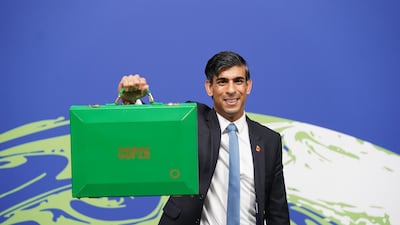
Rishi Sunak, Britain’s Chancellor of the Exchequer, holds his green box at the Cop26 summit in Glasgow, before a meeting a group of finance ministers. PA -

Indigenous leaders in ceremonial dress gather at the McLennan Arch in Glasgow Green to march to the Scottish Event Campus in Glasgow, announcing their arrival at the Cop26 summit. PA -

Rishi Sunak delivers a speech to Cop26 delegates. Getty Images -
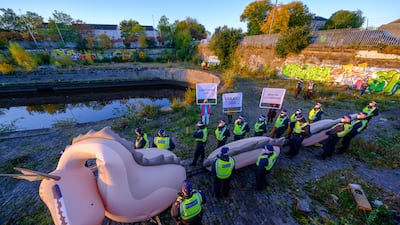
Police officers guarding an inflatable Loch Ness Monster at Govan Dry Dock after it was seized in a dawn raid in Glasgow. PA -
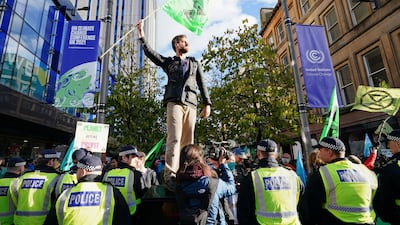
Police and demonstrators at a Extinction Rebellion protest on Buchanan Street, during the Cop26 summit in Glasgow. PA -
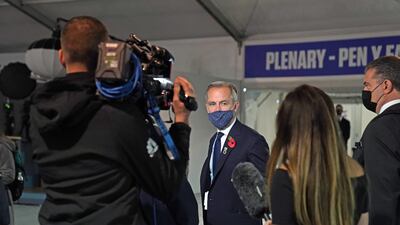
Mark Carney, the former Bank of England governor, speaks to a TV crew at the summit. PA -
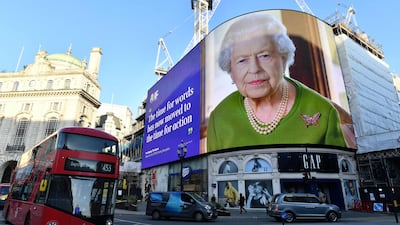
A quote from a message delivered by Britain's Queen Elizabeth to the Cop26 Summit taking place in Glasgow is displayed at Piccadilly Circus in London. AFP -
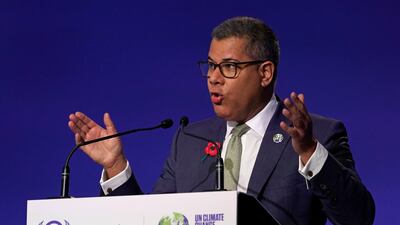
Alok Sharma, president of Cop26, makes his point. AP Photo -

Indigenous Amazon delegate Romancil Gentil Kreta wears a Cop26 branded face mask. Reuters -
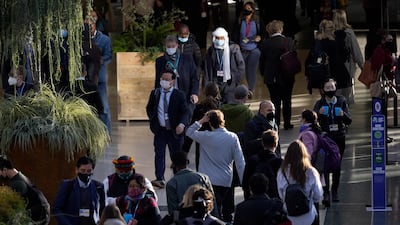
Delegates arrive for another day at the summit in Glasgow. AP Photo -
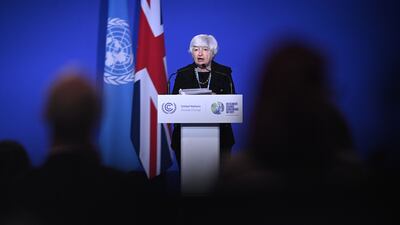
US Treasury Secretary Janet Yellen delivers a speech at the opening of Finance Day at Cop26. AFP


Mr Scholz first proposed the idea of the EU creating a “climate club” last year as a mechanism to avoid trade friction linked to green tariffs.
A planned EU carbon border adjustment mechanism as part of its Green Deal agenda has already stoked criticism around the world with clear differences of opinion on the best strategy evident within the EU as well.
While French President Emmanuel Macron has led the charge for the rapid implementation of a CBAM, essentially a tax on imported products made in countries with less stringent rules on reducing carbon pollution, China and the US are both opposed to a tax.
The objective is to avoid shifting Europe's carbon emissions overseas as they are reduced at home — known as “carbon leakage”, with the sectors affected including steel, aluminium, cement, fertiliser and electricity.
Even within Europe, Germany insists the mechanism can only be implemented gradually, and several countries are outright opposed, including Spain, Portugal, Poland and Austria — mainly because the tax would replace the allocation of free emissions permits.
“I know that we might need it in Europe, looking at our ambitious targets and the policies behind it, but I never liked it, to be honest,” said Mr Flasbarth, who was Germany's state secretary at the Federal Ministry for the Environment, Nature Conservation and Nuclear Safety before taking on his current role seven weeks ago.
“And now in my new position, I like it even less, because of course, it can be misunderstood as producing entry barriers to our markets. And that would make the implementation of global climate policy with our partners even more difficult.
“So we are seeking ways on how to get policy approaches with relevant, and other economically competing countries, to allow that we do not use this kind of mechanism.”
Looking ahead to Cop28 in the UAE in 2023, Mr Flasbarth said he spoke to the UAE delegation at Cop26 in Glasgow to find out what their objectives were.
“They very much want to focus on the technological side of climate change — also, specifically on solar and wind,” he said.
For now, he added, the focus will be on Cop27 at Sharm El Sheikh in Egypt this year, however the threat of war between Russia and Ukraine poses a challenge for the G7 presidency.
“Each and every conflict we have, as a word doesn't make it easier to focus on the other agendas,” Mr Flasbarth added.
Alden Meyer, a strategic adviser on domestic and international climate policy and politics and a Principal at Performance Partners, said there was no doubt the focus on climate change would diminish in the event of war with Russia, as it did during the peak of the Covid-19 crisis when government and central banks shifted focus to propping up their economies.
“I don't think there's any doubt of that,” Mr Meyer said.
“If Putin does invade Ukraine, especially if he does a major incursion and tries to occupy Ukraine, that will be the overriding priority of the G7 as it probably should be in the short term.
“But we have to avoid a reaction that says to deal with what will be the inevitable gas supply implications and price shocks in such a scenario that the answer is to dial back efforts to decarbonise and shift away from fossil fuels towards clean energy resources. That's counterproductive.”

