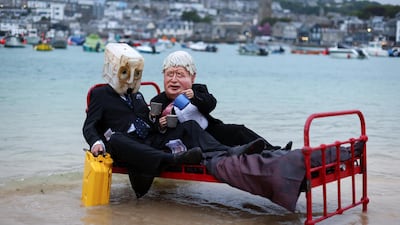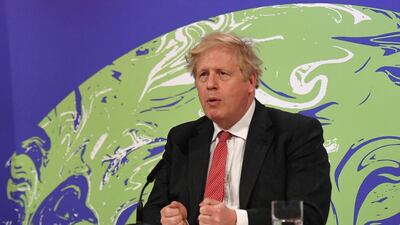
British Prime Minister Boris Johnson wants G7 leaders to commit to a new deal to help developing countries decarbonise their economies as he looks to lead ambitious global action on climate change.
In the year of the UK’s twin presidency of the G7 and the Cop26 environment summit, Mr Johnson wants to push through a clean, green initiative that emulates the so-called Belt and Road Initiative, which has delivered strategic Chinese infrastructure investment to nearly 70 countries over the past eight years.
The prime minister will use the platform of the summit in Cornwall this week to secure support for large-scale renewable energy projects in Africa and Asia, with an agreement between the advanced economies of the G7 vital if they want developing countries to back an ambitious commitment to limit global warming to 1.5°C above post-industrial levels.
Observers are watching closely to see if the UK can secure a deal on ending international financial support on coal production, agreed at a virtual G7 summit last month.
Gareth Redmond-King, from the Energy and Climate Intelligence Unit, said the G7 meeting “has unfinished business to attend to” with both the Paris accord rules and gathering a set of ambitious new emissions pledges from member nations essential to keep 1.5°C within reach.
“As it stands, these crucial tasks risk being blown out of the water with that promise from rich nations as yet unfulfilled and the associated trust needed for successful negotiations absent,” Mr Redmond-King said.
Last month, environment ministers agreed to stop direct funding of coal-fired power stations in poorer nations by the end of 2021.
Mr Johnson now wants to push forward on this pledge, as well as an agreement on securing more cash to help fast-growing economies, such as India and Indonesia get clean technology.
While a communique issued after the May meeting said the G7 would phase out new, direct government support for carbon-intensive, international fossil fuel energy, which is expected to target coal and oil, no date for enactment of the policy has been set. Japan, for example, is not in favour of strong strictures against coal.
Another significant proposal from the prime minister this week was a multi-billion-pound green development bank that would fund projects that reduce carbon emissions in the poorest parts of the world.
However, media reports indicate the British Finance Ministry is resistant to donating to the plan before the autumn spending review.
G7 critics say the world will be watching to see if it can deliver on its longstanding pledge to provide $100bn per year to help poor countries respond to climate change.
Only two G7 countries – the UK and the US – have confirmed they will increase climate finance from current levels.
Meanwhile, France is maintaining its current level of climate finance and Canada, Germany, Japan and Italy have yet to state their intentions.
The G7’s current commitments amount to $36bn in public climate finance by 2025, Oxfam say, with only a quarter of that of that intended for adaptation.
Last week, Oxfam said the economies of the G7 nations could see an average loss of 8.5 per cent annually by 2050 ― equivalent to $4.8 trillion ― if leaders did not take more ambitious action to tackle climate change.
The campaign group said for low-income countries the consequences of climate change could be much greater, with a recent World Bank study warning that up to 132 million additional people would be pushed into extreme poverty by 2030 because of climate change.
“The climate crisis is already devastating lives in poorer countries but the world’s most developed economies are not immune,” Danny Sriskandarajah, chief executive of Oxfam GB said.
“The UK government has a once-in-a-generation opportunity to lead the world towards a safer, more liveable planet for all of us. It should strain every diplomatic sinew to secure the strongest possible outcome at the G7 and Cop26, and lead by example by turning promises into action and reversing self-defeating decisions like the proposed coalmine in Cumbria and cuts to overseas aid.”
The energy transition would “undoubtedly require significant economic restructuring from countries that derive large portions of GDP from oil and gas”, according to Oxford Business Group, with about 5 million jobs lost globally in the shift away from fossil fuels.
However, the International Energy Agency said about 14 million jobs will be created because of the development of and investment in renewables.
Mr Johnson's bid to boost the sustainability drive at the G7 comes as the energy industry, which accounts for about three quarters of global greenhouse gas emissions, focuses on carbon-neutral climate plans.
Last month, the Paris-based IEA released its Net Zero by 2050 report, the first comprehensive energy road map detailing how the sector can achieve net-zero carbon emissions by 2050.
The plan features 400 milestones to achieve the target, with the report calling for an immediate ban on investment in new fossil fuel projects globally, along with the prevention of sales of new internal combustion engine passenger cars from 2035.
To meet demand, the IEA expects a massive distribution of renewable energy, which would account for almost 90 per cent of electricity generation by 2050, with a twentyfold increase in solar capacity between now and 2050, and an elevenfold expansion for wind power.
“Making net‐zero emissions a reality hinges on a singular, unwavering focus from all governments – working together with one another, and with businesses, investors and citizens,” the report said.
“All stakeholders need to play their part. The wide-ranging measures adopted by governments at all levels in the net-zero pathway help to frame, influence and incentivise the purchase by consumers and investment by businesses.”

Ten tax points to be aware of in 2026
1. Domestic VAT refund amendments: request your refund within five years
If a business does not apply for the refund on time, they lose their credit.
2. E-invoicing in the UAE
Businesses should continue preparing for the implementation of e-invoicing in the UAE, with 2026 a preparation and transition period ahead of phased mandatory adoption.
3. More tax audits
Tax authorities are increasingly using data already available across multiple filings to identify audit risks.
4. More beneficial VAT and excise tax penalty regime
Tax disputes are expected to become more frequent and more structured, with clearer administrative objection and appeal processes. The UAE has adopted a new penalty regime for VAT and excise disputes, which now mirrors the penalty regime for corporate tax.
5. Greater emphasis on statutory audit
There is a greater need for the accuracy of financial statements. The International Financial Reporting Standards standards need to be strictly adhered to and, as a result, the quality of the audits will need to increase.
6. Further transfer pricing enforcement
Transfer pricing enforcement, which refers to the practice of establishing prices for internal transactions between related entities, is expected to broaden in scope. The UAE will shortly open the possibility to negotiate advance pricing agreements, or essentially rulings for transfer pricing purposes.
7. Limited time periods for audits
Recent amendments also introduce a default five-year limitation period for tax audits and assessments, subject to specific statutory exceptions. While the standard audit and assessment period is five years, this may be extended to up to 15 years in cases involving fraud or tax evasion.
8. Pillar 2 implementation
Many multinational groups will begin to feel the practical effect of the Domestic Minimum Top-Up Tax (DMTT), the UAE's implementation of the OECD’s global minimum tax under Pillar 2. While the rules apply for financial years starting on or after January 1, 2025, it is 2026 that marks the transition to an operational phase.
9. Reduced compliance obligations for imported goods and services
Businesses that apply the reverse-charge mechanism for VAT purposes in the UAE may benefit from reduced compliance obligations.
10. Substance and CbC reporting focus
Tax authorities are expected to continue strengthening the enforcement of economic substance and Country-by-Country (CbC) reporting frameworks. In the UAE, these regimes are increasingly being used as risk-assessment tools, providing tax authorities with a comprehensive view of multinational groups’ global footprints and enabling them to assess whether profits are aligned with real economic activity.
Contributed by Thomas Vanhee and Hend Rashwan, Aurifer
Mercer, the investment consulting arm of US services company Marsh & McLennan, expects its wealth division to at least double its assets under management (AUM) in the Middle East as wealth in the region continues to grow despite economic headwinds, a company official said.
Mercer Wealth, which globally has $160 billion in AUM, plans to boost its AUM in the region to $2-$3bn in the next 2-3 years from the present $1bn, said Yasir AbuShaban, a Dubai-based principal with Mercer Wealth.
“Within the next two to three years, we are looking at reaching $2 to $3 billion as a conservative estimate and we do see an opportunity to do so,” said Mr AbuShaban.
Mercer does not directly make investments, but allocates clients’ money they have discretion to, to professional asset managers. They also provide advice to clients.
“We have buying power. We can negotiate on their (client’s) behalf with asset managers to provide them lower fees than they otherwise would have to get on their own,” he added.
Mercer Wealth’s clients include sovereign wealth funds, family offices, and insurance companies among others.
From its office in Dubai, Mercer also looks after Africa, India and Turkey, where they also see opportunity for growth.
Wealth creation in Middle East and Africa (MEA) grew 8.5 per cent to $8.1 trillion last year from $7.5tn in 2015, higher than last year’s global average of 6 per cent and the second-highest growth in a region after Asia-Pacific which grew 9.9 per cent, according to consultancy Boston Consulting Group (BCG). In the region, where wealth grew just 1.9 per cent in 2015 compared with 2014, a pickup in oil prices has helped in wealth generation.
BCG is forecasting MEA wealth will rise to $12tn by 2021, growing at an annual average of 8 per cent.
Drivers of wealth generation in the region will be split evenly between new wealth creation and growth of performance of existing assets, according to BCG.
Another general trend in the region is clients’ looking for a comprehensive approach to investing, according to Mr AbuShaban.
“Institutional investors or some of the families are seeing a slowdown in the available capital they have to invest and in that sense they are looking at optimizing the way they manage their portfolios and making sure they are not investing haphazardly and different parts of their investment are working together,” said Mr AbuShaban.
Some clients also have a higher appetite for risk, given the low interest-rate environment that does not provide enough yield for some institutional investors. These clients are keen to invest in illiquid assets, such as private equity and infrastructure.
“What we have seen is a desire for higher returns in what has been a low-return environment specifically in various fixed income or bonds,” he said.
“In this environment, we have seen a de facto increase in the risk that clients are taking in things like illiquid investments, private equity investments, infrastructure and private debt, those kind of investments were higher illiquidity results in incrementally higher returns.”
The Abu Dhabi Investment Authority, one of the largest sovereign wealth funds, said in its 2016 report that has gradually increased its exposure in direct private equity and private credit transactions, mainly in Asian markets and especially in China and India. The authority’s private equity department focused on structured equities owing to “their defensive characteristics.”
'Ghostbusters: From Beyond'
Director: Jason Reitman
Starring: Paul Rudd, Carrie Coon, Finn Wolfhard, Mckenna Grace
Rating: 2/5
2025 Fifa Club World Cup groups
Group A: Palmeiras, Porto, Al Ahly, Inter Miami.
Group B: Paris Saint-Germain, Atletico Madrid, Botafogo, Seattle.
Group C: Bayern Munich, Auckland City, Boca Juniors, Benfica.
Group D: Flamengo, ES Tunis, Chelsea, Leon.
Group E: River Plate, Urawa, Monterrey, Inter Milan.
Group F: Fluminense, Borussia Dortmund, Ulsan, Mamelodi Sundowns.
Group G: Manchester City, Wydad, Al Ain, Juventus.
Group H: Real Madrid, Al Hilal, Pachuca, Salzburg.
Company Fact Box
Company name/date started: Abwaab Technologies / September 2019
Founders: Hamdi Tabbaa, co-founder and CEO. Hussein Alsarabi, co-founder and CTO
Based: Amman, Jordan
Sector: Education Technology
Size (employees/revenue): Total team size: 65. Full-time employees: 25. Revenue undisclosed
Stage: early-stage startup
Investors: Adam Tech Ventures, Endure Capital, Equitrust, the World Bank-backed Innovative Startups SMEs Fund, a London investment fund, a number of former and current executives from Uber and Netflix, among others.
88 Video's most popular rentals
Avengers 3: Infinity War: an American superhero film released in 2018 and based on the Marvel Comics story.
Sholay: a 1975 Indian action-adventure film. It follows the adventures of two criminals hired by police to catch a vagabond. The film was panned on release but is now considered a classic.
Lucifer: is a 2019 Malayalam-language action film. It dives into the gritty world of Kerala’s politics and has become one of the highest-grossing Malayalam films of all time.
Company%20Profile
%3Cp%3E%3Cstrong%3ECompany%3A%3C%2Fstrong%3E%20Astra%20Tech%3Cbr%3E%3Cstrong%3EStarted%3A%20%3C%2Fstrong%3EMarch%202022%3Cbr%3E%3Cstrong%3EBased%3A%20%3C%2Fstrong%3EDubai%3Cbr%3E%3Cstrong%3EFounder%3A%20%3C%2Fstrong%3EAbdallah%20Abu%20Sheikh%3Cbr%3E%3Cstrong%3EIndustry%3A%3C%2Fstrong%3E%20technology%20investment%20and%20development%3Cbr%3E%3Cstrong%3EFunding%20size%3A%3C%2Fstrong%3E%20%24500m%3C%2Fp%3E%0A
Jetour T1 specs
Engine: 2-litre turbocharged
Power: 254hp
Torque: 390Nm
Price: From Dh126,000
Available: Now
The President's Cake
Director: Hasan Hadi
Starring: Baneen Ahmad Nayyef, Waheed Thabet Khreibat, Sajad Mohamad Qasem
Rating: 4/5
Specs
Engine: Dual-motor all-wheel-drive electric
Range: Up to 610km
Power: 905hp
Torque: 985Nm
Price: From Dh439,000
Available: Now
Skoda Superb Specs
Engine: 2-litre TSI petrol
Power: 190hp
Torque: 320Nm
Price: From Dh147,000
Available: Now
Scoreline:
Cardiff City 0
Liverpool 2
Wijnaldum 57', Milner 81' (pen)
In Full Flight: A Story of Africa and Atonement
John Heminway, Knopff
THE SPECS
Engine: 2.0-litre four-cylinder turbo
Transmission: eight-speed automatic
Power: 258hp at 5,000-6,500rpm
Torque: 400Nm from 1,550-4,400rpm
Fuel economy, combined: 6.4L/100km
Price, base: from D215,000 (Dh230,000 as tested)
On sale: now
Russia's Muslim Heartlands
Dominic Rubin, Oxford