

Deadly global pandemics such as coronavirus will increase in frequency if mass deforestation continues, scientists are warning world leaders.
A UN summit on biodiversity in New York will hear from leading biologists that there is now clear evidence of a link between environmental destruction and deadly new diseases such as Covid-19.
A “perfect storm” is being created for diseases that transmit from wild animals to people with continued rampant deforestation in countries such as Brazil alongside mass farming and mining in remote areas.
Nearly 30 per cent of new diseases have originated from land clearances, scientists have claimed. This could soon lead to up to six new epidemics breaking out among the human population each year.
“When workers come into rainforests to chop down trees they don’t take food with them,” said Andy Dobson, professor of ecology and evolutionary biology at Princeton University. “They just eat what they can kill. So that exposes them to infection all the time.”
He was speaking ahead of the United Nations Summit on Biodiversity that will host government leaders on 30 September under the theme of “Urgent action on biodiversity for sustainable development.”
-
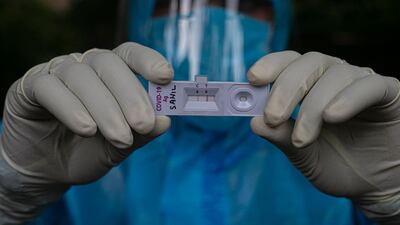
A health worker shows a sample kit of a Covid-19 positive test during a door-to-door test drive in Gauhati, India. AP Photo -

The police detain a woman during a demonstration against Covid-19 measures, in Berlin, Germany. dpa via AP -

Flight attendants from the LAN company listen to a passenger minutes before a flight take-off from Lima to Pucallpa, Peru. AP Photo -

A Huazhong University of Science and Technology student washes his hand on campus in Wuhan, China. EPA -

Hundreds of photos contributed by families have been staked at Belle Isle State Park in Detroit for a memorial drive to honor 1,500 city residents who have died from Covid-19. AP Photo -

Visitors talk in front of a painting during the public reopening at the Metropolitan Museum of Art in New York, USA. Bloomberg -

A woman is reflected in a barber shop mirror waiting for her boyfriend who is getting a haircut, near the Miraflores Palace in Caracas, Venezuela. AP Photo -

A volunteer hands out free face masks at Gelora Bung Karno stadium during a campaign to promote their use in Jakarta, Indonesia. AFP -

People sail a boat at the Retiro park in Madrid, Spain. AP Photo -
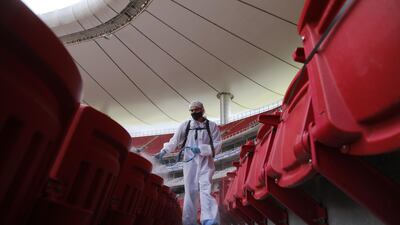
Workers spray disinfectant in the seating area prior to the match between Chivas de Guadalajara and Pachuca in the Guardians 2020 tournament at the Akron Stadium in Guadalajara, Jalisco, Mexico. EPA -

Portraits of essential workers are projected in the facade of the historic Cabildo of Buenos Aires in Argentina. AFP -

Fans watch a game during the second half of the Guardian Credit Union FCS Kickoff football game between Austin Peay and Central Arkansas in Montgomery, Alabama. AFP -
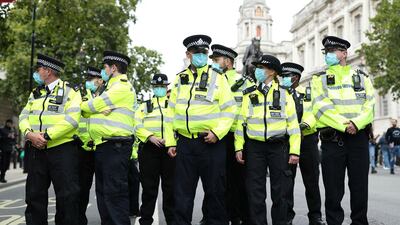
Police officers stand guard during a protest opposed to Covid-19 pandemic restrictions, in Trafalgar Square, London, UK. PA via AP


The continued trade in illegal logging, mining and the selling exotic pets and their meat is not only devastating the environment but creating conditions for life-threatening diseases, academics claim.
Untouched forests cleared at the rate of millions of hectares a year to create products such as palm oil or grazing for cattle bring humans into contact with numerous viruses causing events known as ‘spillovers’ that lead to new diseases.
The HIV disease, that has killed 10 million people, was caused by chimpanzees and gorillas being eaten. The deadly Ebola fever, which has a 90 per cent death rate, was passed from bats to primates and then humans. It is understood that Covid-19 also originated from bats.
"The crucial point is that there are probably 10 times more different species of viruses than there are of mammals," Prof Dobson told the Observer. "The numbers are against us and the emergence of new pathogens inevitable."
The development of cheap air travel has also meant that diseases spread before scientists can detect them.
“The onward transmission of a new disease is another really important element in the pandemic story,” said Professor James Wood, head of veterinary medicine at Cambridge University. “Consider the swine flu pandemic. We flew that around the world several times before we realised what was going on. Global connectivity has allowed – and is still allowing – Covid-19 to be transmitted to just about every country on Earth.”
A $20 billion a year proposal to set up a programme to end the trade in wildlife, reduce deforestation and spillovers was put forward by a group of academics in the Science magazine last month.
“The rate of emergence of novel disease is increasing and their economic impacts are also increasing,” the scientists said. “Society must strive to avoid the impacts of future pandemics.”
The Covid crisis has so far cost the world economy trillions of dollars and by the end of September it is likely to have killed one million people.

