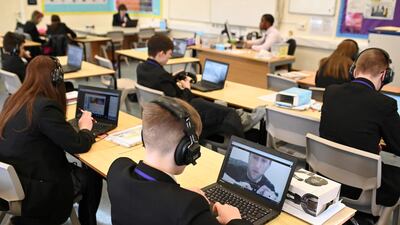
Academic study must take a back seat to mental wellbeing when pupils return to school, experts said.
On Monday, children in England will follow in the footsteps of many young people globally when they finally return to the classroom after months of learning from home.
But alongside the relief felt by parents who were forced to learn how to juggle homeschooling with homelife comes the daunting challenge of smooth reintegration of children into the classroom.
The reopening of schools has typically been the first sign of Covid-19 restrictions loosening, but children face an array of challenges readjusting after such a tumultuous year.
The past 12 months sparked waves of disruption during a critical part of young people's lives, not only school closures but a steady stream of confusing information over examinations and when they get to see their friends again.
The detrimental effect on their studies – and the gaps in knowledge that might open up – are widely documented. But experts say it’s that vital pupils aren’t simply inundated with information on their return and that attention is given to the other aspects missed out on, such as social interaction.
“The danger of is that people are far too concerned with the idea of catching up with content, rather than preparing children to learn again,” said Prof Robert Dingwall, a leading UK sociologist and member of two groups advising the government on its response to Covid-19.
“We have all this talk about extending school days, having summer schools and it’s almost as if education is about cramming stuff into children. But you can't get children to learn unless they are psychologically in a fit state.
“After such an interrupted year and lack of school experience, it is going to take time for the children to settle down to learn how to focus on tasks, to rebuild their skills in interaction, to rebuild some of the basic technical things like just holding a pencil. The priority for the schools should be finding ways to get children back into that.”
It’s about making sure children feel relaxed and comfortable, he says, which could mean increased time devoted to subjects such as drama, or giving more space for creative and outdoor activities.
Of course, that doesn’t mean that school curriculums are all there is to learning. But a nuanced approach that allows an adjustment to formal learning again is important, said Dr Amelia Roberts, Deputy Director UCL centre for inclusive education.
She says it’s important to remember that learning doesn’t suddenly end at the school gates. Some pupils may even absorbed more during lockdown because they could approach their studies differently.
Dr Roberts says its important children are allowed to reconnect with their teachers, friends and the school routine.
“The advantage of that approach is that you're not taking the curriculum and the learning in isolation. We're looking at the whole experience of the transition back. And so, when you do mixed ability, whole classroom teaching, you're being inclusive, everybody's back in the classroom with their teacher, with their classmates.
“And you start to introduce the curriculum again and find out who's remembered what, who's learnt what, who’s done an exciting project, who's really struggling. So you give children – whether that’s primary or secondary – a chance to embed back into the school system, without forcing them to have long school days or catch-up that they don't need.
“It's all about including people and getting them back into the community and then making a much more nuanced assessment of what the needs are of the individual.”
On social media, the hashtag #BackToSchool shows the range of emotions many feel about Monday, with one mother joking she needed a week at a spa after “signing out of the school of mum & dad”.
A primary school teacher said her “heart burst” after she overheard some of her youngest pupils saying how excited they were to return.
PE teacher Michael Davison said physical education would play an important role in the wellbeing of children over the coming months.
Research shows the devastating toll of lockdowns on the mental health of young people, at an age when they are already going through a variety of challenges that could make them more susceptible to psychological struggles.
Claire Sewell, a learning and development specialist at the social enterprise Minds Ahead, said there’s no right or wrong way to managing the return to the classroom, but “each school should consider the individual needs of its school community and what the needs of the children and their families are”.
The Early Intervention Foundation, a charity that advocates early support for children at risk of struggling, says schools are in a unique position to help young people develop the skills to protect themselves from developing mental health issues.
Dr Freyja Fischer, researcher at the EIF, said studies show educators are the most effective people teaching these skills.
“The important thing to remember is that neither social-emotional skills development nor mental health support is the fluff around the edges of hard academic achievement. Wellbeing and mental health are measurable, and both can be supported with evidence-based interventions.
“While we all, and children especially, long for an outing to the zoo, swimming pool or museum, these excursions on their own do not support children’s social-emotional development or their mental health, neither do catch-up programmes focusing on academic achievement alone.”
Dr Roberts said it’s important to think about the children who have experienced stress at home, whether that’s because of a tumultuous environment, lack of access to the outdoors or something else. A gentle transition back into school can make all the difference to future success, she said.
Support for teachers is also important, because a stressed-out teacher at the whiteboard will be less likely to be able to respond in the right way to pupils, said Dr Roberts.
The government is looking into the possibility of a shortened summer holiday and a five-term school year to try to plug the gaps of the last year.
But Prof Dingwall says the Department of Education needs “to hit the pause button” and ask where they want children to be in September, when the new school year is scheduled to start.
“Taking the foot off the pedal for the rest of this school year seems to me to be an eminently sensible proposition and to say to the teachers ‘it doesn't really matter if you don't hit this benchmark,'” he said.
“What we want are happy kids, motivated kids, children who are enthusiastic about school and learning and the social relations that they have with each other and with their teachers. That's the really important stuff to get to by the end of the school year.”

THE SPECS
Engine: 6.75-litre twin-turbocharged V12 petrol engine
Power: 420kW
Torque: 780Nm
Transmission: 8-speed automatic
Price: From Dh1,350,000
On sale: Available for preorder now
Afro%20salons
%3Cp%3E%3Cstrong%3EFor%20women%3A%3C%2Fstrong%3E%3Cbr%3ESisu%20Hair%20Salon%2C%20Jumeirah%201%2C%20Dubai%3Cbr%3EBoho%20Salon%2C%20Al%20Barsha%20South%2C%20Dubai%3Cbr%3EMoonlight%2C%20Al%20Falah%20Street%2C%20Abu%20Dhabi%3Cbr%3E%3Cstrong%3EFor%20men%3A%3C%2Fstrong%3E%3Cbr%3EMK%20Barbershop%2C%20Dar%20Al%20Wasl%20Mall%2C%20Dubai%3Cbr%3ERegency%20Saloon%2C%20Al%20Zahiyah%2C%20Abu%20Dhabi%3Cbr%3EUptown%20Barbershop%2C%20Al%20Nasseriya%2C%20Sharjah%3C%2Fp%3E%0A
More from Neighbourhood Watch:
Mercer, the investment consulting arm of US services company Marsh & McLennan, expects its wealth division to at least double its assets under management (AUM) in the Middle East as wealth in the region continues to grow despite economic headwinds, a company official said.
Mercer Wealth, which globally has $160 billion in AUM, plans to boost its AUM in the region to $2-$3bn in the next 2-3 years from the present $1bn, said Yasir AbuShaban, a Dubai-based principal with Mercer Wealth.
“Within the next two to three years, we are looking at reaching $2 to $3 billion as a conservative estimate and we do see an opportunity to do so,” said Mr AbuShaban.
Mercer does not directly make investments, but allocates clients’ money they have discretion to, to professional asset managers. They also provide advice to clients.
“We have buying power. We can negotiate on their (client’s) behalf with asset managers to provide them lower fees than they otherwise would have to get on their own,” he added.
Mercer Wealth’s clients include sovereign wealth funds, family offices, and insurance companies among others.
From its office in Dubai, Mercer also looks after Africa, India and Turkey, where they also see opportunity for growth.
Wealth creation in Middle East and Africa (MEA) grew 8.5 per cent to $8.1 trillion last year from $7.5tn in 2015, higher than last year’s global average of 6 per cent and the second-highest growth in a region after Asia-Pacific which grew 9.9 per cent, according to consultancy Boston Consulting Group (BCG). In the region, where wealth grew just 1.9 per cent in 2015 compared with 2014, a pickup in oil prices has helped in wealth generation.
BCG is forecasting MEA wealth will rise to $12tn by 2021, growing at an annual average of 8 per cent.
Drivers of wealth generation in the region will be split evenly between new wealth creation and growth of performance of existing assets, according to BCG.
Another general trend in the region is clients’ looking for a comprehensive approach to investing, according to Mr AbuShaban.
“Institutional investors or some of the families are seeing a slowdown in the available capital they have to invest and in that sense they are looking at optimizing the way they manage their portfolios and making sure they are not investing haphazardly and different parts of their investment are working together,” said Mr AbuShaban.
Some clients also have a higher appetite for risk, given the low interest-rate environment that does not provide enough yield for some institutional investors. These clients are keen to invest in illiquid assets, such as private equity and infrastructure.
“What we have seen is a desire for higher returns in what has been a low-return environment specifically in various fixed income or bonds,” he said.
“In this environment, we have seen a de facto increase in the risk that clients are taking in things like illiquid investments, private equity investments, infrastructure and private debt, those kind of investments were higher illiquidity results in incrementally higher returns.”
The Abu Dhabi Investment Authority, one of the largest sovereign wealth funds, said in its 2016 report that has gradually increased its exposure in direct private equity and private credit transactions, mainly in Asian markets and especially in China and India. The authority’s private equity department focused on structured equities owing to “their defensive characteristics.”
2018 ICC World Twenty20 Asian Western Regional Qualifier
Saturday results
Qatar beat Kuwait by 26 runs
Bahrain beat Maldives by six wickets
UAE beat Saudi Arabia by seven wickets
Monday fixtures
Maldives v Qatar
Saudi Arabia v Kuwait
Bahrain v UAE
* The top three teams progress to the Asia Qualifier
%20Ramez%20Gab%20Min%20El%20Akher
%3Cp%3E%3Cstrong%3ECreator%3A%3C%2Fstrong%3E%20Ramez%20Galal%3C%2Fp%3E%0A%3Cp%3E%3Cstrong%3EStarring%3A%3C%2Fstrong%3E%20Ramez%20Galal%3C%2Fp%3E%0A%3Cp%3E%3Cstrong%3EStreaming%20on%3A%20%3C%2Fstrong%3EMBC%20Shahid%3C%2Fp%3E%0A%3Cp%3E%3Cstrong%3ERating%3A%20%3C%2Fstrong%3E2.5%2F5%3C%2Fp%3E%0A
The specs
Engine: 2.0-litre 4-cyl turbo
Power: 247hp at 6,500rpm
Torque: 370Nm from 1,500-3,500rpm
Transmission: 10-speed auto
Fuel consumption: 7.8L/100km
Price: from Dh94,900
On sale: now
FIGHT CARD
Welterweight Mostafa Radi (PAL) v Tohir Zhuraev (TJK)
Catchweight 75kg Leandro Martins (BRA) v Anas Siraj Mounir (MAR)
Flyweight Corinne Laframboise (CAN) v Manon Fiorot (FRA)
Featherweight Ahmed Al Darmaki (UAE) v Bogdan Kirilenko (UZB)
Lightweight Izzedine Al Derabani (JOR) v Atabek Abdimitalipov (KYG)
Featherweight Yousef Al Housani (UAE) v Mohamed Arsharq Ali (SLA)
Catchweight 69kg Jung Han-gook (KOR) v Elias Boudegzdame (ALG)
Catchweight 71kg Usman Nurmagomedov (RUS) v Jerry Kvarnstrom (FIN)
Featherweight title Lee Do-gyeom (KOR) v Alexandru Chitoran (ROU)
Lightweight title Bruno Machado (BRA) v Mike Santiago (USA)
What the law says
Micro-retirement is not a recognised concept or employment status under Federal Decree Law No. 33 of 2021 on the Regulation of Labour Relations (as amended) (UAE Labour Law). As such, it reflects a voluntary work-life balance practice, rather than a recognised legal employment category, according to Dilini Loku, senior associate for law firm Gateley Middle East.
“Some companies may offer formal sabbatical policies or career break programmes; however, beyond such arrangements, there is no automatic right or statutory entitlement to extended breaks,” she explains.
“Any leave taken beyond statutory entitlements, such as annual leave, is typically regarded as unpaid leave in accordance with Article 33 of the UAE Labour Law. While employees may legally take unpaid leave, such requests are subject to the employer’s discretion and require approval.”
If an employee resigns to pursue micro-retirement, the employment contract is terminated, and the employer is under no legal obligation to rehire the employee in the future unless specific contractual agreements are in place (such as return-to-work arrangements), which are generally uncommon, Ms Loku adds.
Australia World Cup squad
Aaron Finch (capt), Usman Khawaja, David Warner, Steve Smith, Shaun Marsh, Glenn Maxwell, Marcus Stoinis, Alex Carey, Pat Cummins, Mitchell Starc, Jhye Richardson, Nathan Coulter-Nile, Jason Behrendorff, Nathan Lyon, Adam Zampa
Learn more about Qasr Al Hosn
In 2013, The National's History Project went beyond the walls to see what life was like living in Abu Dhabi's fabled fort:
Ten tax points to be aware of in 2026
1. Domestic VAT refund amendments: request your refund within five years
If a business does not apply for the refund on time, they lose their credit.
2. E-invoicing in the UAE
Businesses should continue preparing for the implementation of e-invoicing in the UAE, with 2026 a preparation and transition period ahead of phased mandatory adoption.
3. More tax audits
Tax authorities are increasingly using data already available across multiple filings to identify audit risks.
4. More beneficial VAT and excise tax penalty regime
Tax disputes are expected to become more frequent and more structured, with clearer administrative objection and appeal processes. The UAE has adopted a new penalty regime for VAT and excise disputes, which now mirrors the penalty regime for corporate tax.
5. Greater emphasis on statutory audit
There is a greater need for the accuracy of financial statements. The International Financial Reporting Standards standards need to be strictly adhered to and, as a result, the quality of the audits will need to increase.
6. Further transfer pricing enforcement
Transfer pricing enforcement, which refers to the practice of establishing prices for internal transactions between related entities, is expected to broaden in scope. The UAE will shortly open the possibility to negotiate advance pricing agreements, or essentially rulings for transfer pricing purposes.
7. Limited time periods for audits
Recent amendments also introduce a default five-year limitation period for tax audits and assessments, subject to specific statutory exceptions. While the standard audit and assessment period is five years, this may be extended to up to 15 years in cases involving fraud or tax evasion.
8. Pillar 2 implementation
Many multinational groups will begin to feel the practical effect of the Domestic Minimum Top-Up Tax (DMTT), the UAE's implementation of the OECD’s global minimum tax under Pillar 2. While the rules apply for financial years starting on or after January 1, 2025, it is 2026 that marks the transition to an operational phase.
9. Reduced compliance obligations for imported goods and services
Businesses that apply the reverse-charge mechanism for VAT purposes in the UAE may benefit from reduced compliance obligations.
10. Substance and CbC reporting focus
Tax authorities are expected to continue strengthening the enforcement of economic substance and Country-by-Country (CbC) reporting frameworks. In the UAE, these regimes are increasingly being used as risk-assessment tools, providing tax authorities with a comprehensive view of multinational groups’ global footprints and enabling them to assess whether profits are aligned with real economic activity.
Contributed by Thomas Vanhee and Hend Rashwan, Aurifer
John%20Wick%3A%20Chapter%204
%3Cp%3E%3Cstrong%3EDirector%3A%3C%2Fstrong%3E%20Chad%20Stahelski%3C%2Fp%3E%0A%3Cp%3E%3Cstrong%3EStars%3A%3C%2Fstrong%3E%20Keanu%20Reeves%2C%20Laurence%20Fishburne%2C%20George%20Georgiou%3C%2Fp%3E%0A%3Cp%3E%3Cstrong%3ERating%3A%20%3C%2Fstrong%3E4%2F5%3C%2Fp%3E%0A
Milestones on the road to union
1970
October 26: Bahrain withdraws from a proposal to create a federation of nine with the seven Trucial States and Qatar.
December: Ahmed Al Suwaidi visits New York to discuss potential UN membership.
1971
March 1: Alex Douglas Hume, Conservative foreign secretary confirms that Britain will leave the Gulf and “strongly supports” the creation of a Union of Arab Emirates.
July 12: Historic meeting at which Sheikh Zayed and Sheikh Rashid make a binding agreement to create what will become the UAE.
July 18: It is announced that the UAE will be formed from six emirates, with a proposed constitution signed. RAK is not yet part of the agreement.
August 6: The fifth anniversary of Sheikh Zayed becoming Ruler of Abu Dhabi, with official celebrations deferred until later in the year.
August 15: Bahrain becomes independent.
September 3: Qatar becomes independent.
November 23-25: Meeting with Sheikh Zayed and Sheikh Rashid and senior British officials to fix December 2 as date of creation of the UAE.
November 29: At 5.30pm Iranian forces seize the Greater and Lesser Tunbs by force.
November 30: Despite a power sharing agreement, Tehran takes full control of Abu Musa.
November 31: UK officials visit all six participating Emirates to formally end the Trucial States treaties
December 2: 11am, Dubai. New Supreme Council formally elects Sheikh Zayed as President. Treaty of Friendship signed with the UK. 11.30am. Flag raising ceremony at Union House and Al Manhal Palace in Abu Dhabi witnessed by Sheikh Khalifa, then Crown Prince of Abu Dhabi.
December 6: Arab League formally admits the UAE. The first British Ambassador presents his credentials to Sheikh Zayed.
December 9: UAE joins the United Nations.
How much of your income do you need to save?
The more you save, the sooner you can retire. Tuan Phan, a board member of SimplyFI.com, says if you save just 5 per cent of your salary, you can expect to work for another 66 years before you are able to retire without too large a drop in income.
In other words, you will not save enough to retire comfortably. If you save 15 per cent, you can forward to another 43 working years. Up that to 40 per cent of your income, and your remaining working life drops to just 22 years. (see table)
Obviously, this is only a rough guide. How much you save will depend on variables, not least your salary and how much you already have in your pension pot. But it shows what you need to do to achieve financial independence.