



Live updates: follow the latest news on Russia-Ukraine
As Ukraine reaches the milestone of 100 days since it awoke to the sounds of missiles exploding, air raid sirens wailing and warplanes circling overhead, the impact of the war is only just starting to take shape in Europe and beyond.
Before that gloomy morning, Russia’s army was feared for its lightning speed, its oil and gas kept Europe’s lights on in winter and its President Vladimir Putin was a man for western leaders to reason with. Nato was at a low ebb after its humiliation in Afghanistan, Ukraine’s wheat fields fed entire countries, Sweden and Finland were neutral nations and Volodymyr Zelenskyy was best known outside Ukraine for his cameo in a Donald Trump scandal.
Some of that changed within hours. By the evening of February 24, Mr Zelenskyy had swapped his suit jacket for the olive-green, action-man T-shirt that soon became his trademark, becoming the face of a people he vowed would “never give up their freedom … to anyone”.
The weeks that followed saw Russia’s military aura evaporate as a bungled assault on Kyiv, heavy casualties, clumsy communications and effective Ukrainian resistance forced its generals to rethink their approach. Politicians who had courted Mr Putin were shamed for their naivete.
But other realities of the wartime world are still taking shape, with Europe trying to find its feet in a more hostile era and tackle the sensitive issues of food, energy and migration arising from the war.
Although there have been momentous shifts in European politics — with Sweden and Finland seeking Nato membership and Germany promising to turn a page on its post-1945 pacifism — there are doubts over how long the West’s much-vaunted unity can hold out.
Asked by The National about the 100-day milestone, Estonia’s Prime Minister Kaja Kallas said the leaps that Europe had made could not be considered a success until Mr Putin was forced to change course.
“We have done a lot, but still not enough,” Ms Kallas said, “because the war continues.”

February: Zelenskyy wins allies
President Zelenskyy, a former actor who once voiced a translation of Paddington Bear and played a fictional president on TV before being elected the real one, was transformed in the war's early days into a wartime leader compared to Britain's Winston Churchill.
Western intelligence said Mr Putin hoped to capture Kyiv in days and “decapitate the government”, as one US official put it. Mr Zelenskyy told leaders of the EU they might not see him again.
But he refused to flee Ukraine, instead embracing the social media war to send defiant messages from his bunker and trigger an auction from western leaders for a coveted thumbs-up from Kyiv.
The showmanship worked. Leaders praised Mr Zelenskyy's personal bravery and sent him weapons. A spirited Ukrainian defence stopped Russia's advance in its tracks. Mr Zelenskyy's charisma was compared favourably with the cold stares of Mr Putin from behind his comically large tables.
By early April, Russia had pulled its forces back from Kyiv and a pilgrimage to the capital became a benchmark of loyalty for Mr Zelenskyy’s western allies as the focus of fighting shifted to the Donbas.

February: Germany’s watershed moment
German Chancellor Olaf Scholz was on the back foot in the weeks before the invasion after offering minimal military assistance to Ukraine and evading questions over the Nord Stream 2 gas pipeline.
He appeased his doubters by scrapping the pipeline and making a landmark speech on February 27 declaring a watershed, or changing of the times, in which Germany would properly arm Ukraine and upgrade its own underfunded military.
But as the conflict wore on, Ukraine and others grew increasingly frustrated that Mr Scholz’s fine words were not translating into action, culminating in a public spat between the two countries over a presidential visit to Kyiv.
“There’s been a huge trust gap between central and eastern European countries and France and Germany,” who are seen as soft on Russia, said analyst Luigi Scazzieri of the Centre for European Reform.
Mr Scholz eventually ceded to pressure to step up weapons shipments to Ukraine and this week announced he was offering air defence missiles and state-of-the-art tracking radar.

March: The Europe of Defence
Germany was not alone in waking up to a new reality. After pacifist Sweden armed Ukraine and even neutral Switzerland imposed sanctions on Russia, European Council president Charles Michel declared that “the Europe of Defence was born”.
The crisis gave new impetus to French President Emmanuel Macron’s long-cherished vision of European defence autonomy, which was shown to be lacking by events in Afghanistan last year.
But for countries such as Poland and the Baltic states, the Russian invasion “strengthens the case for sticking as close to Nato and Washington as possible”, said Mr Scazzieri.
“I’m very sceptical about the notion that this heralds a broader, geopolitical Europe. What we have is a very unique set of circumstances,” he said. “I’m almost certain that if Russia had carried out a smaller operation, then we wouldn’t have had this kind of European response.”
The Swedish security review that led to an application to join Nato concluded that the EU’s fledgling military muscle was no substitute for the American-backed might of Nato.
And allies wary of loosening ties with the Pentagon worked a statement into a European defence memo this week that Nato, not the EU, “remains the foundation of collective defence for its members”.
“There is still a rivalry between the two institutions,” said Ian Davis of independent analyst Nato Watch, who said chronic issues in European security — such as tensions between Turkey and Greece — had not gone away.

March: Refugee crisis
More than 6.8 million people, the vast majority of them women and children, have poured across Ukraine’s borders into neighbours Poland and Slovakia and other countries since the invasion.
The numbers peaked in March, when more than 100,000 people a day were crossing into Poland alone. Almost half the refugees in border states have since moved on to other countries.
Acting with unusual unity on what is often an intractable issue in the bloc, the EU agreed to grant an automatic one-year residency permit to any Ukrainians fleeing the war. Charities set into motion what is by now a well-drilled humanitarian machine after flows of refugees from Syria, Afghanistan and elsewhere.
Poland morphed from a self-styled defender of Europe’s borders, against a migration flow from Belarus, to the country toasted by Mr Zelenskyy for its warmth in sheltering Ukrainians.
UN agencies say people's needs are only increasing as the war grinds on. Britain has been criticised for an overly laborious procedure for Ukrainian refugees to reach the UK.
-
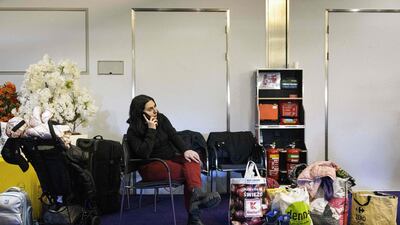
A Ukrainian refugee waits to be given shelter in Amsterdam, the Netherlands. AFP -
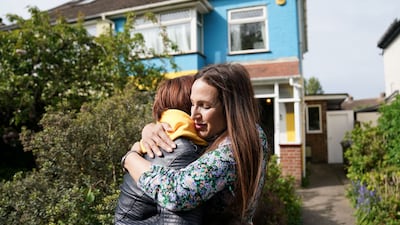
Campaigner Rend Platings, right, embraces her Ukrainian best friend Kristina Korniiuk as they are reunited outside her home in Cambridge. Ms Platings went on hunger strike until MsKorniiuk's UK visa was approved and painted her house in the colours of the Ukrainian flag. PA -
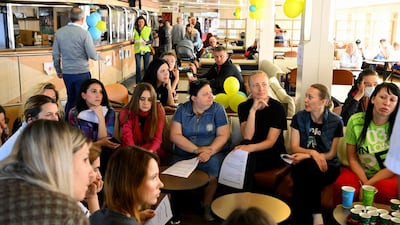
Ukrainian women attend a job-seekers' meeting aboard the 'Mediterranee' ferry, where they are living while it remains docked in Marseille, southern France. AFP -
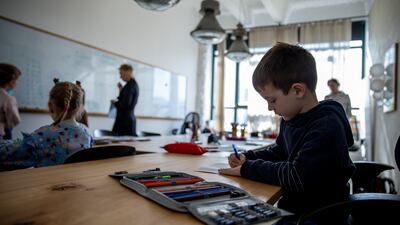
Refugee schoolchildren are given Ukrainian primary school education in Berlin, where they also have the choice of attending German schools. Getty -
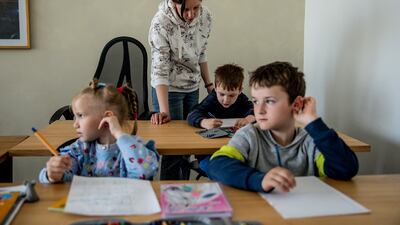
Teacher Katja with Artem, Sofia and Alexander, refugee schoolchildren who are receiving Ukrainian curriculum primary school education in Berlin, Germany. Getty -
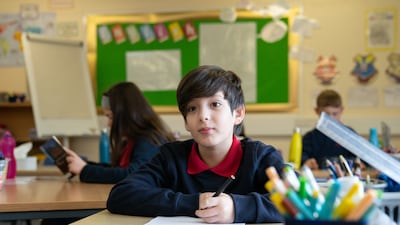
Ukrainian refugee Alikhan Yusupov, 10, on his first day at Caldecote Primary School after his family fled their home in Kharkiv and moved to Cambridgeshire, England. PA -
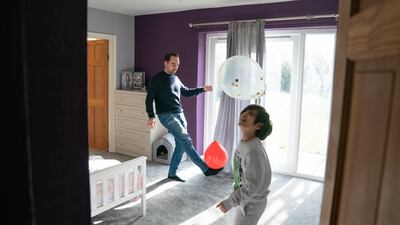
Roman Starkov plays with nephew Alikhan as they settle into their new home in Caldecote, near Cambridge, after they fled Kharkiv. PA -
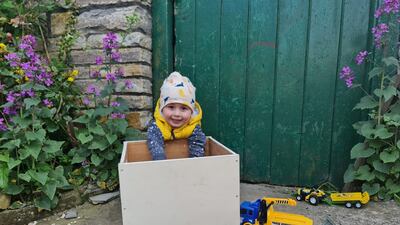
Ukrainian refugee Egor Svichkar, 3, whose family now live with a British host. PA -
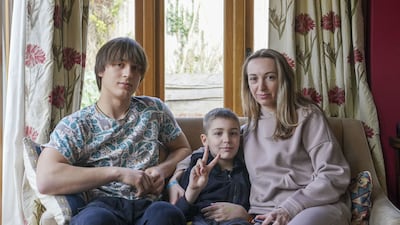
Ukrainian refugees Yaroslav Kryvoshyia and Irina Kryvoviaz, with her son Sasha as they settle into their new home in North Moreton, Oxfordshire. PA -
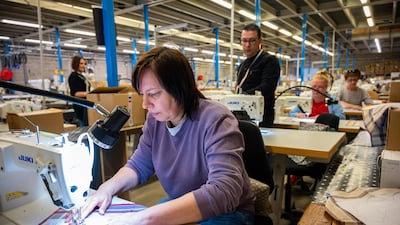
An Ukrainian refugee woman sews in Strasbourg, France, part of project for Ukrainian refugees to find jobs after fleeing the war. AFP -
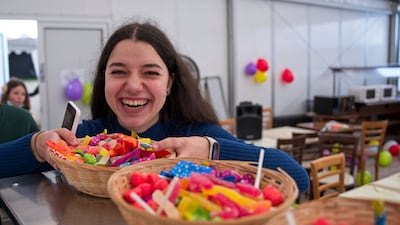
Ukranian refugee Karolina, 16, laughs as she prepares for a party at the La Ville-aux-Dames camp site, her family's temporary home in La Ville-aux-Dames, central France. AFP -
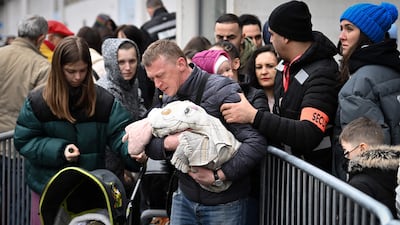
Ukrainians queue outside a refugee centre in Paris. AFP -
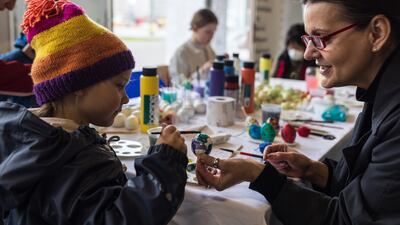
Myroslava Perevalska (R), an artist who fled Kyiv, helps a Ukrainian girl paint Easter eggs in Berlin. Getty Images -
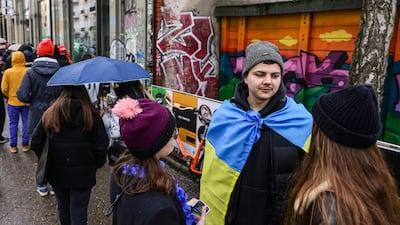
The 'Beacon of Ukraine', a gathering at Markthalle Neun in Berlin, bringing together refugees and NGOs as well as showcasing Ukrainian culture. Getty Images -
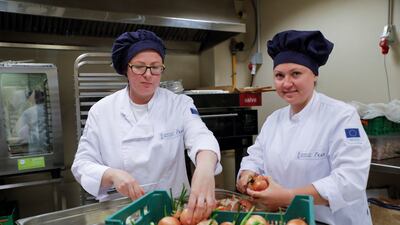
Larysa Biachenko, 40, who does not know if her house in Chernihiv is still standing, and Svitlana Lykhonos, 43, who was the owner of a hotel restaurant in Frankiusk, peel onions at a special cooking course run by the regional government to offer them a job opportunity, in Alicante, Spain. Reuters -
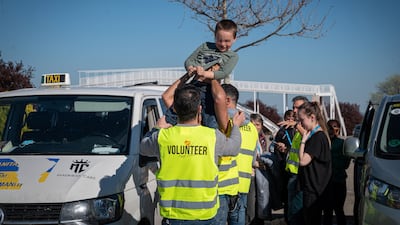
A convoy of Ukrainian refugees who left Mariupol, accompanied by 17 volunteers, arrive at Juan Carlos I park in Madrid. EPA -
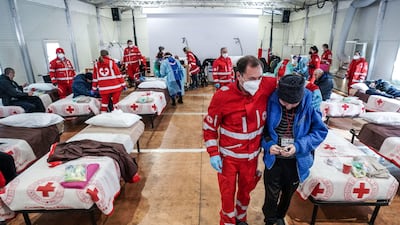
Ukrainian refugees, who arrived in Italy from Lviv after two weeks of travel, are tended to in the reception centre of the Red Cross in Settimo Torinese, near Turin. EPA


March: Sanctions isolate Putin
The invasion forced western leaders to make good on their threats of “severe costs and massive consequences” for Moscow, a wording used repeatedly by western officials as they tried to defuse the crisis in February.
Britain’s Defence Secretary Ben Wallace recalled having told his counterpart Sergei Shoigu days before the invasion that the world would breathe a sigh of relief if Russia stepped back from the brink, only to be told there was no offensive planned.
When the invasion did come, the barrage of sanctions saw Russian banks cut off from the financial world and oligarchs have their assets frozen. Airspace was closed, Kremlin propaganda channels were banned and luxury brands pulled out of Russia of their own accord. Mr Putin was sanctioned personally, although his personal finances have long been shrouded in mystery.
However, some European leaders argue that none of this has gone far enough because the stated objective of sanctions — to squeeze Mr Putin into calling off his troops — has not been met.
The conflict also threw a grenade into international diplomacy of which Russia had been a central part. The US called for Moscow's banishment from the G20, and Russia's attempts to work around sanctions were blamed in part for an impasse in nuclear talks with Iran.
April: Horrors of Bucha
Until the world learnt the name Bucha, peace talks had been making tentative progress and some EU politicians were starting to shift their tone towards consolidating existing sanctions rather than imposing new ones.
That changed after civilians who entered Bucha in early April, after it was abandoned by Russian forces, made gruesome findings of corpses lying in the street, mass graves and Ukrainians apparently killed with their hands tied behind their backs.
Revulsion at what was found in Bucha prompted the EU to sanction Russian energy for the first time, banning coal imports, and increased pressure on western countries to support Ukraine. Moscow claimed it was a fabrication.
Investigations into alleged war crimes are continuing. The Organisation for Security and Co-operation in Europe described possible breaches of international law besides Bucha, including indiscriminate Russian attacks that hit homes, schools and hospitals.

April: Energy stand-off escalates
Years of dependency on Russian fossil fuels put Europe in the awkward position of continuing to wire money to Moscow to pay for oil and gas while at the same time trying to support Ukraine.
After racing through the first five rounds of sanctions, the EU hit a wall when it ventured into Russia’s lucrative oil market. A proposed ban on crude imports was eventually watered down to exempt the 4,000-kilometre Druzhba pipeline that flows via Ukraine and serves Hungary.
But the EU has promised to end the era of Russian dominance over its power grids, racing to find alternative suppliers and generate more renewable energy at home.
Gas exporter Gazprom raised the stakes in April by cutting off gas supplies to Poland and Bulgaria after their refusal to pay in roubles, subsequently taking the same step against Finland, the Netherlands and Denmark. Germany is preparing for potential power cuts next winter.
“Maybe this will go such that the Russians will put the sanctions on gas,” Ms Kallas said, half-joking.

May: Nato goes large
The war in Ukraine reinvigorated Nato six months after the botched departure from Afghanistan left it facing questions over its future.
Within days of each other, Sweden and Finland announced they would tear up decades of military neutrality by seeking Nato membership to guard against a newly hostile Russia.
Their accession, currently held up by Turkish objections, would double the length of Nato’s border with Russia and be a permanent change that “certainly wouldn’t have happened if Russia hadn’t invaded Ukraine”, Mr Davis said.
It marked what Nato Secretary General Jens Stoltenberg called a “big strategic mistake” by Mr Putin, who finds himself facing the very Nato enlargement on his borders that he has spent two decades trying to prevent.
His miscalculation will also mean a more forceful military presence in eastern Europe, with Baltic nations planning increases in military spending and four new battle groups poised to add to Nato firepower.

May: Food crisis emerges
Ukraine and Russia are two of the world's biggest agricultural exporters and the war has brought grain exports to a standstill, dragging malnourished countries into the fallout of the conflict.
The chair of the African Union told EU leaders on Tuesday that the continent faced a “catastrophic scenario” if food exports were not unblocked from Ukraine's Black Sea ports.
The EU accused Moscow of deliberately engineering the crisis and spying an opportunity to get sanctions lifted in exchange for releasing its own agricultural stocks.
The West is not contemplating lifting sanctions but the protracted oil debate in Europe suggested it had hit a ceiling in how far it could go to help Ukraine.
Analysts have expressed doubt over whether expensive support for Ukraine can be maintained if the war is still dragging on when winter bites. But a Ukrainian resurgence could just as well divide Europe over how far to egg it on in pushing Russia back, said Mr Scazzieri.
Mr Putin appears determined to see the war through, with his Foreign Minister Sergey Lavrov most recently citing the defence of the Russian language as a justification for the continued fighting.
“Russia has solidified around the autocratic leadership of Putin, and it’s very difficult to see how that would come to an end,” said Mr Davis. “But then again, no one anticipated the Cold War ending.”

